ch 16 - treatment of psychological disorders
 Call Kai
 Learn
Learn Practice Test
 Spaced Repetition
 Match
Match Flashcards
 Knowt Play
1/56

There's no tags or description
Looks like no tags are added yet.
Name | Mastery | Learn | Test | Matching | Spaced | Call with Kai | Chat |
|---|
No analytics yet
Send a link to your students to track their progress
57 Terms
# in # canadians suffer from a mental disorder in any given year
1 in 5
at least # employed people in canada are unable to work due to mental health problems in any given week
half a million
only [a quarter / half / three-quarters] of those receiving treatment for major depression receive potentially adequate care
half
mental health needs were not fully met for # in # who received treatment for major depression
1 in 3
[a quarter / half / three quarters] of children in Canada with mental disorders do not access specialized care
¾
give 3 reasons why individuals fail to seek treatment
not realizing they have a mental disorder that can be treated
barriers such as beliefs and circumstances
structural barriers, physically prevent people from getting treatment
name 2 broad categories of treatment
psychological treatment: interacting with clinicians, environment meant to change person’s brain and behaviour
biological treatment: brain is treated with drugs/surgery as direct intervention
sometimes both treatment categories are applied
psychotherapy (def + goal)
interaction between clinician and someone suffering from psychological problem
goal: provide support or relief
eclectic psychotherapy
drawing on techniques from different forms of therapy, depending on client and problem
psychodynamic psychotherapies
explores childhood events, encourages individuals to develop insight into their problems
psychoanalysis (sigmund freud)
assumes that humans are born with aggressive, sexual urges repressed during childhood
goal is to understand the unconscious through developing insight
techniques developing insight (4) (and name treatment type category)
(psychological → psychodynamic → psychoanalysis)
free association (report every thought that comes to mind)
dream analysis
interpretation (suggests possible meanings)
analysis of resistance - reluctance to cooperate with treatment for fear of confronting unpleasant unconscious material
define transferece (and name treatment type, category)
(psychological → psychodynamic → psychoanalysis)
event occurring in psychoanalysis where analyst assumes a major significance in client’s life; patient unconsciously redirects feelings from a person in their past onto the analyst
it is a therapy tool but may worsen the outcome
interpersonal psychotherapy (IPT)
def
goal
how it differs form classical psychoanalysis
psychotherapy form focusing on helping clients improve current relationships, usually more effective in depressive and anxiety disorder treatment
goal: relief from symptoms and gaining insight
differs from classical psychoanalysis: sitting face to face, less intensive
humanistic therapy
def and origin
provide example of a humanistic therapy type
(psychological → psychotherapy)
assume that psychological problems stem from alienation and loneliness; traces feelings to failure of reaching one’s potential
ex/ person-centered therapy (client-centered)
existential therapy (def and provide example)
(psychological → psychotherapy)
assumes that psychological problems stem from feelings of alienation and loneliness; feelings stem from failure to find meaning in life
ex/ gestalt therapy
person-centered therapy (provide category/subcategory it is in)
define
3 basic qualities therapists demonstrate
goal
(psychological → psychotherapy→ humanistic therapy)
assumes all individuals have tendency for growth, facilitated by acceptance
3 basic qualities therapists demonstrate
congruence (body/words)
empathy (trying to understand)
unconditional positive regard (non-judgemental)
goal
understanding and reflecting client experiences supportively, encouraging growth
gestalt therapy (provide category/subcategory it is in)
define/goal
qualities therapists demonstrate
techniques
(psychological → psychotherapy → existential therapy)
helping client become aware of thoughts, behaviours/feelings and owning/taking responsibility for them
qualities therapists demonstrate
enthusiastic and warm
reflect their impressions
techniques
focusing and mindfulness
empty chair technique
empty chair technique
(psychological → psychotherapy → existential therapy → gestalt therapy)
clients encouraged to imagine another person sitting across from them → client moves from chair to chair roleplaying what he/she would say to person/what they would answer
used for life coaching, job interviews, etc
behavioural and cognitive therapies
emphasize changing a person’s current thoughts and behaviours to decrease/eliminate psychopathology (manifestations of mental disorders)
behaviour therapy
what it assumes
what techniques are based on
what it tries to change
assumes disordered behaviour is learned, and can be relieved by changing maladaptive behaviours to more constructive behaviours
techniques based on operant (reinforce/punish) and classical conditioning (ivan pavlov dog ringing bell LR NR)
changes maladaptive behaviour patterns
3 behavioural therapy techniques
eliminating unwanted behaviour: operant conditioning
promoting desired behaviour: token economy (giving clients tokens for desired behaviour)
reducing unwanted emotional responses: exposure therapy (confronting emotion-arousing stimulus directly, repeatedly)
exposure hierarchy for social phobia
exposure therapy where client is gradually accustomed to feared object/situation
easier situations come first, and client progresses to more difficult/frightening situations
important
cognitive therapy (def)
helps client identify, correct distorted thinking about oneself, therapy, or teh world
techniques used in cognitive therapy (2), and give definitions for each
cognitive restructuring - teaching clients to question automatic beliefs that lead to negative thinking using realistic, positive beliefs
mindfulness meditation - teaches individual to be fully present, be aware of thoughts/feelings to detect symptoms before they become a problem
cognitive-behavioural therapy
blending of cognitive and behavioural therapeutic strategies; problem-focused and action oriented
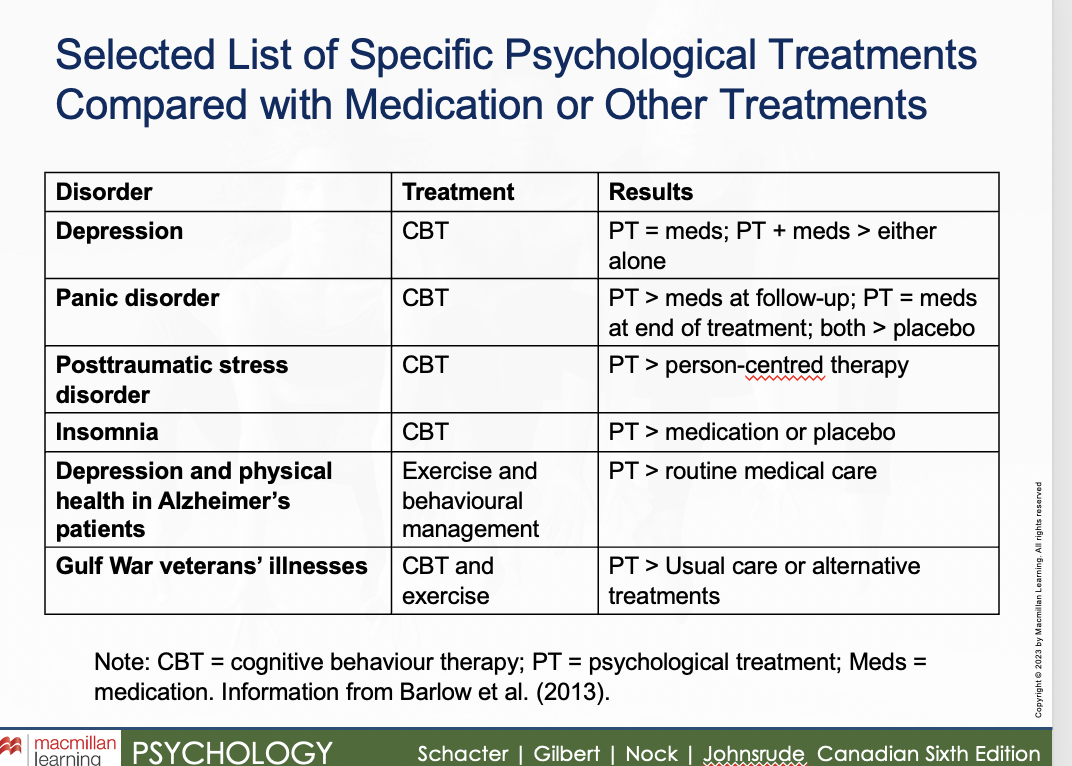
positive effects for GAD, panic disorder, PTSD, social phobia
advantages and disadvantages of group therapy
advantages:
clients are not alone, shared insight and problem solving is used
disadvantages:
one member could hijack discussions
less individual attention
group therapy types (2) and their treatment goals
couples therapy: married/dating couple working on problems within relationship - goal to break repetitive dysfunctional patterns
family therapy: entire family is the client - tries to identify how interactions between individuals can make problems arise
group therapy treatments and their disadvantage
self-help, support groups
run by peers struggling with same issues
could also encourage countertherapeutic behaviours
historic substances used as biological treatments (2)
theriac - results probably arose from opium ingredient
cocaine
most common biological approach to treating psychological disorders
drugs targeting specific neurotransmitters
antipsychotic mediations (what disorder they most commonly treat)
schizophrenia
one of the first antipsychotic drugs & what it led to
chlorpromazine - led to deinstitutionalization of hundreds of thousands of people
provide the fraction of people decreased from being in psychiatric hospitals after the introduction of antipsychotic drugs
decreased by more than 2/3rd
describe how antipsychotic and atypical antipsychotic mediations exert their effects
block dopamine receptors (works for positive symptoms, but not negative ones) in areas of brain such as mesolimbic pathway (pathway with dopamine neurons extending to nuclei in basal ganglia)
possibly exerts side effects
atypical antipsychotic
blocks both dopamine and seratonin receptors; works for both positive and negative symptoms
antianxiety medications (def) (what it does)
drugs helping reduce person’s experience of fear/anxiety
inhibits
2 most commonly used antidepressants
SSRIs - selective serotonin reuptake inhibitors
SNRIs - serotonin and norepinephrine reuptake inhibitor
describe how antidepressant drugs work
act on neurotransmitters serotonin, dopamine, and norepinephrine by inhibiting breakdown and blocking reuptake
antidepressants vs placebo effects on:
severe depression
mild/moderate
severe - antidepressants are more effective in improvements
mild/moderate - antidepressants did not work any better than placebo
name the disorder mood stabilizers are most commonly used for
bipolar disorder
most effective mood stabilizer available, and its risks
lithium - possible long-term kidney/thyroid problems
alternative medications
easily available OTC; includes herbal vitamins
phototherapy (def, what disorder it is used to treat)
form of biological treatment - natural treatment
repeated exposure to bright lights
used for SAD, depression
name the region of the brain showing reduced activity when social phobia is treated with CBT and SSRIs
amygdala-hippocampus region - affect brain regions associated with threat reactions
electroconvulsive therapy (ECT)
what it is
what it may be used to treat
main side effect
inducing mild seizures by delivering electrical shocks to the brain
may be used to treat severe depressions, manias, mental disorders not responding to treatment
short-term memory impairment
transcranial magnetic stimulation (TMS)
definition
what it may used to treat
places powerful pulsed magnetic wand over person’s scalp, altering neuronal brain activity
can be used to treat depression
psychosurgery
what it is
what it can treat
surgical destruction of brain areas
treats severe unresponsive disorders (ex/ severe OCD)
cingulotomy
?? may not need to know idk, probs not important
destroys part of corpus callosum
deep brain stimulation (DBS)
what it is
what it has successfully worked for
involves insertion of battery-powered electrodes delivering electrical pulses to brain areas believed to be causing mental disorder
successful for OCD treatment
name 3 treatment illusions
natural improvement
placebo effects
reconstructive memory
natural improvement
(treatment illusion)
tendency for symptoms to return to average level (you would have improved anyway)
placebo effect
(treatment illusion)
substance/procedure has not been applied, but expectation that healing response will occur (just knowing it will work actually helps)
reconstructive memory
(treatment illusion)
client’s motivation to get well causes memory errors for original symptoms
the typical psychotherapy client is better off than [fraction] of untreated individuals
[3/4]
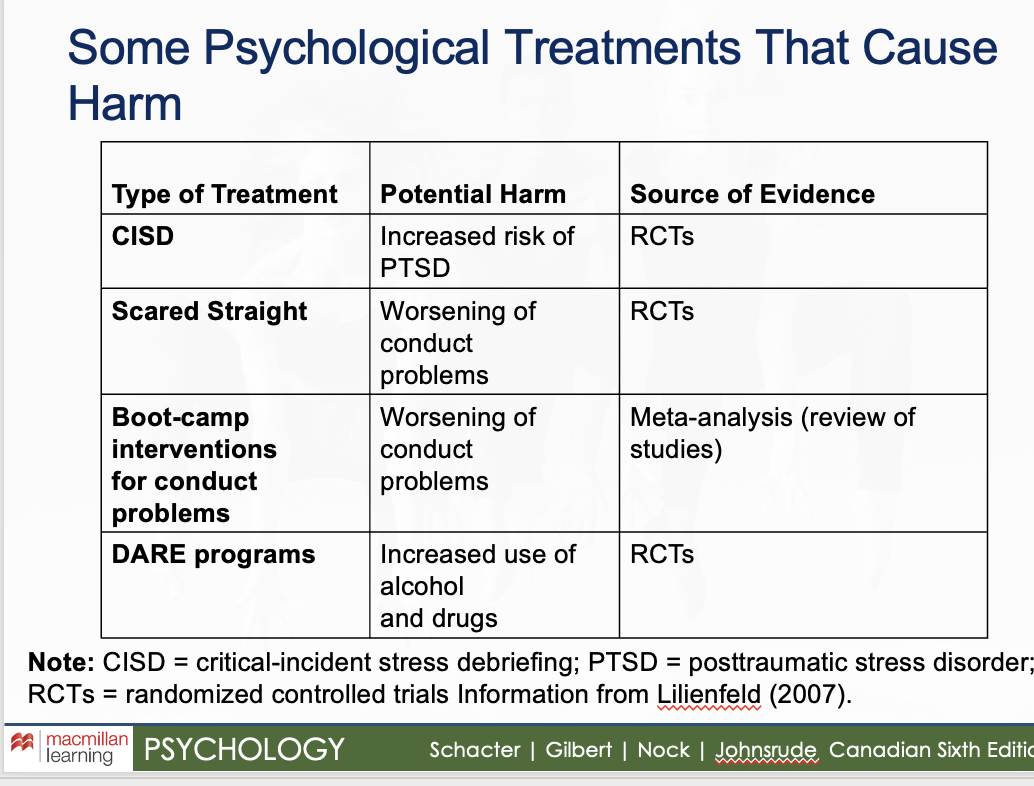
iatrogenic illness
disorder/symptom occurring as result of medical/psychotherapeutic treatment
therapy leading clients to develop beliefs and cause harm