📸Chapter 24: Digestive System
 Call Kai
 Learn
Learn Practice Test
 Spaced Repetition
 Match
Match Flashcards
 Knowt Play
1/85

Earn XP
Description and Tags
https://quizlet.com/ca/853466426/chapter-24-digestive-system-flash-cards/?funnelUUID=170bdd78-da07-4a43-820d-40de59465456
Name | Mastery | Learn | Test | Matching | Spaced | Call with Kai | Chat |
|---|
No analytics yet
Send a link to your students to track their progress
86 Terms
Which of following processes is the function of the smooth muscle layer of the digestive system?
a) Ingestion
b) Secretion
c) Motility
d) Absorption
e) Reabsorption
C
Which of following enzymes is secreted into the mouth?
a) Lipase
b) Maltase
c) Dextrinase
d) Peptidase
e) Pepsinogen
A
Which of the following processes is the primary function of the villi of the small intestine?
a) Ingestion
b) Secretion
c) Mixing and propulsion
d) Absorption
e) Reabsorption
D
Which of the following accessory organs produces a fluid to soften solid food?
a) Teeth
b) Salivary glands
c) Liver
d) Gallbladder
e) Pharynx
B
Which of the following accessory organs produces a fluid that functions to emulsify dietary fats?
a) Teeth
b) Salivary glands
c) Liver
d) Gallbladder
e) Pharynx
C
Which of the following accessory organs stores bile?
a) Teeth
b) Salivary glands
c) Liver
d) Gallbladder
e) Pharynx
D
The capability of the GI tract to move material along its length is called
1. motility.
2. propulsion.
3. digestion.
4. defecation.
a) 1 only
b) 2 only
c) 3 only
d) 4 only
e) Both 1 and 2
E
Which layer of the mucosa of the GI tract is composed of areolar connective tissue containing blood and lymph vessels?
a) Submucosa
b) Lamina propria
c) MALT
d) Muscular layer
e) Epithelium
B
Which layer of the GI tract is composed of areolar connective tissue that binds the mucosa to the muscular layer?
a) Submucosa
b) Lamina propria
c) Epithelium
d) Serosa
e) None of these choices
A
Which layer of the GI tract is composed of areolar connective tissue and a simple squamous epithelium?
a) Serosa
b) Submucosa
c) Muscular layer
d) Mucosa
e) MALT
A
Which structure is composed of prominent lymphatic nodules that function in the immune response?
a) Mucosa
b) Lamina propria
c) MALT
d) Submucosa
e) Serosa
C
Which plexus is located between the longitudinal and circular smooth muscle layers of the muscular layer?
a) ENS
b) Myenteric plexus
c) Submucosal plexus
d) Digestive plexus
e) Absorption plexus
B
Why do emotions such as anger or fear slow digestion?
a) Because they stimulate the parasympathetic nerves supplying the GI tract
b) Because they stimulate the somatic nerves that supply the GI tract
c) Because they stimulate the sympathetic nerves that supply the GI tract
d) They do not affect digestion
e) Because all emotions are controlled by the vagus nerves
C
Which portion of the peritoneum drapes over the transverse colon and coils of the small intestine?
a) Greater omentum
b) Falciform ligament
c) Lesser omentum
d) Mesentery
e) Mesocolon
A
Which portion of the peritoneum attaches the liver to the anterior abdominal wall and diaphragm?
a) Greater omentum
b) Falciform ligament
c) Lesser omentum
d) Mesentery
e) Mesocolon
B
Which portion of the peritoneum binds the transverse colon and sigmoid colon to the posterior abdominal wall?
a) Greater omentum
b) Falciform ligament
c) Lesser omentum
d) Mesentery
e) Mesocolon
E
In the mouth, the tooth sockets are lined with
a) gingivae.
b) cementum.
c) periodontium.
d) pulp.
e) root.
C
Deciduous molars are replaced by
a) bicuspids
.b) molars.
c) incisors.
d) canines.
e) wisdom teeth.
B
Which of the following layers of the GI tract contains skeletal muscle?
a) Muscular layer of the mouth, pharynx and upper esophagus
b) Muscular layer of the stomach, small and large intestines
c) Serosa
d) Submucosa
e) Myotonic plexus
A
How many stages of deglutition are there?
a) 2
b) 3
c) 4
d) 5
e) 8
B
Which structure of the stomach traverses several regions?
a) Cardia
b) Fundus
c) Pylorus
d) Rugae
e) Sphincter
D
Which of the following cells secretes hydrochloric acid?
a) Mucous cells
b) Parietal cells
c) Chief cells
d) Serosa cells
e) Chyme cells
B
Which cell secretes the hormone that promotes production of hydrochloric acid?
a) Neck cell
b) Chief cell
c) G cell
d) Chyme cell
e) Parietal cell
C
How long can food stay in the fundus before being mixed with gastric juices?
a) 10 minutes
b) 20 minutes
c) 30 minutes
d) 45 minutes
e) 1 hour
E
In most people, which pancreatic duct joins a bile duct?
a) Wirsung duct
b) Hepatopancreatic duct
c) Cystic duct
d) Vater duct
e) Santorini duct
A
Which of the following pancreatic enzymes digests lipids?
a) Trypsin
b) Elastase
c) Lipase
d) Pepsin
e) All of these choices
C
Which of the following structures is found on the liver and is a remnant of the umbilical vein in a fetus?
a) Coronary ligament
b) Falciform ligament
c) Round ligament
d) Kupffer ligament
e) Bile ductule
C
Which of the following is the principle bile pigment?
a) Stercobilin
b) Bilirubin
c) Biliverdin
d) Both Stercobilin and Bilirubin e) All of these choices
B
Which of the following is NOT a function of the liver itself?
a) Conversion of carbohydrates b) Protein metabolism
c) Storage of bile
d) Processing drugs
e) Storage of vitamins
C
Which of the following small intestine cells secretes lysozyme?
a) Goblet cells
b) Absorptive cells
c) Mucosa cells
d) Paneth cells
e) S cells
D
In the small intestine, which of the following is absorbed through the apical membrane via facilitated diffusion?
a) Glucose
b) Amino acid
c) Galactose
d) Fructose
e) Sodium ion
D
Which of the following enzymes acts to produce monoglycerides along with other products?
a) Lipase
b) Amylase
c) Trypsin
d) Phosphatase
e) Ligase
A
Which of the following pancreatic enzymes acts on glycogen and starches?
a) Chymotrypsin
b) Amylase
c) Trypsin
d) Phosphatase
e) Dextrinase
B
Which of the following pancreatic enzymes acts on peptide bonds?
a) Chymotrypsin
b) Amylase
c) Pepsin
d) Phosphatase
e) Nucleosidase
A
Which hormone functions to counteract the effect of gastric acid in the small intestine?
a) Pepsin
b) Secretin
c) Gastrin
d) Cholecystokinin
e) Amylase
B
Which hormone is stimulated by high levels of amino acids and fatty acids in the small intestine?
a) Pepsin
b) Secretin
c) Gastrin
d) Cholecystokinin
e) Amylase
D
Which digestive aid, produced by the stomach, begins digestion by denaturing proteins?
a) Bicarbonate ion
b) Mucus
c) Bile
d) Hydrochloric acid
e) Water
D
Which structure regulates the flow of material into the colon?
a) Ileocecal sphincter
b) Pyloric sphincter
c) Appendix
d) Sigmoid colon
e) Anal canal
A
Which of the following is NOT a function of the large intestine?
a) Mechanical digestion
b) Chemical digestion
c) Absorption of water
d) Feces formation
e) Regulation of blood glucose
E
What is line A pointing to?
a) Lumen
b) MALT
c) Mucosa
d) Submucosa
e) Muscular layer
B
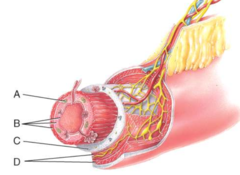
Which layer is composed of areolar connective tissue and simple squamous epithelium?
a) A
b) B
c) C
d) D
e) None of these
E
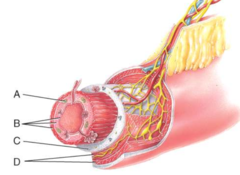
42) Which layer contains the lamina propria?
a) A
b) B
c) C
d) D
e) E
B
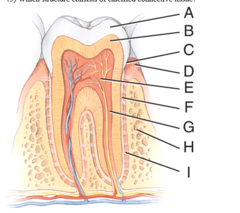
Which structure consists of calcified connective tissue?
a) A
b) B
c) E
d) F
e) G
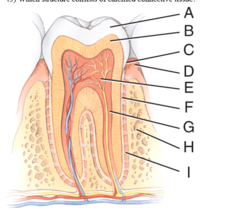
What is line F pointing to?
a) Pulp cavity
b) Cementum
c) Root canal
d) Alveolar bone
e) Gingival sulcus
B
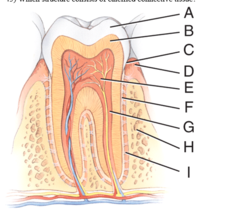
Which structure has an opening called the apical foramen?
a) A
b) F
c) G
d) H
e) I
C
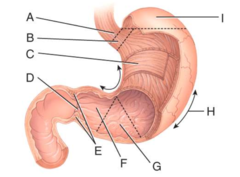
What does line D point to?
a) Cardia
b) Duodenum
c) Pylorus
d) Fundus
e) Greater curvature
C
What does line G point to?
a) Pylorus
b) Pyloric sphincter
c) Rugae
d) Pyloric antrum
e) Greater curvature
D
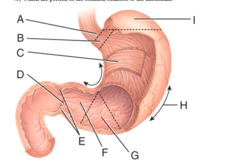
This is the area where pyloric stenosis occurs.
a) E
b) H
c) G
d) B
e) I
A
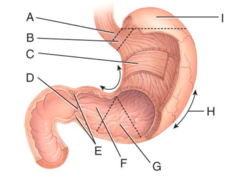
What is line I pointing to?
a) Greater curvature
b) Lesser curvature
c) Body
d) Fundus
e) Cardia
D
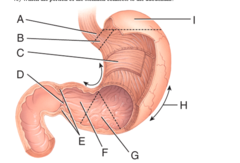
Which of the following cells secretes mucus?
a) B
b) C
c) D
d) E
e) A and B
E
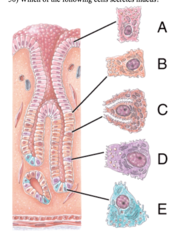
Which of the following cells secretes intrinsic factor?
a) A
b) B
c) C
d) D
e) E
C
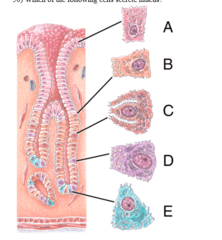
Which of the following cells secretes gastrin?
a) A
b) B
c) C
d) D
e) E
E
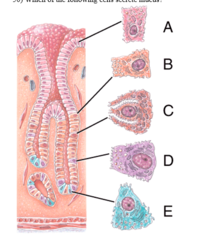
Which of the following cells secretes pepsinogen?
a) A
b) B
c) C
d) D
e) E
D
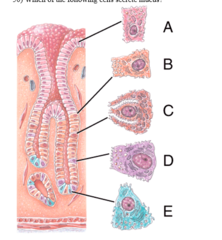
Name the structure labeled F.
a) Parietal cell
b) Gastric glands
c) Gastric pit
d) Chief cell
e) Simple columnar epithelium
C
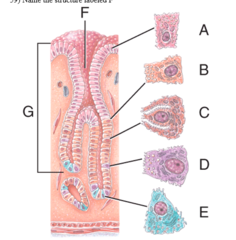
Name the structure labeled G.
a) Parietal cell
b) Gastric glands
c) Gastric pit
d) Chief cell
e) Simple columnar epithelium
B
Name the layer labeled A.
a) Submucosa
b) Serosa
c) Longitudinal muscle
d) Mucosa
e) Circular muscle
E
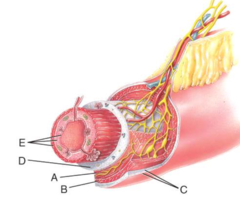
Name the layer labeled B.
a) Submucosa
b) Serosa
c) Longitudinal muscle
d) Mucosa
e) Circular muscle
C
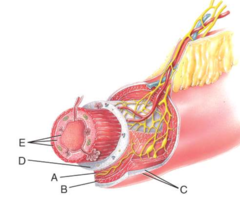
Name the layer labeled C.
a) Submucosa
b) Serosa
c) Longitudinal muscle
d) Mucosa
e) Circular muscle
B
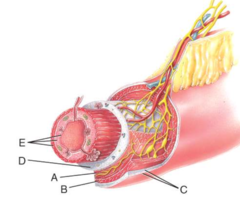
Name the layer labeled E.
a) Submucosa
b) Serosa
c) Longitudinal muscle
d) Mucosa
e) Circular muscle
D
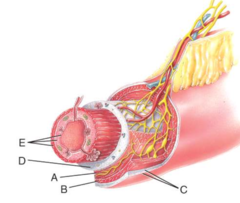
Name the layer labeled D.
a) Submucosa
b) Serosa
c) Longitudinal muscle
d) Mucosa
e) Circular muscle
A
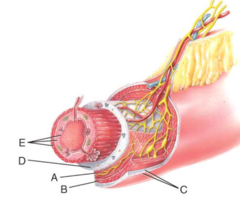
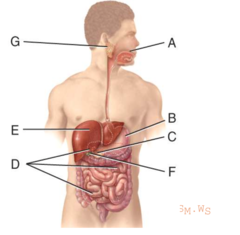
The enzyme, produced in the organ labeled C, which digests DNA is called
a) deoxyribonuclease.
b) ribonuclease.
c) salivary amylase.
d) pepsin.
e) sucrase.
A
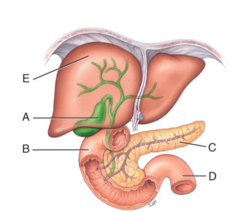
The enzyme, produced in the organ labeled C, that leads to the production of fatty acids and monoglycerides during digestion is called
a) sucrase.
b) pancreatic lipase.
c) salivary amylase.
d) trypsin.
e) elastase.
B
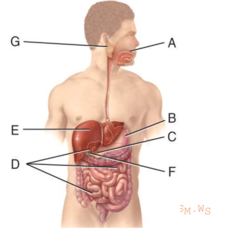
The enzyme, produced in the organ labeled D, that leads to the production of both glucose and galactose as products is called
a) lactase.
b) pancreatic lipase.
c) sucrase.
d) pepsin.
e) nuclease.
A
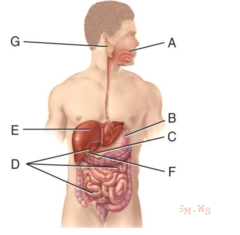
The enzyme, produced in the organ labeled D, that leads to the production of ONLY glucose as a product is called
a) maltase
.b) pancreatic lipase.
c) sucrase.
d) pepsin.
e) nucleases.
A
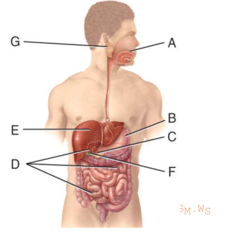
Which of the following disorders involving the organ labeled E can result from viruses, drugs and chemicals such as alcohol?
A) Heartburn
b) Mumps
c) Pancreatitis
d) Hepatitis
e) Vomiting
D
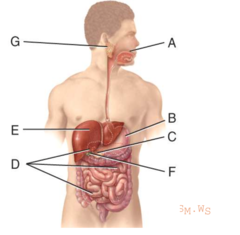
Which of the following disorders can occur in the organ labeled B?
a) Appendicitis
b) Mumps
c) Pancreatitis
d) Hepatitis
e) Peptic ulcer
E
Which of the following is the forerunner of the digestive canal?
a) Primitive gut
b) Foregut
c) Midgut
d) Hindgut
A
Which of the following is a change in the digestive system associated with aging?
a) Decreased secretory mechanisms
b) Decreased motility of the digestive organs
c) Loss of strength and tone of the muscular tissue
d) Changes in neurosensory feedback regarding enzyme and hormone release
e) All of these are age related changes in the digestive system.
E
Which of the following is a contribution of the digestive system to the muscular system?
a) Small intestine absorbs dietary calcium and phosphorous salts.
b) The liver can convert lactic acid produced during exercise to glucose.
c) Small intestine absorbs vitamin D.
d) Excess dietary calories are stored as triglycerides in adipose cells.
e) The liver synthesizes most plasma proteins.
B
Which type of hepatitis is spread via fecal contamination of objects such as food, clothing, toys, and eating utensils and is characterized by loss of appetite, malaise, nausea, diarrhea, fever, and chills?
a) Hepatitis A
b) Hepatitis B
c) Hepatitis C
d) Hepatitis D
e) Hepatitis E
A
Which permanent tooth will erupt between the ages of nine and ten? Select all that apply.
a) First upper premolar
b) First lower premolar
c) Lower canine
d) Upper canine
e) Second lower molar
A,B,C
Which enzymes are secreted in the small intestine? Select all that apply.
a) Carboxypeptidase
b) Pepsin
c) Sucrase
d) Maltase
e) Aminopeptidase
C,D,E
Which structure secretes alkaline fluid to buffer stomach acid?
a) Paneth cells
b) Absorptive cells
c) Brunner's glands
d) Microvilli
e) Enteroendocrine cells
C
The purpose of circular folds, villi and microvilli in the small intestine is to
a) secrete digestive enzymes.
b) secrete digestive hormones.
c) allow for stretching of the intestine as food passes through. d) increase surface area for absorption.
e) slow down motility for better digestion.
D
If an individual complains of bloating, gas, cramps, and diarrhea following the eating of a milk shake, they are MOST LIKELY suffering from
a) food poisoning.
b) a bacterial infection of the intestines.
c) lactose intolerance.
d) excess sucrose intake.
e) a gastrointestinal virus.
C
An individual eats a diet high in digestible carbohydrates and fats and low in fiber. He begins to experience abdominal pain, constipation, nausea, vomiting and a low-grade fever. He is most likely suffering from
a) viral gastroenteritis.
b) diverticulitis.
c) diverticulosis.
d) appendicitis.
e) gastric ulcer.
B
The substance that helps bacteria stick to teeth is
a) glucose.
b) sucrose.
c) fructose.
d) galactose.
e) dextran.
E
A disease characterized by a high fever, elevated neutrophil count higher than 75%, elevated white blood cell count and anorexia is
a) appendicitis.
b) colitis.
c) diverticulitis.
d) severe constipation.
e) diarrhea.
A
The secretion of gastric juice, strengthening of contractions of the lower esophageal sphincter, increased motility of the stomach and relaxation of the pyloric sphincter are stimulated by which hormone?
a) Cholecystokinin
b) Gastrin
c) Enterogastrone
d) Secretin
B
Elderly people are more prone to
a) constipation.
b) malabsorption.
c) duodenal ulcers.
d) periodontal disease.
e) all of these.
E
Which of the following divides the liver into two principle lobes?
a) Greater omentum
b) Falciform ligament
c) Lesser omentum
d) Coronary ligament
e) Round ligament
B
Which of the following structures is retroperitoneal?
a) Transverse colon of the large intestine
b) Stomach
c) Jejunum of the small intestine
d) Pancreas
e) Sigmoid colon of the large intestine
D
Which structures of the stomach are visible to naked eyes?
a) Mucous cells
b) Gastric pits
c) Gastric glands
d) Rugae
e) Villi
D
Which of the following statements is NOT true about Brunner's glands?
a) These are located in the submucosa
b) They are called duodenal glands
c) They secrete an acidic mucus
d) They secrete into the lumen of duodenum
e) Their secretion helps neutralize chyme
C
Which of the following carries deoxygenated blood into the liver?
a) Hepatic artery
b) Hepatic vein
c) Central vein
d) Hepatic portal vein
e) Abdominal aorta
D
During which phase of digestion secretion of cholecystokinin occurs?
a) Cephalic
b) Gastric
c) Intestinal
d) Neural
e) All of the above
C