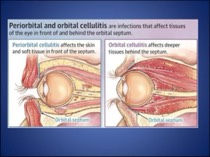
Periorbital and Orbital Cellulitis Practice Flashcards
 Call Kai
 Learn
Learn Practice Test
 Spaced Repetition
 Match
Match Flashcards
 Knowt Play
 Podcast
1/15

Earn XP
Description and Tags
Vocabulary-style flashcards covering the causes, symptoms, treatments, and distinguishing features of periorbital and orbital cellulitis based on lecture notes.
Name | Mastery | Learn | Test | Matching | Spaced | Call with Kai | Chat |
|---|
No analytics yet
Send a link to your students to track their progress
16 Terms
Periorbital / preseptal cellulitis
Infection of the lids or eyebrows caused by skin trauma, insect bites, or spread from local, upper respiratory, or ear infections.
treatment for periorbital
clindamycin or TMP-SMX ( can be used for MRAS) plus Amoxicillin-clavulanic acid or Cefpodoxime or Cefdinir as appropriate.
Orbital cellulitis
Infection behind the orbital septum, usually secondary to ethmoiditis, and characterized by severe malaise, fever, and orbital signs.
Major Pathogens
Staphylococcus aureus, Streptococcus pneumoniae, and Streptococcus pyogenes.
Proptosis
A bulging of the eye most frequently lateral and down; present in orbital cellulitis but absent in preseptal cellulitis.
Ophthalmoplegia
Painful restriction of ocular motility found in orbital cellulitis; ocular motility remains intact in preseptal cellulitis.
Preseptal systemic antibiotic treatment
Clindamycin or TMP-SMX (for MRSA) plus Amoxicillin-clavulanic acid or Cefpodoxime or Cefdinir.
Orbital systemic antibiotic treatment
Intravenously administered Cefotaxime/ceftriaxone + Flucloxacillin/vancomycin (if MRSA); can change to oral if symptom become better oral amoxicillin clavulanic acid.
Intracranial complications
Spreading of infection that results in Meningitis, brain abscess, or cavernous sinus thrombosis.
Orbital complications
Orbital or subperiosteal abscess, raised intraocular pressure, retinal vasculature occlusion, and optic neuropathy.
Indications for surgery
Resistance to antibiotics, presence of orbital or subperiosteal abscess, or optic neuropathy.
chemosis
swelling of the conjunctiva due to increased vascular permeability, often seen in cases of orbital cellulitis not in preseptal cellulitis.
EOM
Extra-Ocular Movement; monitored for restriction or pain, which helps differentiate orbital from preseptal cellulitis.
Visual Acuity (Orbital vs. Preseptal)
May be slightly decreased in preseptal due to eyelid edema, but may be markedly decreased in orbital cellulitis.
proptosis
absent in Preseptal cellulitis, but can be present in orbital cellulitis as the eye is pushed forward due to increased orbital pressure.
difference between periorbital and orital cellulitis
Periorbital cellulitis affects the eyelid and surrounding skin, while orbital cellulitis involves the eye socket and can lead to vision impairment and complications. pain with eye movement / ophthalmoplegia + proptosis+ vision effect