(6) BIO (Book 2): Molecular Techniques
 Call Kai
 Learn
Learn Practice Test
 Spaced Repetition
 Match
Match Flashcards
 Knowt Play
1/12

There's no tags or description
Looks like no tags are added yet.
Name | Mastery | Learn | Test | Matching | Spaced | Call with Kai | Chat |
|---|
No analytics yet
Send a link to your students to track their progress
13 Terms
Polymerase Chain Reaction (PCR) — Introduction
What is PCR:
PCR is a method of cell-free cloning of a particular DNA region, which is performed directly with a thermostable DNA polymerase
PCR is a technique that can amplify a specific region of DNA from a trace sample
This amplification is carried out in vitro (heat), where heat is used to separate the 2 DNA strands
For the amplification to occur, at least part of the sequence of the DNA sample must be known
Polymerase Chain Reaction (PCR) — Components of PCR
DNA template
The double-stranded DNA sample contains the nucleotide sequence of interest
The sample could be from any source
It may also be complementary DNA (cDNA) that was reverse transcribed from an RNA sample
PCR primers
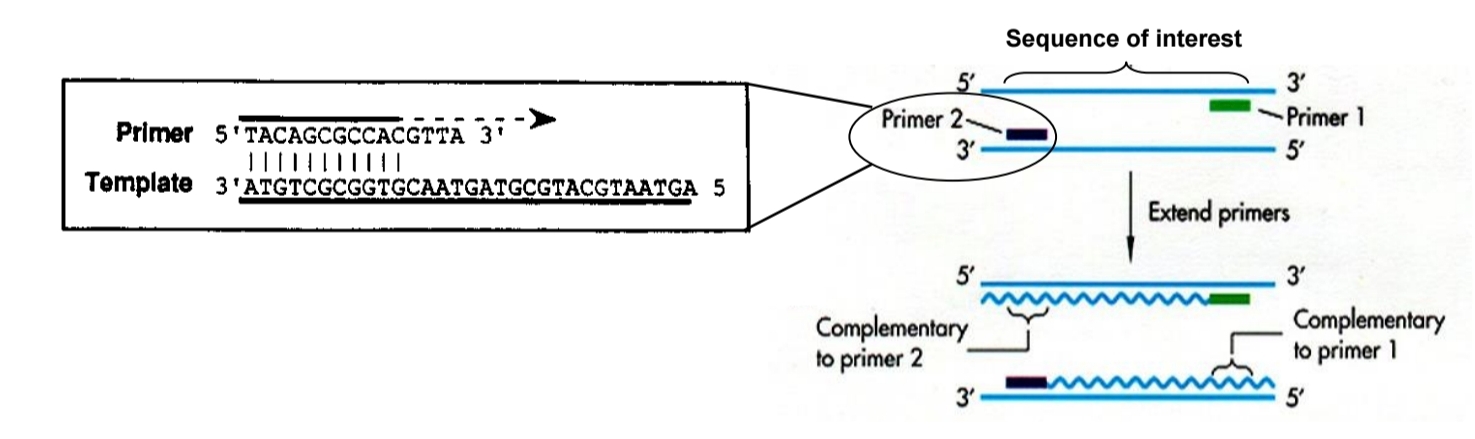
Two sets of short, single-stranded DNA primers
These DNA primers are a specific type of oligonucleotides of about 20 bases in length, which are chemically synthesised
Primers must be specific to the sequence of interest
The primer sequences flank the sequence of interest (on the DNA template) and are complementary to the 3’ end of both template strands
Flank → Lie immediately adjacent to a target gene of interest
Complementary to 3’ end → Primers are near to both the 3’ ends
Free deoxyribonucleoside triphosphates / dNTPs (dATP, dTTP, dCTP, dGTP)
These free deoxyribonucleotides must be present in excess as raw materials for the synthesis of new DNA strands.
Thermostable DNA polymerase
The thermostable DNA polymerase is obtained by being isolated from a thermophilic (heat loving) bacterium
These bacteria contain thermostable DNA polymerase
Eg: Taq polymerase is isolated from Thermus aquaticus.
The enzyme is stable at high temperatures (thermostable) and is not denatured by repeated heat treatments in the PCR cycle
PCR reaction buffer
Among other ingredients like buffering salts and detergent, this buffer contains MgCl2 (Mg2+ ions) that function as the cofactors required for DNA polymerase activity (activate them)
Polymerase Chain Reaction (PCR) — PCR Cycle
PCR is carried out in a programmable thermal cycler
This allows rapid heating and cooling of reaction tubes to the required temperatures for a PCR cycle
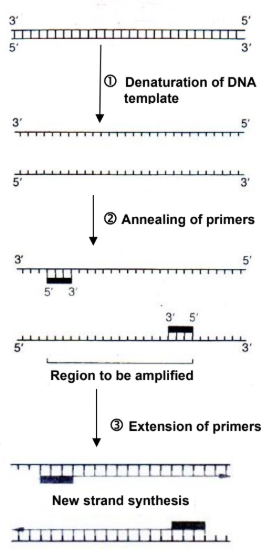
The process involves repeated rounds of three steps:
Denaturation of DNA template
Annealing of primers
Extension of primers
Polymerase Chain Reaction (PCR) — PCR Cycle — Denaturation of DNA template
Denaturation of DNA template:
Occurs between 90 oC – 100 oC
The reaction mixture is heated to 95 oC for 30 s.
At this temperature, the hydrogen bonds holding together the two strands of the DNA template are broken.
Thus, the DNA template is denatured, and becomes a single-stranded DNA
Polymerase Chain Reaction (PCR) — PCR Cycle — Annealing of Primers
Annealing of primers
Occurs between 50 oC – 65 oC
The reaction mixture is cooled to 54 oC for 1 min in the presence of a large excess of the 2 sets of DNA primers.
Cooling allows primers to anneal specifically to complementary sequences at the 3’ end of single-stranded DNA templates via hydrogen bonds → Hybridisation
The optimum annealing temperature for a pair of primers depends on primer length and base composition
Polymerase Chain Reaction (PCR) — PCR Cycle — Extension of Primers
Extension of primers
Occurs between 60 oC – 75 oC
The reaction mixture is then heated to ~ 72 oC for 2 min, which is close to the optimum temperature of the thermostable Taq polymerase
The annealed primers prime DNA synthesis using the four deoxyribonucleoside triphosphates (dATP, dCTP, dGTP, dTTP).
The process is catalysed by Taq polymerase.
The region of DNA downstream of each of the two primers is extended in the 5' to 3' direction.
Polymerase Chain Reaction (PCR) — PCR Cycle — Important Features
Repetition of cycle:
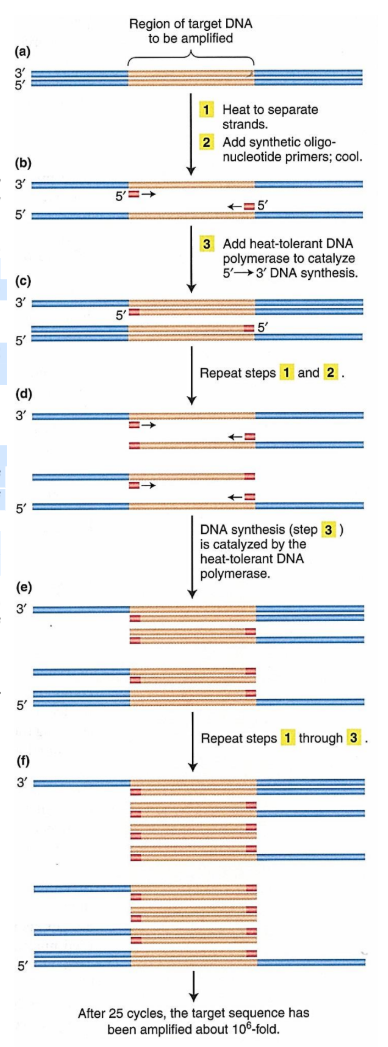
The entire three-step cycle is repeated 20 to 30 times
Each cycle begins with a heat treatment to denature the newly-synthesised DNA duplexes from the previous cycle.
Features:
The PCR is a chain reaction
Newly- synthesised DNA strands will serve as templates for DNA synthesis in subsequent cycles
Within a few cycles, the predominant DNA species is identical to the sequence of interest (the sequence flanked by and including the two primers)
The PCR is specific
Only the sequence of interest is amplified because primers are specific and do not attach elsewhere
Eg: 3 PCR cycles produce:
16 DNA strands - eight are exactly identical in length and sequence to the sequence of interest; eight contain extra DNA downstream of the sequence of interest
8 DNA molecules (double-stranded DNA) – two are exactly identical to the sequence of interest.
After 30 cycles, essentially all (more than 99.99%) the DNA molecules are exact copies of the sequence of interest
After 30 PCR cycles, the number of DNA molecules has increased exponentially to more than 1 billion
No. of DNA molecules = 2no.of cycles
Polymerase Chain Reaction (PCR) — Practical Applications
PCR can amplify
Make a large number of copies of a DNA sequence from a small amount of original sample in a short time.
Hence, PCR can be performed before other techniques used in forensic analysis, medical testing, detection of infectious diseases etc.
PCR specifically amplifies the section of DNA between the two primers.
Hence, it can also be used to make large amounts of pure PCR products (almost exclusively the DNA sequence of interest)
Polymerase Chain Reaction (PCR) — Advantages
Sensitivity
The PCR method is extremely sensitive
It can amplify sequences from minute amounts of DNA, such as that in a single cell
Speed and ease of use
PCR is rapid and can be easily automated
A single PCR cycle takes less than 5 minutes
20 – 30 cycles typically required takes only 2-3 hours
Robustness
PCR can permit amplification of specific sequences from material in which the DNA is badly degraded or embedded in a medium from which conventional DNA isolation is difficult
Hence, PCR is suitable for molecular anthropology and palaeontology studies
Eg: Analysis of DNA recovered from archaeological remains.
It has also been successfully used to amplify DNA from formalin-fixed samples, which has important applications in pathology.
Polymerase Chain Reaction (PCR) — Limitations
Risk of contamination
Due to the extreme sensitivity of PCR, any contamination of the reaction by non-template nucleic acids present in the laboratory environment could cause non-target sequences to be amplified instead
Eg: From bacteria, viruses and the experimenter’s own DNA
Infidelity of DNA replication in vitro (heat)
DNA polymerases (eg: Taq polymerase) used in PCR often lack 3’ to 5’ exonuclease activity (error and fix), having an error rate of 1 in 10000 bases which are wrongly incorporated.
Even so, the majority of amplified DNA possesses the correct sequence.
But recently, recombinant DNA polymerases with 3’ to 5’ exonuclease activity are now available
Short size and limiting amounts of PCR product
DNA polymerases efficiently amplify DNA products up to a few thousand base-pairs (0.1 – 5 kb).
PCRs for longer products are less efficient due to enzyme activity loss, and inaccuracies accumulated in longer PCRs
FYI: Adding fresh DNA polymerase helps with enzyme activity lost due to the half-life of the polymerase, however this does not help when accurate PCR is required.
FYI: Improvements have been made to increase the size range of accurate PCR. It is possible to amplify PCR products up to 20kb using modified heating cycles and a two-polymerase system, which provides optimal levels of DNA polymerase and 3’ – 5’ exonuclease activity for proof-reading.
Need for target DNA sequence information
In order to construct specific oligonucleotide primers that permit selective amplification of a particular DNA sequence, some prior sequence information is needed
The PCR technique can only be applied to amplify nucleic acids, but NOT proteins
Gel Electrophoresis — How it works
Electrophoresis separates charged molecules (nucleic acids and proteins) based on their different rates of movement / migration in an electric field
The electric field is created by application of a direct current through a semi-solid, porous gel matrix
The gel matrix is made of a tangled meshwork of polymer chains of 2 main types:
Agarose - a polysaccharide extracted from seaweed
Polyacrylamide – made from monomers of a small organic molecule, acrylamide, that are polymerised and cross-linked.
DNA molecules are separated based on their rate of movement through the gel matrix.
As the phosphate groups of the sugar-phosphate backbone in DNA are negatively-charged, DNA moves towards the positive electrode (anode)
DNA molecules essentially have a constant charge density (charge per unit of mass), thus they separate in porous agarose and polyacrylamide gels primarily on the basis of size
DNA molecules to be separated by electrophoresis should be linear
The complex network of pores in the gel matrix act as a “molecular sieve" to impede the movement of DNA molecules and separate them by size / length.
Agarose gels are more porous and can be used to separate larger DNA molecules of about 0.5kb – 20 kb.
▪ Polyacrylamide gels have smaller pore sizes and are useful in separating DNA molecules of smaller sizes, and can separate DNA fragments that differ in length by just a single nucleotide.
5. Shorter DNA fragments are less impeded by the pores than longer ones and move through the gel more quickly (Fig. 7), so that DNA fragments of different lengths migrate as distinct bands.
Thus, a complex mixture of linear DNA fragments is size-fractionated into discrete bands, each consisting of DNA fragments of the same length.
6. After electrophoresis, the gel is removed and stained with a DNA-binding dye such as methylene blue or ethidium bromide (EtBr, which intercalates DNA and fluoresces in UV light). This allows the separated DNA fragments to be visualised as a series of bands within the gel.
Gel Electrophoresis — Practical Applications of DNA Gel Electrophoresis
1. To separate DNA fragments (e.g. restriction digests) according to size.
2. To determine the approximate molecular weight of the separated DNA fragments.
3. To isolate / purify individual DNA fragments for further study (band(s) of interest can be excised
from the gel).
4. To check results of PCR, i.e. to determine if a PCR experiment is successful (See Section 2)
Gel Electrophoresis — Practical Steps of DNA Gel Electrophoresis