Unit 1
 Call Kai
 Learn
Learn Practice Test
 Spaced Repetition
 Match
Match Flashcards
 Knowt Play
1/16

Earn XP
Description and Tags
8/25/2026-10/6/2026 EXAM ON OCT. 6TH
Name | Mastery | Learn | Test | Matching | Spaced | Call with Kai | Chat |
|---|
No analytics yet
Send a link to your students to track their progress
17 Terms
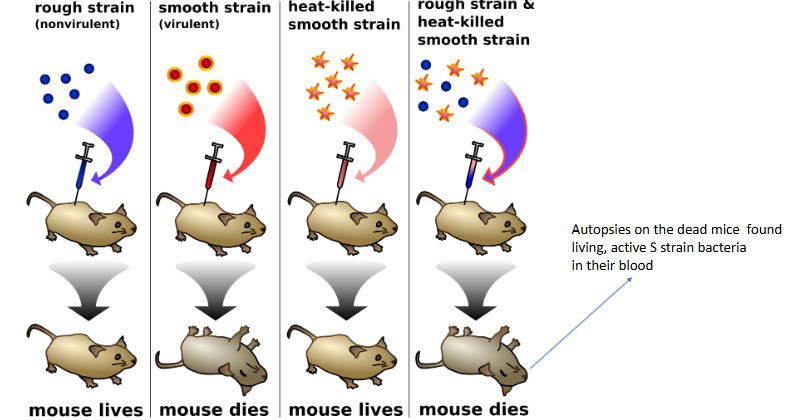
Who was Frederick Griffith?
He was a bacteriologist that discovered the first evidence that genetic information be transferred between organisms.
What were the strands that Griffin studied?
Streptococcus pneumoniae bacteria-
S strain (smooth): deadly (virulent)
R strain (rough): Harmless (non-virulent)
What was one principle that Griffith did not know?
the transforming principle- everyone believed that proteins were the true carries of genes
What was Avery-MacLeod-McCarty known for?
Removed proteins (by protease), RNA (by RNase), carbohydrates, lipids—- transformation occurred normally. He destroyed DNA (by DNase)—- transformation stopped
What is the loss-of-function strategy?
To test the necessity of a subject in an experiment (delete gene, insert tissues, etc.)
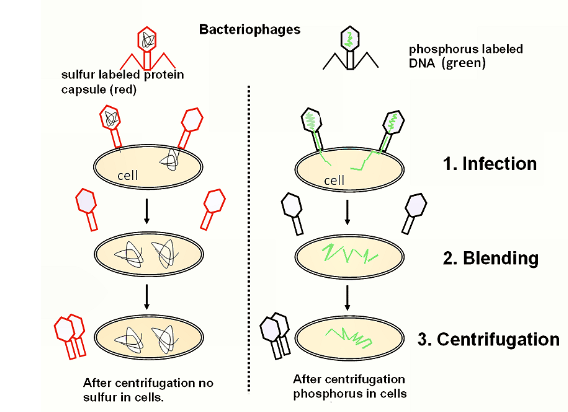
What was the Hershey-Chase Experiment?
They used radioactive labeling on viruses to conclusively verify that DNA (not protein) is the absolute vehicle of genetic inheritance.
What was the “blender experiment”?
32P in the phage DNA (is in DNA but not protein), then label the protein with radioactive 35Sulphur. Let the phage infect the bacteria, then remove the phage (coat protein) using a standard kitchen blender. After, spin in a centrifuge and then test for which isotope is present in the bacteria pellets and supernatants.
What was Schrodinger’s impact on DNA?
Inspired the discovery of DNA. He also theorized the Hereditary Code- he theorized that genes were stored in an “aperiodic crystal”, a concept that directly influenced
biologists in their discovery of the double helix
What does Deoxyribonucleic acid (DNA) contain?
Nitrogenous base (purine or pyrimidine), pentose, and phosphate
Purines (double rings)- adenine and guanine
Pyrimidines (single ring)- cytosine and thymine
Who were the biologists Watson, Crick, Franklin, and Wilkins? (1953)
They were inspired by Schrodingers book. Franklin captured the X-ray images of DNAs helical shape, Wilkins showed the x-ray images to Watson, and then Watson and Crick synthesized these findings into a physical, 3D model
Watson wrote a paper proposing what?
the double helix structure with a sugar-phosphate backbone and specific base pairing (A-T, G-C) on the inside.
What implies the concept that each DNA strand acts as a template for replication?
It has not escaped our notice that the specific pairing we have postulated immediately suggests a possible copying mechanism for the genetic material.

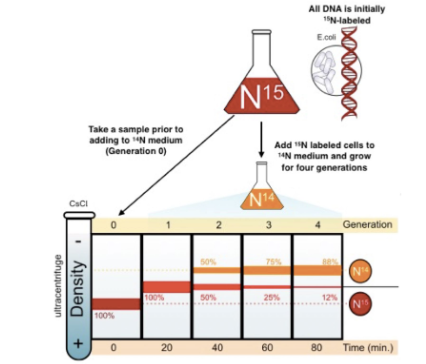
Who was Meselson-Stahl?
A biologist that discovered confirmed DNA replication. He compared 15N and 14N. They cultured bacteria with 15N to their base then incorporated 14N into 15N. Its density was in the middle, so that means they formed together.
What is Central Dogma?
DNA to RNA to Protein (the transcription and translation into protein)
What is transcription?
a specific segment of DNA is copied into a
complementary strand of RNA by the enzyme RNA polymerases
What is translation?
synthesize protein using
mRNA as a template
What is epigentics?
beyond genetics……………