Unit 1 Biology Study Guide
 Call Kai
 Learn
Learn Practice Test
 Spaced Repetition
 Match
Match Flashcards
 Knowt Play
1/24

There's no tags or description
Looks like no tags are added yet.
Name | Mastery | Learn | Test | Matching | Spaced | Call with Kai | Chat |
|---|
No analytics yet
Send a link to your students to track their progress
25 Terms
What piece of equipment can not be used to transfer liquid from one container to another
petri dish
What piece of equipment can give you a precise measurement
graduated cylinder
What glassware is never used for making measurements
test tube
What is the difference between an observation and an inference
an observation is going to be a factual statement gathered using your five sense, which an inference is an educated guess or explanation based on those observations and past experience
Independence variable
what the experimenter will deliberately change or manipulate in the investigation
Dependent variable
what changes in response to the independent variable
Control
group used for comparison with your experimental groups, this is the “normal group”
Experimental group
groups that are being tested
Constants
the aspects of an experiment that are held constant/consistent
What is the difference between quantitative data and qualitative data? Give an example of each.
Quantitative data deals with numbers and quantities that can be measured or counted, while qualitative data describes description and qualities that can’t deal with numbers.
What is the difference between accurate and precise
Precision is how close your measurements are to each other, accuracy is how close your measurement is to the correct/accepted value.
What is the structure of a hypothesis? Write an example of a hypothesis.
“If (IV) then (DV)”. If students consume more caffeine, they will have more energy.
What is the smallest part of an element that still has properties of that element
Atom
How can life exist under frozen surfaces?
life can exist under frozen surfaces because ice floats and acts as a blanket, keeping the liquid below from freezing solid.
Oil is (hydrophilic/hydrophobic) and (polar/nonpolar)
Hydrophobic, non polar
What property of water makes it form a meniscus when in a graduated cylinder? Explain what it is
Water forms in a meniscus in a graduated cylinder due to adhesion, which works together with cohesion. Adhesion is basically the type of attraction that happens between two different molecules. Cohesion is the attraction between molecules of the same substance.
Give an example of one of water’s properties that make it “awesome”
One of water’s most incredible properties is high specific heat capacity.
What macromolecules make up the majority of the cell membranes structure.
lipids, specifically phospholipids
Sugars and starches are members of what group of macromolecules
Carbohydrates
What macromolecule does the body digest first if it is available
Carbohydrates
The macromolecule that most likely would be responsible for contracting muscles would be _________
Proteins
How do animals store most of their excess energy? Why?
Animals store most of their excess energy by lipids, they use these fats as long term energy.
Which macromolecule do we not obtain from food that we eat
Nucleic acids, specifically our DNA.
Your body consumes macromolecules for energy. In what order would your body consume them?
Carbohydrates, lipids, then protein
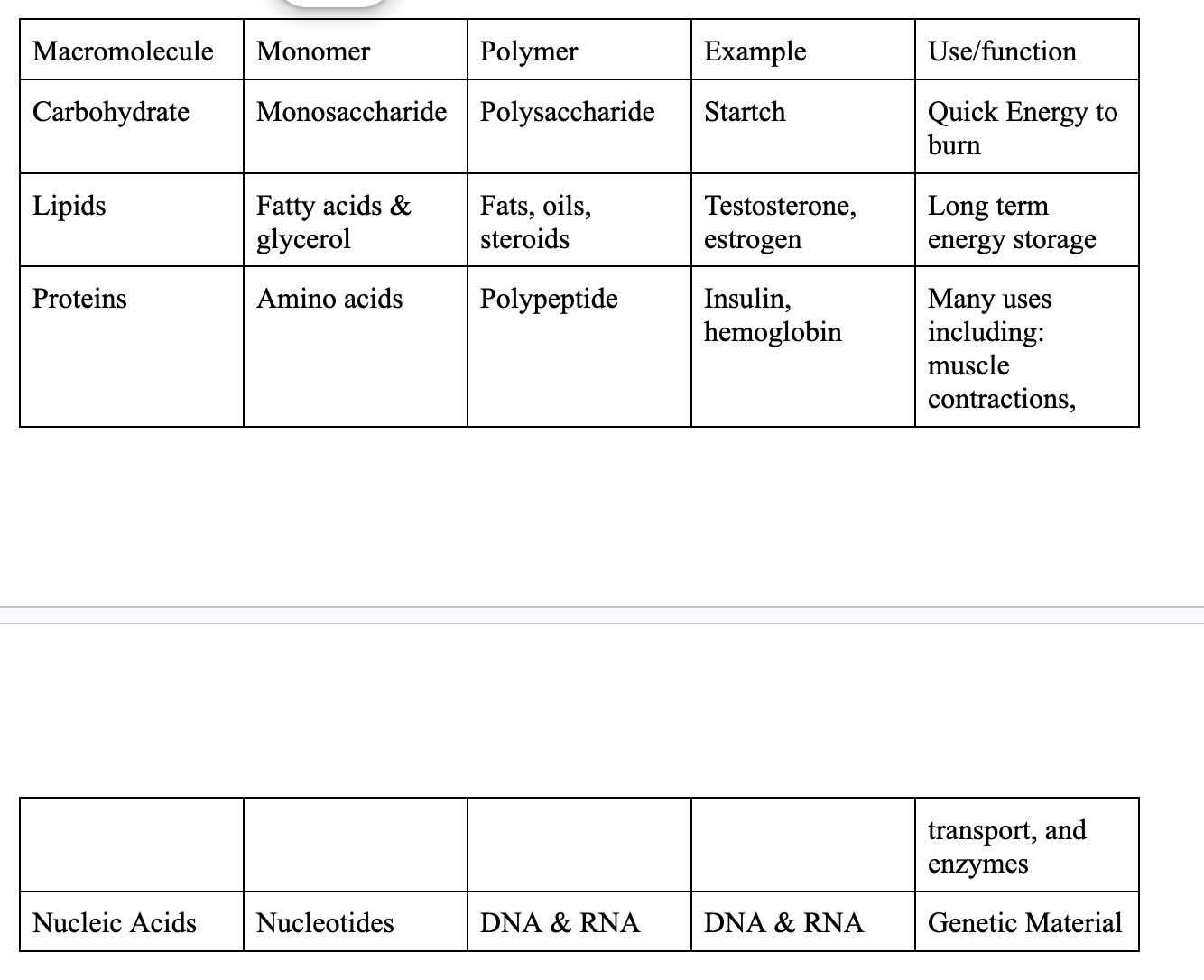
Fill in the table below