Biogeography
 Call Kai
 Learn
Learn Practice Test
 Spaced Repetition
 Match
Match Flashcards
 Knowt Play
1/36

There's no tags or description
Looks like no tags are added yet.
Name | Mastery | Learn | Test | Matching | Spaced | Call with Kai | Chat |
|---|
No analytics yet
Send a link to your students to track their progress
37 Terms
Biogeography
the study of geographic distributions of organisms
endemic
restricted to a particular geographic region
bromeliads are restricted to New World
plethodod salamanders in NA
platypus to AUS
Narrow endemic
restricted to a small geographic region
one flower in just Kauai ie.
Cosmopolitan
found worldwide (in an appropriate habitat)
applies to many higher taxa (angiosperms)
Biogeographic realms (wallace)
major geographic regions of the Earth that have characteristic animal or plant taxa
Wallace’s line
sharp break in animal species among islands between eastern Asia and Australia despite proximity
continental drift
two geologic plates that came together recently
Certain species or higher taxa may be restricted to a specific biogeographic realm
i.e. neotropical realm with armadillos, armored catfish
Biogeographic realm can be further divided into
regions of endemism (provinces) with unique flora or fauna
Disjunct distributions
geographic distribution that has unoccupied gaps separating regions that are occupied
Higher taxa typically have different but similar species in
disjunct regions
Boas are in South America and the South Pacific islands, and nowhere else, which is an example of
disjunct distributions
What are the three main historical processes that affect distributions?
dispersal
vicariance
extinction
European starlings and cattle egrets are examples of species that have expanded their range via
dispersal; In a short amount of time a species can dramatically expand their range
Vicariance
separation of populations by barriers arising from changes in geology, climate or habitat
The Isthmus of Panama is an example of _____ ; as it split the marine organisms into the Caribbean and Pacific populations
vicariance
The modern horse is an example of how ____ can explain biogeography
extinction
horses arose in NA, went extinct and later reintroduced
Dispersal, vicariance, and extinction need not be
mutually exclusive
Saxifruga cernua (a herby plant) is an example of
Dispersal, vicariance, and extinction
glaciers split populations (V)
dispersal (recolonized formerly glaciate regions)
extinction (cold adapted populations in south went extinct with warming, remained in mountainous regions)
relict populations remain in high areas
progression rule
most basal lineages on Kauai, and youngest on Big Island
makes phylogeny predictive
phylogeography
study of processes governing the geographic distributions of genealogical lineages
In phylogeography, we use ____ to draw inferences about historical processes
gene trees
can be applied within species and across
Pleistocene population shifts
glacial cycles changed climate and made large areas of north temperate zone uninhabitable for most species
also impacted tropical regions
Glacial refugia
locations where populations of a given species survived during the glacial maximum
Many northern temperate taxa show evidence of recent or ongoing ____ to the north
range expansions
species richness
number of species
Rarefaction
accounting for variation in sample size when calculating species richness
can compare disimilar sample sizes
diversification
increase in the number of taxa in a clade
time-and-area hypothesis
most lineages have been diversifying over longer time periods and over larger areas in the tropics
frogs more diverse in tropical than temperate
Time calibrated phylogenetic trees (chronograms) can be used to estimate
diversification rates
Lineage-through time plots
count up lineages existing over different times
log number of taxa over time
slop of the line provides the estimate of r (per capita diversification rate) `
In lineage through timeplots, the graph
typically curves upward near the present (increasing diversity rapidly)
The slope in the recent past represents the speciation rate (S)
new things that havent had time to go extinct yet
Why are some clades so much more species rich than others?
Older clades may have more species
i.e. beetles
Negative diversity dependent diversification
the diversification rate is dependent on how much diversity exists at that time
there is a ceiling to it (carrying capacity)
no relationship between species richness and clade age
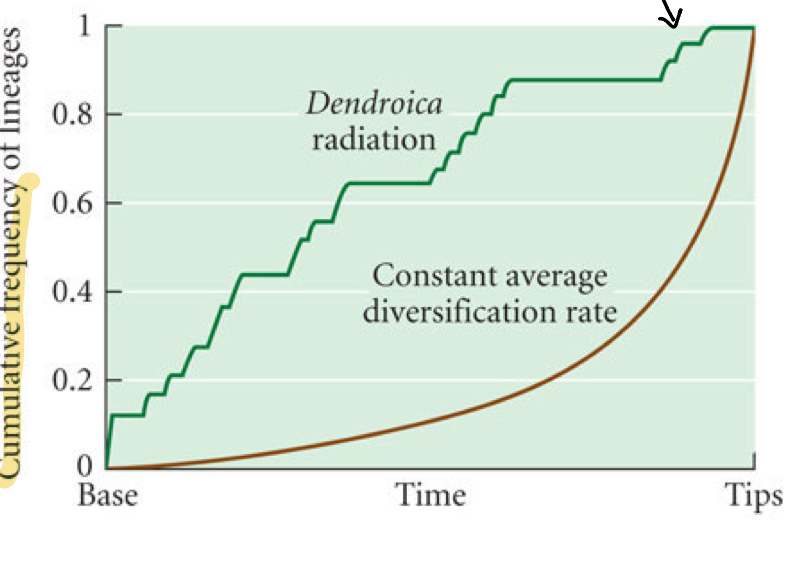
Diversification rates slow towards the present
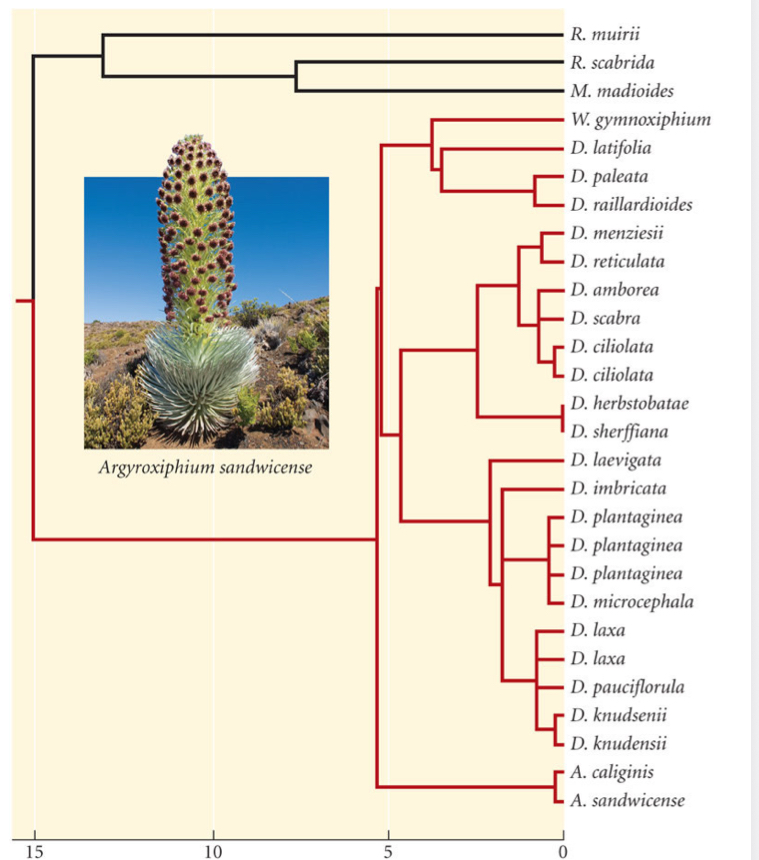
S = 0.56; ancestor 5 mya from CA
vast number of nodes near the present, not a lot in the past - high diversification rate over a small period of time
Clades that evolved herbivory diversified faster than those feeding on
animal, fungus or detritus