📸A&P 3 - Wiley + Urinary System (Lecture 20)
 Call Kai
 Learn
Learn Practice Test
 Spaced Repetition
 Match
Match Flashcards
 Knowt Play
1/55

Earn XP
Description and Tags
https://quizlet.com/ca/856979280/ap-3-wiley-urinary-system-lecture-20-flash-cards/
Name | Mastery | Learn | Test | Matching | Spaced | Call with Kai | Chat |
|---|
No analytics yet
Send a link to your students to track their progress
56 Terms
All of the following are wastes removed by the kidneys EXCEPT:
Water
All of the following are functions of the kidneys EXCEPT:
Removal of worn out RBC's and pathogens from the blood
Urine produced by thee kidneys is transported by the __________ to the urinary bladder where it is stored until being excreted from the body.
Ureters
Choose the organ of the urinary system and corresponding function that are matched INCORRECTLY.
The urinary bladder excretes waste in urine
Which is NOT a major function of the kidney?
Regulation of blood cell size
This is the formation of a new glucose molecule.
Gluconeogenesis
Which of the following is a waste product normally excreted by the kidneys?
Urea
The kidneys lie within the peritoneal membrane.
False
A nephron includes a:
1. Renal corpuscle
2. Renal tubule
3. Renal capsule
1 & 2 are correct
Which is NOT a function of the kidneys?
All of these choices are functions of the kidneys
Which of the following correctly lists the connective tissues surrounding the kidneys starting with the most superficial layer?
Renal fascia, adipose capsule, renal capsule
The renal __________ is part of the renal parenchyma.
cortex
Which of the following correctly traces the flow of blood through the kidney after entry through the renal arteries and prior to entry into the peritubular capillaries?
Segmental arteries, interlobar arteries, arcuate arteries, interlobular arteries, afferent arteriole, glomerulus, efferent arteriole
Juxtamedullary nephrons
Allows excretion of very dilute or concentrated urine
The kidneys lie within the ___________ membrane.
None of these
These blood vessels extend through the renal cortex and arise from arcuate arteries.
Cortical radiate artery
The middle layer of tissue surrounding the kidneys and protecting them from trauma.
Perirenal fat capsule
The kidneys produce two hormones, calcitriol and ___________.
erythropoietin
Why are the kidneys said to be retroperitoneal?
They are posterior to the peritoneum
Identify the three layers that surround the kidney from internal to external:
Renal capsule, adipose capsule, renal fascia
Renal pyramids occur in the __________ of the kidney.
Renal medulla
A drop of blood entering a renal artery would pass through a segmental artery, interloper artery and ___________ before reaching a cortisol radiate artery.
Arcuate artery
The two main parts of the nephron are the renal corpuscle and the renal tubule.
True
This is a smooth, transparent dense irregular connective tissue that is continuous with the out coat of the ureter.
Fibrous capsule
The portion of the kidney that extends between the renal pyramids is called the:
Renal columns
What is the correct order of blood flow through the kidneys?
Interlobar arteries > arcuate arteries > glomerular capillaries > arcuate veins
C
This is composed of dense irregular tissue that runs continuous with the ureter.
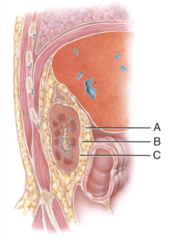
B
This layer's main function is to protect the kidney from trauma and hold it's place within the abdominal cavity.
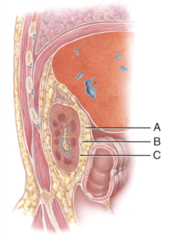
A
This layer runs deep to the peritoneum on the anterior surface of the kidneys.
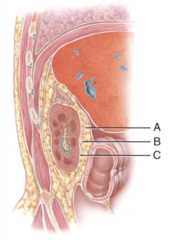
A
This can be divided into the cortical zone and the juxtamedullary zone.
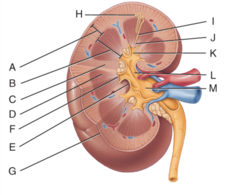
F
This structure is the apex of the renal pyramid.
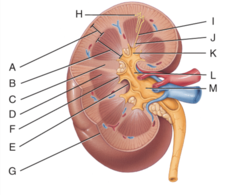
C
Which of the following labels correctly identifies the juxtaglomerular apparatus?
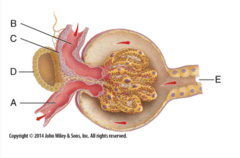
Filtered fluid leaving the glomerular capillaries immediately enters the:
Glomerular capsule
Which correctly associates structure with tissue type?
Descending limb and thin ascending limb of nephron loop > simple squamous epithelial cells
The renal corpuscle consists of the glomerulus and the glomerular capsule.
True
The juxtaglomerular apparatus consists partially of the:
Juxtaglomerular cells of an afferent arteriole
_____________ selectively removes material from the tubular fluid and returns to the blood while ___________ removes materials from the blood.
Tubular reabsorption; tubular secretion
Which is the correct order of filtrate flow?
Glomerular capsule, proximal convoluted tubule (PCT), loop of Henle, distal convoluted tubule (DCT), collecting duct
A & B
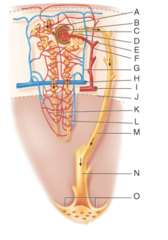
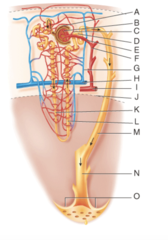
What structure(s) comprise the renal corpuscle?

D
Where is the DCT?
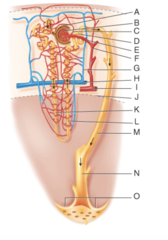
H
Where is the arcuate vein?

L
Where is the Ascending limb of the Nephron loop?
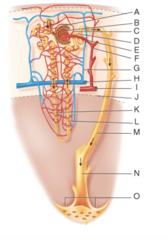
J
Where is the corticomedullary junction?

N
Where is the papillary duct?
M
Where is the collecting duct?

C
Where is the Efferent glomerular arteriole?
G
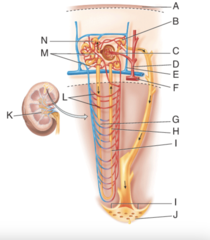
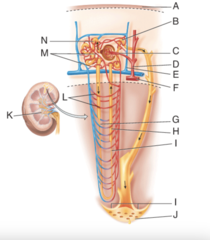
Fluid flowing from point N in the image will go to which structure next?
I
Fluid flowing from point G in the image will go to which structure next?
B
Fluid flowing from point H in the image will go to which structure next?
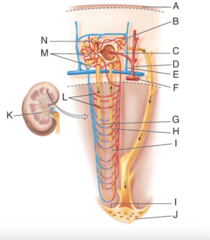
J
Fluid flowing from point B in the image will go to which structure next?

C
Where is the Afferent glomerular arteriole?
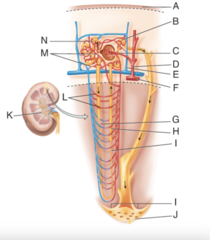
E
Which vessel in the diagram is the cortical radiate vein?
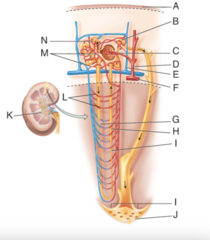
A
Which structure in the diagram is the fibrous capsule?

D
Which vessel in the diagram is the cortical radiate artery?
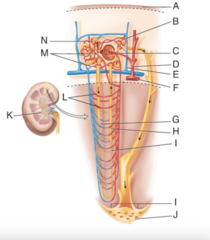
Another name for the glomerular capsule is _____________ capsule.
Bowman's
What type of cells are found in the PCT?
Simple cuboidal