Physics 3
 Call Kai
 Learn
Learn Practice Test
 Spaced Repetition
 Match
Match Flashcards
 Knowt Play
1/32

There's no tags or description
Looks like no tags are added yet.
Name | Mastery | Learn | Test | Matching | Spaced | Call with Kai | Chat |
|---|
No analytics yet
Send a link to your students to track their progress
33 Terms
Linear horizontal motion equation in terms of initial velocity only
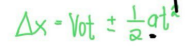
linear horizontal motion equation in terms of final velocity and time
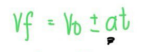
linear horizontal motion equation in terms of final velocity and change in x (position)
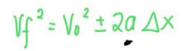
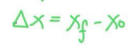
linear horizontal motion equation to solve for change in x (position)
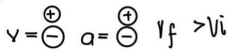
If speed increases
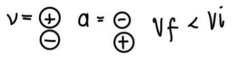
if speed decreases
Horizontal component of velocity in projectile motion
Vo cos(theta) and is constant
Vertical component of velocity in projectile motion
Vo sin(theta), and is changing
Velocity of y component (Voy) at ymax in projectile motion
0
Acceleration of y-component in projectile motion
= -g = -9.81m/s²
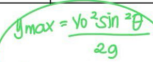
ymax equation in projectile motion
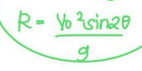
Range equation in projectile motion
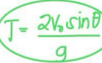
Total time (T) in projectile motion
degree where max ymax in projectile motion
90 degrees
degree where there is maximum range in projectile motion
45 degrees
degree where there is maximum area in projectile motion
60
degree where there is maximum arc length in projectile motion
56.6 degrees
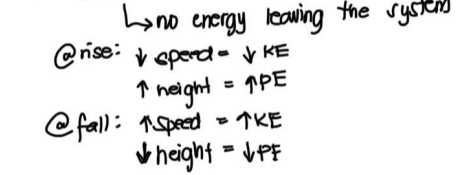
Ignoring air resistance, mechanical energy (KE+PE) of the projectile is always
constant
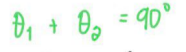
@ an angle that has corresponding R, the only other angle that will produce same R is its ___
complementary
Uniform Circular motion
motion at constant speed
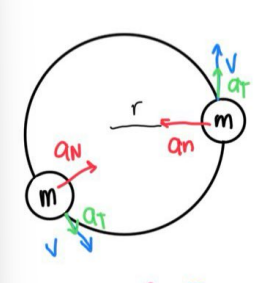
Centripetal acceleration can be computed using
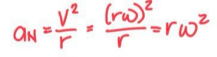
Centripetal acceleration
changes the direction of velocity
points toward the center of the circle
when object is turning
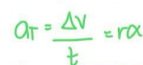
Tangential acceleration is given by
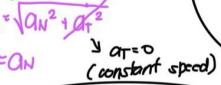
total acceleration in uniform circular motion is just equivalent to
centripetal acceleration
Centripetal force is given by the formula
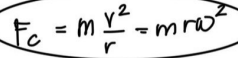
@ constant speed, acceleration is directed
radially inward
1 rev = ___ rad (note: rad is dimensionless, equivalent to measure of arc length(m) over radius(m) so m/m =1)
2pi
linear displacement given angular displacement (rad)
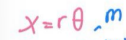
linear velocity given angular velocity (rad/s)

linear acceleration given the angular acceleration, rad/s²
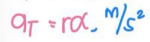
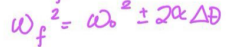
Non-uniform circular motion given the initial angular velocity only with change in angular displacement
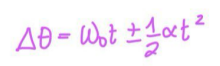
Non-uniform circular motion given the initial angular velocity with time
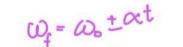
Non-uniform circular motion given the initial angular velocity with change in angular displacement