Cell Biology
 Call Kai
 Learn
Learn Practice Test
 Spaced Repetition
 Match
Match Flashcards
 Knowt Play
1/99

Earn XP
Description and Tags
Purple Pages
Name | Mastery | Learn | Test | Matching | Spaced | Call with Kai | Chat |
|---|
No analytics yet
Send a link to your students to track their progress
100 Terms
Scientific Method
Acquiring knowledge by making observations about the natural world, developing explanations and testing them
Observations
Lead us to ask questions
Hypothesis
Predicted answer to a question
Must be testable and falsifiable
Can have more than one (First may not work)
Leads to predictions that can be tested by observing/experimenting
Failure to falsify does not prove hypothesis
Controlled Experiment
Is an experiment with a control group
Variable
Factor within the experiment
Independent Variable
A variable that is changed between test groups
Dependent Variable
A variable that depends on the independent variable
Controlled Variable
A variable that remains consistent
Bigger Sample Size
Gives a more specific/detailed result
Scientific Method Order
Observation, Hypothesis, Experimentation, Interpretation of Results, Conclusion, Peer Review (Research Paper), Scientific theory (Takes years)
Scientific Theory
Acceptable and well-substantiated explanation of some aspect of the natural world
- takes many years to establish
- supported by exhaustive experimentation
- established truths that are unlikely to be contradicted by future research
Observational Science
Look for a pattern and cause in observations, relies on statistical techniques
Biology (Definition)
The study of living things
Bio- Living things
Logos- The study of
Cell (Definition)
Basic unit of life
Matter
Has a mass, occupies space and is made of pure element
Element
A substance that cannot be broken down into other substances by chemical reactions
Compound
A substance that consists of 2 or more elements using certain fixed ratios
Which elements make up 96% of living organisms
Carbon, Hydrogen, Oxygen, and Nitrogen
What makes living organisms so different
The ratios or organization of the main 4 elements (O,H,N,C)
Different shapes have different functions
Atomic Number
Number of Protons
Atomic Mass
Protons and Neutrons
(Electron mass is negligible)
Connection Between Protons and Electrons
Number of Protons is equal to number of Electrons and vise versa
Protons, Neutrons, and Electrons
Protons- Positive
Neutrons- Neutral
Electrons- Negative
Isotopes
Atoms with the same number of protons but a different number of electrons.
Same Atomic number different atomic mass
Orbitals
Stable orbitals have paired electrons
Orbitals are grouped into shells
Made up of protons moved in specific ways by electrons
Radioisotopes
Unstable isotopes that decay and release energy
Rate of Decay is constant
Used for nuclear medicine (Such as diagnostic testing)
Radioactive Tracer
A substance containing a radioisotope that is used to measure the speed of chemical processes and/or movement of substances.
(Nuclear Medicine)
Why was there a global radioisotope shortage between 2007-2010
Because the Chalk River reactor in Canada was shut down and we supplied 30-40% of the world’s supply
Valence Electrons
Electrons in the outermost shell (Valence Shell)
Determines reactivity of an atom
Full Valence shell = Inert (Stable/will not react)
4 types of Chemical Bonds
Ionic
Covalent
Hydrogen
Van der waals forces
Ionic Bonds
Transfer of electrons from one atom to another resulting in both atoms having charges. Which makes them ions
Intramolecular bond
Covalent Bonds
Sharing a pair of valence electrons by 2 atoms which makes a distinct 3D form. The 3D form (Structure) has to do with the functions.
Intramolecular bond
Hydrogen Bonds
Partial Positive charge of H atoms attracts partial negative charge of nearby atoms, only partial charges
Weaker than ionic and covalent bonds
Intermolecular bond
Van Der Waals Forces
Developed between non-polar bonds, constant motion of electrons causes them to accumulate by chance on one region of molecule this causes zones of negative and positive charge. (Holds molecules close together)
Weaker than hydrogen bonds
Intermolecular bond
Electronegativity
Measures atoms attraction for electrons in covalent bonds
(Polar or Non-polar)
Non-Polar Covalent
Equal Sharing of electrons
Polar Covalent
Unequal Sharing of electrons
One is slightly positive (Lower electronegativity)
One is slightly negative (Higher electronegativity)
Intramolecular Bonds
Intra means within
Applies to ionic and covalent bonds
Intermolecular Bonds
Inter means between
Applies to Hydrogen bonds and Van Der Waals forces
Cation
A positively charges ion that has lost one or more electrons
Anion
A negatively charged ion that has gained one or more electrons
Structure determines
Function
Cohesion
Attraction between water molecules (water “sticks” to itself ie, water droplets)
Solvent
Dissolves solute ie. water
Solute
Dissolved by solvent ie. salt
Hydrogen Shell
Water molecules surround polar molecules and ions
Allows for separation of molecules
Water Ionization
Separation of water = H+ and OH-
Base
Proton acceptor
7.1-14 pH
Acid
Proton donor
1-6.9 pH
Acidity of a Solution
The concentration of H+ verses OH-
Buffer
Controls pH by absorbing or releasing H+
Most are weak acids or weak bases
Carboxylic Acid Controls…
The pH of our blood
Tetravalence
Has 4 valence electrons
Allows for large complex molecules
example carbon can make 4 covalent bonds
Hydrocarbons
Molecule where carbon is only bonded to hydrogen
Vary in length and shape
Functional Group (Definition)
Reactive groups
Part of biological reactions
Bind to carbon
Hydroxyl
-OH
Carbonyl
-C=O
Carboxyl
-COOH
Amino
-NH2
Phosphate
-PO42-
Sulfhydryl
-SH
Synthesis of a Polymer
Dehydration Reaction
Removes water
Forms a bond
Breakdown of a Polymer
Hydrolysis Reaction
Add water
Break a bond
Carbohydrate
Sugars, Starches, Fiber
Main fuel source for cells
Helps as a building block for cell wall (In plants)
Monosaccharide
Means one sugar
CH2O
Isomer
Same chemical formula, different structure
Enantiomer
Mirrored Isomer
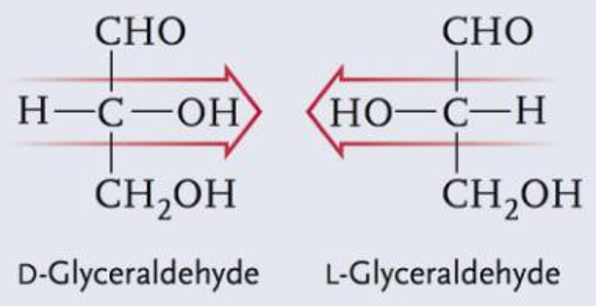
Structural Isomer
Different position of carbonyl group

Disaccharide
Meaning two sugars
Two monosaccharides
Maltose=
Glucose + Glucose
Sucrose=
Glucose + Fructose
Lactose
Glucose + Galactose
Glycosidic Linkage
Covalent bond between sugars
Has H-bonds and N-groups
Polysaccharides
Meaning many sugars (Many monosaccharides)
Unbranched Vs Branched Polysaccharides
Unbranched is straight one continuous line
Branches has jut outs or branches
Proteins
Have many structures therefore many functions
“workhouse” of the cell
Structural support, storage, transport, enzymes in reactions, cellular communications, movement
Over 100,000 different functional proteins
Made of one or more polypeptides
Polypeptides
A continuous chain of amino acids held together by peptide bonds
Amino Acid
Organic molecule that bonds to form proteins
20 different ones

Nonpolar Amino Acids
10 out of 20
R group consists of carbon and hydrogen
Uncharged Polar Amino Acids
5 of the 20
R group consists of carbon, hydrogen and oxygen
Oxygen hogs electrons and becomes slightly negative making it polar
Charged Amino Acids
5 of the 20
2 types - negatively charged (Acidic)
-Positively charged (Basic)
Peptides
Covalent Bonds
Dehydration synthesis
Peptide bonds
Amino Acid added only to carboxyl end
Primary Protein Structure
Linear sequence of amino acids
tells us nothing about the structure
Secondary Protein Structure
Backbone of oxygen and hydrogen
Hydrogen bonds between amino acids
Folds into either a alpha helix or beta plated sheets
Tertiary Protein Structure
Polypeptide backbone
All types of bonds between R groups
3D shape
Now has function
Quaternary Protein Structure
Two or more polypeptides
All types of bonds
Heme Groups
Are prosthetic groups added to protein to help it function
Non protein component
Transport oxygen using iron to attract it (Oxygen is attracted to iron)
Prosthetic Groups
Non protein component
Needed for proper function in for example proteins
Nucleic Acids
Polymers of nucleotides
Stores genetic information like inherited genes
DNA
Deoxyribonucleic Acid
2 nucleotide chains
Sugar-phosphate backbone
Phosphodiester bonds
Read from 5’-3’
RNA
Ribonucleic Acid
Nitrogenous bases inside
H-bonds
mRNA
Messenger RNA
A single-stranded molecule that carries genetic instructions from DNA in a cell's nucleus to the ribosomes in the cytoplasm, where the cell builds proteins
tRNA
Transfer RNA
A small RNA molecule that helps build proteins by matching messenger RNA (mRNA) codes with the correct amino acids
rRNA
Ribosomal RNA
The main building block and working core of the cell's ribosome
Lipids
Nonpolar molecule
Hydrocarbon backbone
Not a true macromolecule
3 types- Fats, phospholipids, steroids
Saturated Fats
Maximum number of hydrogen bonds possible
No double bonds
At room temp it is a solid
Unsaturated Fats
One or more double bonds that cause a bend in the structure
At room temp it is a liquid (like oil)
Fatty Acid does what
Stores lots of energy when glucose isn’t available
Phospholipid
Found in cell membrane
Amphipathic (Has a polar head and a nonpolar end)
Polar head is hydrophilic, nonpolar end is hydrophobic
Forms primary structural foundation of all biological cell membranes
Steroids
4 carbon rings
Dual solubility
polar and nonpolar end