All cases - Heimlers history manual cards
 Call Kai
 Learn
Learn Practice Test
 Spaced Repetition
 Match
Match Flashcards
 Knowt Play
1/89

There's no tags or description
Looks like no tags are added yet.
Name | Mastery | Learn | Test | Matching | Spaced | Call with Kai | Chat |
|---|
No analytics yet
Send a link to your students to track their progress
90 Terms
Context (Citizens United v FEC)
this is all about campaign finance laws and the Bipartisan Campaign Reform Act. Regarding this case, the act made it illegal for corporations/nonprofits to engage in electioneering communications for 60 days before an election or for 30 days before a primary. In 2008 the Democratic primary was between Barack Obama and Hillary Clinton. A conservative group called citizens United made a film called “Hillary, the movie” full of accusations. Before it was released, it was already within this forbidden period under the BCRA.
Constitutional principle / Citizens United Argument (Citizens United v FEC)
The mentioned portion of BCRA was a violation of the first amendment freedom of speech. Since the 1800s SCOTUS ruled corporations as associations of individuals, meaning that constitutional liberties extended to them
Bipartisan Campaign Reform Act (Citizens United v FEC)
A provision that prohibited corporations and labor unions from using their general treasury funds to fund "electioneering communications" (political advertisements) within 60 days of a general election or 30 days of a primary.
Federal Election Committee (Citizens United v FEC)
Argued that the BCRA was not a restriction or infringing upon the first amendment rights to free speech of Citizens United because the act still allowed corporations to have political engagement via a Political Action Committee (PAC). It was Citizens United’s fault that they didn’t follow the PAC guideline and subsequently ended in a case.
Decision (Citizens United v FEC)
[5-4] in favor of citizens United. The limitations on corporations political advertisements are not different from government censorship as the corporations have civil liberties as well.
Matters (Citizens United v FEC)
Question→ since money=speech in the political arena, is it fair for those with the most money to have the loudest voice?
To this question, the court ruled yes. Technically, as long as no direct communication to the candidate up to the day of the election
Context (Brown v BOE)
this is actually a series of cases which all concerned racial segregation in schools. Southern states operated on segregated schools under Jim Crow justified by the "separate by equal" doctrine that was established in Plessy v Ferguson. A black family tried to enroll their daughter into a nearby white school. They were denied, and thus had to bust to a further black school, which also put the children in direct danger as they had to cross railroads.
Plessy v Ferguson ruling (Brown v BOE)
“Separate but Equal” Doctrine: Racial segregation was constitutional if the separate facilities were equal.
Constitutional principle (Brown v BOE)
The segregation was a violation of the 14th amendment equal protection clause
Brown's argument (Brown v BOE)
The schools racial segregation was a violation of the fortune amendments equal protection clause. Brown's lawyer, Thurgood Marshall, also argued for the psychological effects of racial segregation that created an inferiority mentality within black children, and that inherently separation was unequal.
Board of Educations argument (Brown v BOE)
Under the separate but equal doctrine, this was perfectly legal, and both races of children still went to school, therefor not an issue.
Decision (Brown v BOE)
unanimously agreed that the separate facilities violated the equal protection clause and the court overturned the Plessy v Ferguson “separate but equal” doctrine/precedent.
Matters (Brown v BOE)
A monumental case for the rising civil rights movement
Some southern states still refused due to the vague wording of the decision, purposefully taking a long time to integrate
Context (Gideon v Wainwright)
Clarence Earl Gideon broke into a pool hall in 1961 in Florida and smashed a cigarette machine to steal the cash inside. He was arrested. Because he was poor the court appointed a lawyer for him at no charge. However, Florida law states that they will only appoint a lawyer to a defendant in a capital case thus Gideon was not entitled to representation. Therefore, Gideon had to act as his own lawyer, was convicted, and he later appealed to the SCOTUS.
Capital case (Gideon v Wainwright)
A criminal prosecution where the defendant is charged with a crime that is punishable by the death penalty
Constitutional principle (Gideon v Wainwright)
6th amendment: “in all criminal prosecutions the accused shall enjoy the right… to have the assistance of council for his defense”
↪Only applies to the federal government
↪14th Amendment Equal Protection Clause applies the bill of rights to the states, too
Fourteenth Amendment's Due Process Clause (Gideon v Wainwright)
The Supreme Court used this term to apply the Sixth Amendment's right to counsel to state courts. By doing so, the Court established that appointing attorneys for indigent defendants is a fundamental right essential to a fair trial, binding all state and local governments.
Gideon argument (Gideon v Wainwright)
The right to a lawyer is fundamental, and he had been denied that right
This right also applied to the state via the 14th Amendment, which the State of Florida had denied him
Overturning Betts v. Brady: ruled that states only had to provide counsel in special circumstances (such as illiteracy or the death penalty)
Betts v. Brady connection (Gideon v Wainwright)
Gideon’s team asked the Supreme Court to overturn the 1942 precedent set in this case, which had previously ruled that states only had to provide counsel in special circumstances (such as illiteracy or the death penalty)
Wainwright argument (Gideon v Wainwright)
The administration of criminal justice was a state power and that states should be allowed to determine their own procedures for appointing counsel
Selective Application: The state contended that the Fourteenth Amendment does not require states to incorporate every provision of the Bill of Rights
They relied on the existing Betts v. Brady ruling; there was no constitutional mandate to force states to pay for defense attorneys in all felony cases.
Decision (Gideon v Wainwright)
ruled unanimously and favor of Gideon as his sixth amendment right was violated and ruled that his sixth amendment right does apply to the state due to the 14th amendment. Our rights to the lawyer in this case is/was done as far back as the founding of the country to assure fair trials (Justice Hugo Black)
Matters (Gideon v Wainwright)
Selective Incoproration: applying the amendments to the state governments
States were required to fund and train thousands of public defense lawyers in these cases where the defendant cannot afford to pay their lawyers
Context (McDonald v Chicago)
In Heller v the District of Columbia, it ruled that restrictive gun ownership laws in Washington DC were unconstitutional, but because DC is a federal district it only applied to federal territory. Otis McDonald and others did what they could for this decision to apply to the states. McDonald's Street was taken over by gangs. He himself was a hunter and owned rifles legally, but argued that they weren't functional for self-defense. Chicago's strict gun laws tried preventing him from buying a handgun.
Heller v District of Columbia summary (McDonald v Chicago)
Ruled that restrictive gun ownership laws in Washington DC were unconstitutional, but because DC is a federal district it only applied to federal territory. McDonald's wanted this to apply to the states as well
Constitutional principle (McDonald v Chicago)
Second amendment right to bare arms
McDonald argument (McDonald v Chicago)
Chicago's restrictive gun laws infringed on the second amendment rights for people to own guns
Chicago argument (McDonald v Chicago)
the laws were necessary to uphold public safety and order. The restrictive laws also did not outlaw the buying or restrict the ability to be lisenced, it just added an extra step/different method.
Decision (McDonald v Chicago)
Ruled in favor of McDonald and that the laws did in fact infringe on the citizens rights. The 14th amendment with the equal protection clause allows the courts to apply the bill of rights to state governments as well. This is also why the court ruled on a state law about guns.
Matters (McDonald v Chicago)
Since the Heller case, only applied to federal territory, this case applied the same ruling to the states
This is known as selective incorporation
Any state with similar restrictive gun laws had to rewrite their laws to agree with this case
Selective Incorporation (McDonald v Chicago)
How courts apply civil liberties in the Bill of Rights to the states
Context (NYT v US)
in the 1960s and 70s, Americans did not want to be involved in the Vietnam war. President London, B Johnson, and Richard Nixon kept pressing for more men because we were "so close" to winning the war. Nixon commissioned a top-secret inquiry into the history of the United States involvement in the war and found a lot of information. Presidents and agencies were deceiving the public. One of the workers leaking this information to the New York Times and in Washington Post, and they published this info in what became known as the Pentagon Papers. Nixon sent in order to cease publications because it could threaten national security a.k.a. called prior restraint.
Prior restraint (NYT v US)
A form of government censorship that prohibits speech or other expression before it can take place. Often associated with the press, it includes pre-publication reviews, licensing requirements, and judicial injunctions (gag orders).
Constitutional principle (NYT v US)
The First Amendment freedom of the press, for the New York Times and Washington Post to publish such information.
NYT argument (NYT v US)
Argued that Nixon violated the first amendment right with the prior restraining order
Nixon/US argument (NYT v US)
Argued that prior restraint was justified since publications could threaten national security during a war, especially with one like the Vietnam war
Decision (NYT v US)
Agreed with the New York Times and ruled Nixon's administration's restraining order unconstitutional. They allowed the New York Times to keep printing the Pentagon paper papers, and they rolled that prior restraint is justified in some cases, but not in this one
Matters (NYT v US)
Free press vs censorship
This decision raised the bar for prior restraint to be used and in what circumstances it can be used
Context (Schenck v US)
In 1917, the US passed the Espionage that outlaws hinderance to any US military operations during the First World War, especially with recruitment and the draft that had just started that year. Charles Schenck was a Philadelphia socialist member that wrote pamphlets encouraging young men to resist the draft, comparing it to the illegal practice of indentured servitude under the 13th Amendment. He proceeded to distribute around 15,000 copies and was arrested under the Espionage Act.
Constitutional principle & Schencks argument (Schenck v US)
It was his first Amendment Right of free speech that was violated and therefore the section of the Espionage Act outlawing certain anti-government speech was unconstitutional
Decision (Schenck v US)
Court ruled unanimously that Schencks First Amendment rights were not violated because he wasn’t just protesting, he was actively encouraging men to avoid the draft through his publications. This was, then, not protected speech because as Oliver Wendell Holmes wrote in the majority opinion.
“The most stringent protection of free speech would not protect a man falsely shouting ‘fire’ in a theatre and causing a panic… The question is…whether words used i such circumstances & are of such a nature as to create a clear and present danger…congress has the right to prevent it”
*Especially during wartime!
Matters (Schenck v US)
Created a clear standard through Holmes’s majority opinion for silencing speech under a clear and present danger
Holmes also states how speech is even more so limited in a time of war, like this case was during WWI
This test was later replaced by the Bradenburg Test by distinguishing the difference betwwen intent of speech and likelyhood to incite lawless activity.
Context (Tinker v Des Moines)
The Tinker family were activists and supported ending the war in Vietnam. So, once in 1965 Senator Robert Kennedy called for a Christmas Truce, the children of the Tinker Family decided to protest the war by wearing a black armband with a peace symbol to school. School Administration became aware of the plan and wrote new policy that if students were caught wearing armbands, they would be faced with suspension if they refused to remove it.
Constitutional principle (Tinker v Des Moines)
1st Amendment protection of free speech
→These rights are not absolute, rather limited. The student was silent and peaceful in their symbolic protest, but it was a very contentious issue and even more so on public school (federal) property.
Decision (Tinker v Des Moines)
In a [7-2] decision, the court ruled in favor of Tinker, and that this was a violation of free speech. While school administration is tasked with creating a safe environment, sometimes through limiting free speech, this case was not that.
Matters (Tinker v Des Moines)
Created a 6-part Substantial Disruption test to see if schools could limit speech in a given situation
student speech has to be “materially and substantially interfer(ing) with the requirements of appropriate discipline in the operation of the school”
Outlined student speech protections
But, in cases like Bethel School District v Fraser, the student’s vulgar and obscene speech was not protected. the student gave a speech full of sexual innuendos and therefor was disciplined. The court ruled in favor of the school, since vulgar speech is different from political speech.
Context (Wisconsin v Yoder)
3 Amish families removed their schoolchildren from public school after 8th grade, according to their religion, worldly ideal concern, and offering a more homestead focused and self-sufficient education at home. Wisconsin had a compulsory education law where only children above the age of 16 could be pulled from school. Therefor, the parents broke the law and were fined $5 each, but refused to pay on account of moral principle.
Constitutional Question (Wisconsin v Yoder)
1st Amendment Right to freedom of Religion
Yoder’s argument (Wisconsin v Yoder)
Argued that Wisconsin violated their right to freedom to exercise their religion
Wisconsins argument (Wisconsin v Yoder)
Argued that the states interest in education trumped over the Amish communities religious rights.
Decision (Wisconsin v Yoder)
Unanimously ruled in favor of Yoder. Chief Justice Warren Burger: “…universal compulsory education, it is by no means absolute to the exclusion of subordination of all other interests”
Matters (Wisconsin v Yoder)
Set a tone for the other cases regarding state interest vs religion
The homeschool movement grew
Context (Engel v Vitale)
In 1962, the New York Board of Regents had a non-denominational prayer to be recited by school children and teachers alike in the morning, after the Pledge of Allegiance.
The prayer” “Allmighty God, we acknowledge our dependence upon thee, and we beg thy blessings upon us, our parents, our teachers and our community”
Although students could opt out of the prayer, a parent-group led by Steven Engel challenged this in court.
Constitutional Principle (Engel v Vitale)
1st Amendments Establishment Clause
“Congress shall make no law respecting an establishment of religion:
14th Amendment applied this to states, too
Engel’s argument (Engel v Vitale)
The recited prayer violated the Establishment clause"
Vitale’s Argument (Engel v Vitale)
School Board (New York Regents) represented by William Vitale, argued that the daily, state-written prayer was constitutional because it was completely voluntary and nondenominational. They maintained it did not establish an official state religion and simply acknowledged the nation's dependence on God without favoring any specific faith.
Decision (Engel v Vitale)
[6-1] ruled in favor that the prayer was infact a violation of the Establishment clause.Justice Hugo Black guaranteed that goverment wouldn’t influence US prayer/religion. Dissenting Justice Potter Stuart argued that it was constitutional because it offered children “the opportunity of sharing the spiritual heritage of our nation”
Matters (Engel v Vitale)
Thomas Jefferson’s Separate of Church and State won the case
The court ruled in favor of individual liberties versus social order
Established a foundation for later similar cases
Wallace v Jaffree 1985 - Alabama “minute of silence” in school was struck down
Ruled a clergy led prayer at middle school graduation ceremony as unconstitutional
Context (Marbury v Madison)
In 1803. The Federalists had just lost the election against the Democratic Republicans, and the Federalist President, John Adams, attempted to pack the court full of federalist-leaning judges in the final days of his presidency through his “Midnight Appointments’, Not all of these commissions were delivered in time before the end of his term, and the judges were not able to work until they physically held the commission document. The new president, Thomas Jefferson, ordered Secretary of State James Madison to not deliver the remaining commissions. One of these pending commissions was William Marbury’s, and he sued Madison for his commission by a Writ of Mandamus through the Supreme Court.
Writ of Mandamus (Marbury v Madison)
A court order compelling a government official, agency, or lower court to perform a mandatory, non-discretionary duty.
Madison asked the SCOTUS for this to get his commission.
Constitutional principle (Marbury v Madison)
Jurisdiction Clauses in Article III of the constitution (the scope of power and what cases) that the Supreme Court has.
Original Jurisdiction: the power for SCOTUS to hear some cases for the first time, *only for cases including states, foreign embassadors or consoles.
Appellate Jurisdiction: the power for SCOTUS to hear appeals from lower courts on cases
The issue: this case didn’t qualify for either! So, how was Marbury allowed to go up to the SCOTUS?
John Marshall’s 3 proceeding case questions (Marbury v Madison)
Does Marbury have the legal right to his commission?
is the Writ of Mandamus the proper legal means?
Does the court have the authority to grant the writ?
Marshalls question answers: (Marbury v Madison)
Does Marbury have the legal right to his commission?
is the Writ of Mandamus the proper legal means?
Does the court have the authority to grant the writ?
yes
yes
no! the constitution said nothing about judicial power concerning the writ.
Why did Marbury believe he could get a Writ of Mandamus? (Marbury v Madison)
the Judicial Act of 1789 Article XIII that SCOTUS does have the power in original jurisdiction cases to grant one.
Decision (Marbury v Madison)
Marshall stated the Judiciary Act’s Article XIII conflicts with the constitutions Article III, and this case isn’t either of the jurisdictions allowed for the SCOTUS to rule on, so Marbury didn’t even have the right for this case to go up to them! Ruled Article XIII unconstitutional, null, and void. Marbury never got his commission.
Matters (Marbury v Madison)
Marshall vested the SCOTUS with the power of Judicial Review, the Judicial branch is the final interpreter of the constitution and looking over laws passed by congress/legislative branch.
Context (Shaw v Reno)
In 1990, none of North Carolina’s representatives were black despite making up 20% of the states population. In reapportioning districts, they created 1 majority-black district, but the Justice Department claimed they could create a second one. The second district was politically bad-shaped, Gerrymandering- specifically drawing the district shape to make sure a certain race majority or another group.
District 12 combats with the Civil Rights Act of 1965, if certain states change districts, must first be approved by the federal government.
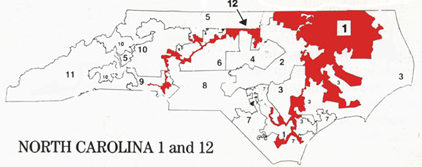
Racial Gerrymandering (Shaw v Reno)
Deliberate manipulation of electoral district boundaries to dilute or enhance the voting power of a specific racial group.
While partisan gerrymandering is legally permissible in the U.S., using race as the predominant factor in drawing maps is strictly prohibited by the 14th Amendment and the Voting Rights Act
Constitutional principle (Shaw v Reno)
14th Amendment Equal Protection Clause. Each side argued a different aspect of this
Shaw’s argument (Shaw v Reno)
The 14th Amendment’s Equal Protection Clause was violated because the district was drawn only for once race
Reno’s / Justice Dep. argument (Shaw v Reno)
Janet Reno was the attorney general at the time. She argued that it didn’t violate the 14th Amendment’s Equal Protection Clause because the intention was to help blacks that faced historic discrimination. They recognized the constitutions colorblind interpretation, but argued that blacks were the only race considered because of the prior discrimination and marginalization.
“We should favor the marginalized to create an equal society”
Decision (Shaw v Reno)
In a [5-4] majority ruling in favor of Shaw, against Reno, concluded that even with the noble intent, the district drawn on race was unconstitutional and set a dangerous precedent. The Equal Protection Clause was violated.
Matters (Shaw v Reno)
Set a precedent for cases involving racial gerrymandering
Context (Baker v Carr)
Decided in 1962, Tennessee hadn’t redrawn voting districts for over 60 years. Rural voters therefor had much more disproportional power than urban voters, when districts did not have the proper amounts of votes representative of population. The SCOTUS decided questions of redistricting were not justiciable - the court couldnt rule on this as it was a political question, not judicial.
Constitutional principle (Baker v Carr)
14th Amendment and especially the Equal Protection Clause
“no state shall make or enforce any law which shall deny to any person within its jurisdiction the equal protection of the laws”
(state infringements)
Baker’s argument (Baker v Carr)
Baker was the plantiff: By refusing to redraw the districts & reapportion representation, all citizens were in fact not equally protected under the laws and therefor this question is justiciable as a violation of the 14th Amendment
Carr’s argument (Baker v Carr)
Carr represented the state of Tennessee. He argued that this issue in entirety was not justiciable and should not have been brought to the courts.
Decision (Baker v Carr)
Ruled in favor of Baker [6-2] that the issues of reapportionment were justiciable.
SCOTUS did have the power to rule on reapportioning matters
Matters (Baker v Carr)
Established “one person, one vote” doctrine
Altered the nature of political representation across the US
Many states also had to redistrict due to this case
Got SCOTUS involved in matters priorly unavailable concerning some political issues
Established a 6-part test for the future judges to see if they should get involved in the case (political or justiciable?)
Context (McCulloch v Maryland)
In San Antonio Texas, a high school senior, Alfonso Lopez, carried a 38 caliber pistol and bullets to school. Under Texas Law, Lopez got sent to jail because in TX it’s forbidden to carry a weapon on school property. The next day the charges were dropped, there was also a federal law named the Gun Force School Zones ACt. So, state charges were dropped because federal charges were brought against Lopez. Then Lopez was sentenced to 6 months imprisonment.
Constitutional Principle (McCulloch v Maryland)
This is NOT a Second Amendment case! Rather, its on gun legislation being a state issue. How did congress then pass anti-gun legislation if its a state issue?
Congress acted under the Article I’s Commerce Clause - congress regulated commerce between states
US argument (McCulloch v Maryland)
Guns in schools are related to commerce because they lead to gun violence, then negatively impacts the travel through the area, disrupting commerce. The learning environment of the students is also disrupted, therefor the non-educated future citizens will lead to bad commerce.
Lopez argument (McCulloch v Maryland)
Gun regulation on school property is a power reserved to the states. Tyranical federal overreach and loose argument connection for the US’s side
Decision (McCulloch v Maryland)
Sided with Lopez in a [5-4] decision. The US argument perceives difficult limitation to federal power
Matters (McCulloch v Maryland)
A case about federalism that was in favor of the states, contrary to McCulloch v Maryland
Balance between the power of the states versus the federal government
Context (McCulloch v Maryland)
In 1816, congress chartered the Second Bank of the US that intended to establish branches in several states (including Maryland). Maryland passed a law saying any bank not officially chartered by the state was have to pay $15,000 a year in taxes. The cashier of the Baltimore branch of the national bank, James McCulloch, refused to pay it.
Marylands argument (McCulloch v Maryland)
The establishment of the national bank was unconstitutional. Article I Section 8 of the constitution did not grant the federal government this power
McCulloch’s argument (McCulloch v Maryland)
The bank was infact constitutional, as Article I Section 8 contained the Necessary and Proper Clause
Necessary and Proper Clause (McCulloch v Maryland)
Allows congress to make necessary and proper laws although the topics may not be explicitly cited under congress in the constitution.
Connects as the law to create the second bank was seen as necessary
Decision (McCulloch v Maryland)
Unanimous in favor of McCulloch. Chief Justice John Marshall argued it was constitutional on the account of the authority of the Necessary and Proper Clause.
If the is not prohibited by the constitution and the law upholds the spirit of the constitution, then the law stands
National Law over state law (federal supremacy)
Matters (McCulloch v Maryland)
Balances Principles of Federalism
In US v Lopez, tilted in favor of the states. this case did the opposite in favor of the federal government