Gingival enlargement - systemic changes and drug influenced causes
 Call Kai
 Learn
Learn Practice Test
 Spaced Repetition
 Match
Match Flashcards
 Knowt Play
1/31

There's no tags or description
Looks like no tags are added yet.
Name | Mastery | Learn | Test | Matching | Spaced | Call with Kai | Chat |
|---|
No analytics yet
Send a link to your students to track their progress
32 Terms
Gingival swellings and gingival enlargement can be caused by a range of different things…4
Plaque - induced Inflammation - top
Modifying systemic factors - pregnancy - lower
Neoplasms ( rare) genetic conditions and systemic diseases,more localised, blood neoplasms - generalised
Gingival enlargement associated with specific medications
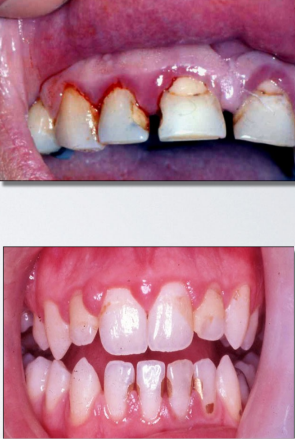
gingival swellings and gingival enlargements cause…
false pocketing - typically from interdental papillae
Can be very unsightly
Can compromise function - mastication
Compromises plaque control

Drug Induced Gingival Enlargement - Terminology
Drug-Induced Gingival Enlargement (DIGE) - correct term
Internationally agreed term following World Workshop 2017
Drug Induced Gingival Overgrowth (DIGO)
Previously widely used term.
Gingival Hyperplasia - pathological
( implies increased number of cells )
Gingival Hypertrophy - pathological - NOT what happens in gingival enlargement
( Implies increase in size of gingival cells)
drug induced gingival enlargement is related to 3 different types of medications 3
calcium channel blockers - antihypertensive drugs
phenytoin - anti-convulsant drug - used to manage epilepsy
ciclosporin - an immunosuppresant - used for tissue rejection following transplants
UK subjects taking selected drugs
With a conservative estimate of DIGE in 20% of these patients there would be a prevalence of around 400 000 people in UK
note verapimil and diltiazem
note that the numbers are increasing

PHENYTOIN
PHT anti-convulsant drug used for management of epilepsy
plaque control becomes hard to mange - you will see secondary gingival enlargements - redder enlargements
PHT-induced DIGE reported in early 20th century
Characterised by fibrous overgrowth of interdental papillae
Prevalence of approx 40% of those taking the drug
prevalence and severity associated with dose and serum drug concentrations
associated with plaque levels
but is this cause or effect ?? - possible vicious cycle

FOLATE AND PHENYTOIN INDUCED DIGE
PHT reduces Folate levels
Some studies report association of DIGO with folate concentrations
Others find no association
Clinical trials of oral folate supplements largely negative
1 study of topical folate application showed some benefit in children
OTHER ANTICONVULSIVES AND DIGE
Sporadic case reports of DIGE with other anti convulsive medications
Particularly Sodium Valproate
Systematic investigations do not support the idea that other anticonvulsants cause DIGO

CALCIUM CHANNEL BLOCKERS AND HYPERTENSION
used to manage high blood pressure and hypertension - swelling coming from the interdental papillae particularly
probing causes bleeding

CALCIUM CHANNEL BLOCKERS
Dihydropyridines ( DHPs) incl. Amlodipine, Nifedipine, Felodipine
Non- Dihydropyridines ( non-DHPs) incl Diltiazem, Verapimil
Reports of all CCBs causing DIGE
Reported prevalence of DIGE in CCB patients varies enormously from around 2% to above 50% (!)
SO WHY THE VARIATION IN PREVALENCE?
Case definitions of DIGE ?
Wide variations in study settings - clinic vs community definitions
Wide variations in sample populations
Dosing variations
drug induced gingival enlargement AETIOLOGIC FACTORS
Associated with drug dosage
Associated with plaque control
Associated with smoking
(Potential confounding factors incl diabetes, hypertension ??)
4290 subjects from SHIP study examined between 1997 - 2001
Those taking CCBs had increased pocketing in adjusted models
In a case-control subset CCB use was associated with increased pocketing but not attachment loss

EFFECTS ON PERIODONTAL DISEASE
SHIP study and our studies are consistent with CCBs resulting in significant increase in Probing Pocket Depth
In our studies patients taking CCBs have on average approximately 2 fewer teeth after adjustment for confounders
Studies with PHT also show increases in PPD but not bone loss
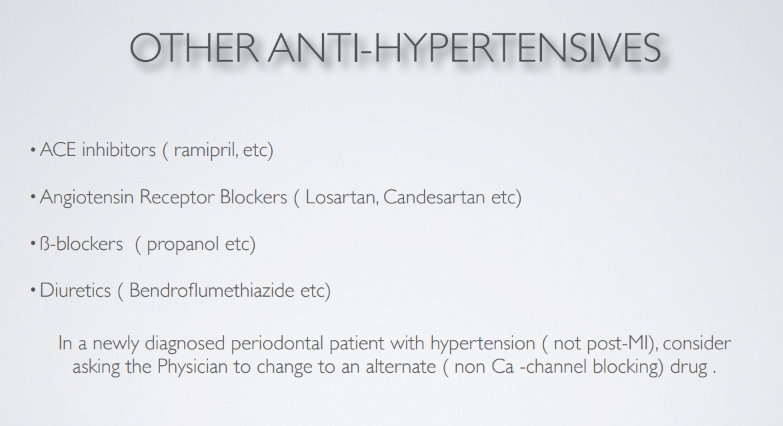
Other Antihypertensive Drugs Do Not Cause DIGE
ACE Inhibitors eg Ramapril, Enalapril Lisinopril
AR2P Blockers eg Candesartan, Losartan etc
Diuretics eg Furosemide
Betas Blockers eg Propranolol etc
CICLOSPORIN
Immunosuppressant taken particularly for suppression of graft rejection
Also used increasingly for other conditions incl Behcets disease, etc
Post-renal transplant patients often take ciclosporin and a CCB
Combinations associated with particular severe DIGE

OTHER IMMUNOSUPPRESSIVES DO NOT CAUSE DIGE
Tacrolimus
Methotrexate
Corticosteroids
PHT, CCBS AND CICLOSPORIN
PHT in use for far longer than other drugs
When overgrowth was reported there was an implication that this was the same as PHT induced DIGE
However empirically and experimentally there is good reason to think this is not the case
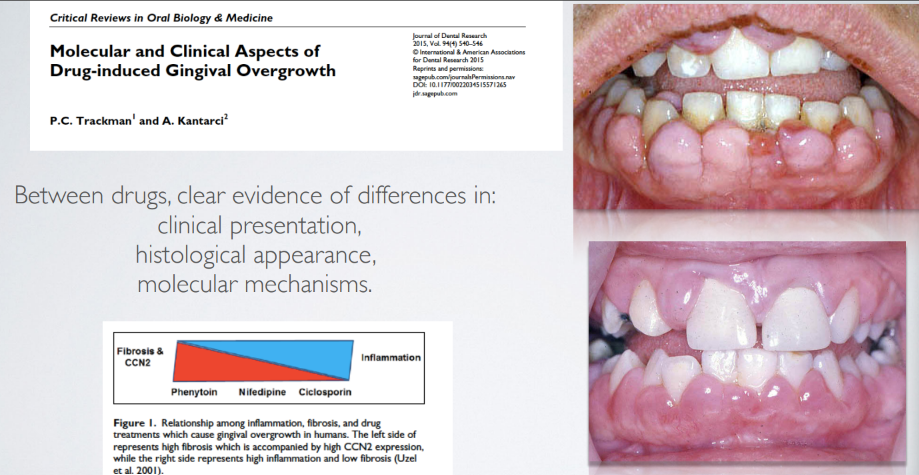
phenytoin is more fibrous, CCBs are more vascular and the cyclosporin is more inflammatory - slightly different mechanisms at play

Between drugs, clear evidence of differences in: clinical presentation, histological appearance, molecular mechanisms
HISTOLOGY AND MORPHOMETRY
In PHT, lesions obvious fibrosis, with CTGF (CCN2) expression
In ciclosporin, very little fibrosis, largely inflammatory lesions
In CCBs, an intermediate picture with some fibrosis but also increased vascularity
Evidence of cell proliferation and decreased fibroblast apoptosis ( cell death) ( Uzel et al 2001, Kantarcı et al 2007)

Overall pathogenesis of DIGE remains poorly understood and requires further study
new studies involving collagen synthesis
DIGE - management
Plaque Control ( would you consider surgical reduction before achieiving perfect plaque control ? - but plaque control will be easier after surgical reduction)
Other nonsurgical measures - debridement
Surgical reduction by gingectomy -
BUT relapse is common with all drugs - reported rates of between 40 -60% within 1 year
INVERSE BEVEL GINGIVECTOMY FOR DIGE
tissue is excised and flap of healthy tissue is sutured back

DO WE NEED TO GET THE DRUG CHANGED ?
42 % of patients experienced relapsed soon after treatment
Pts on CCBs lost 3 times more teeth than others during long term maintenance compared to pts who are not on calcium channel blockers
Improvement in GO during treatment was not associated with plaque, drug type or dose - suprise
Replacing the drug significantly reduced GO and improved outcomes
COHORT STUDY OF PERIODONTAL OUTCOME OF CCB PATIENTS
30 patients taking CCBs
Test group - had drug changed
Control - did not.
Outcome of initial nonsurgical therapy

CHANGING THE DRUG?
Not your decision - never tell a patient they should have their drug changed;
Letter to Physician requesting an assessment of this

CHANGING THE DRUG? - Phentytoin
Not a frontline drug for initial management of seizures
Used by those who have been long term seizure-free
And in combination with other drugs where seizure control is complex
Not usually a candidate for drug substitution.
CHANGING THE DRUG? - CICLOSPORIN
Immunosuppressant taken particularly for suppression of graft rejection
Post-renal transplant patients often take ciclosporin and a CCB
Despite availability of Tacrolimus, usually unwise to change this drug


‘very rare’ - no its actually way more common


BRIEF CONSIDERATION OF OTHER CAUSES OF GINGIVAL ENLARGEMENT
Periodontal Disease
periodontal disease ± Pregnancy
Rare Genetic Conditions ( incl Hereditary Gingival Fibromatosis - in children- grows back after surgery)
Neoplastic Disease Others ( including Sarcoidosis (uncommon), Chronic granulomatous disease, GPA(Wegener's granulomatosis))
leukaemias - early presentations


