Philosophy & Psychology
 Call Kai
 Learn
Learn Practice Test
 Spaced Repetition
 Match
Match Flashcards
 Knowt Play
1/83

There's no tags or description
Looks like no tags are added yet.
Name | Mastery | Learn | Test | Matching | Spaced | Call with Kai | Chat |
|---|
No analytics yet
Send a link to your students to track their progress
84 Terms
Folk psychology
Folk psychology (also common-sense psychology or theory of mind) is the everyday practice of interpreting and predicting human behaviour based on the ascription of mental states, such as beliefs, desires, emotions, or intentions. This practice allows us to explain past actions and anticipate future ones.
Folk psychology lies at the heart of philosophy of mind, but its mentalistic vocabulary is also central to other disciplines, such as psychology, sociology, or economics:
Examples:
“Beliefs about positive treatment outcomes can make a positive treatment outcome more likely.”
“The voter’s decisions are primarily guided by unconscious fears increased through engagements with the algorithm governing certain social media platforms.”
“The client’s behavior can be shaped by exploiting their desires.”
Issues with Folk Psychology
How do we know that others and maybe even ourselves have mental states? Can we directly access our own mental states or those of others, or do we need more complex epistemic strategies to infer them? → Lecture on Social Cognition
What are we referring to when speaking about mental states such as beliefs, desires, emotions, or intentions? Are these real entities in the world that causally influence behavior, or are they only semantic tools? → Lecture on Behaviourism
Is folk psychology a true and scientific account of our mind, or maybe a misguided heuristic? What are the implications for everyday life and science if it turns out that our mind does not exist in the manner folk psychology suggests?
Why does this matter to psychology?
Some philosophers believe that folk psychology is like theories about witches: an outdated theory postulating entities that we have no good reason to assume actually exist.
We should do what we always do in these cases: eliminate the postulated entities from our scientific worldview and replace them with a better one.
Eliminate mentalistic vocabulary and replace it with neuroscientific vocabulary. → Eliminate psychological practice and replace it with neuroscientific practice
Philosophy and Science
Philosophy is not a science: philosophers do not collect data and produce theories whose predictions could be directly tested (exceptions are experimental philosophers).
Many philosophers engage in activities called armchair philosophy, with different methods:
I. Conceptual Analysis
II. Thought Experiment
III. Argumentation
Conceptual Analysis
The aim of philosophy is not speculation but analysis and conceptual clarification.
Concept analysis aims to define the conditions for the proper use of a term. For example, when are we justified in calling something a ‘mental state’, an ‘emotion’, or a ‘belief’. This is central because it might help us to dissect the central characteristics that we aim to capture when studying a group of phenomena, and to distinguish research subjects that we might otherwise conflate.
Procedure
Starting with the ordinary use of a concept
Formulate a definition
Test with counterexamples
Revise
Thought Experiments
A thought experiment is a hypothetical scenario used to explore the implications of a concept, theory, or principle without needing to test it in the real world.
Unlike fiction, which often aims to entertain or tell a story, thought experiments are designed to clarify ideas, reveal hidden assumptions, or test the logic of a position through focused imagination.
We just discussed examples of thought experiments, such as the case of inverted colour perception or the brain implant. We will meet Mary the Scientist next lecture.
Thought experiments are also relevant to psychology! There are many thought experiments concerning the nature of the mind, consciousness, self, or free will.
Argumentation
The central business of philosophy is to provide arguments!
Philosophy is the art of reasoning, and all scientists need to reason.
To make an argument is to give a set of reasons (‘premises’) in support of an assumption (‘conclusion’) that you want to defend
The function of premises is to support the conclusion
The conclusion should, in some way or another, follow from the premises without simply restating them
To make a counter-argument is to show that a conclusion does not follow from certain premises or that the premises are false

Substance Dualism
The philosophical view that mind (the mental) and matter (the physical) are two fundamentally distinct kinds of foundations or substances
Modern variants: Some non-Cartesian substance dualists argue that a person is a composite, but do not define the mental substance strictly as a non-spatial, purely thinking ego the way Descartes did
Cartesian Dualism
The classical formulation of dualism created by René Descartes in the 17th century.
Defines the mind (res cogitans) as an unextended, non-physical thinking thing, and the body (res extensa) as a spatially extended, unthinking machine
Famously proposed that the immaterial mind and physical body interact directly inside the human brain via the pineal gland
Cartesian Dualism: Interactionism
Mind and body continuously interact
In everyday life, body and mind form a unit: for example, sensory processes can lead to conscious experiences, and conscious experiences can lead to motor processes
Substance dualism merely requires that mind and body can, in principle, exist as separate entities
Implications of Substance Dualism
If the subject of the sciences is the material world, then the mind cannot be studied scientifically
→ Separation of the material from the mental world
→ Separating the mind from scientific inquiry
The Interaction Problem
How is it possible that the immaterial mind and material body causally interact? - Princess Elizabeth of Bohemia (1618–1680)
The described interaction between mind and body is relatively elusive and pure speculation
Causal interaction needs spatial contact: how can something non-spatial (mind/soul) interact with something spatial (pineal gland)?
→ Insofar as mind and body are supposed to be radically different, they lack the commonalities necessary for interaction: spatial point of contact
Materialism vs. Physicalism
Materialism is the older term and traditionally holds that everything that exists is made of matter — the physical substance studied in classical physics (e.g., particles, atoms)
Physicalism is a more modern view that extends beyond matter, including everything that is fundamentally physical (e.g., forces, energy, fields, spacetime, quantum phenomena)
Phenomenal Consciousness
There are different types of consciousness; the critical one is phenomenal consciousness
Subjective, experiential quality
Subjective character of experience
‘What it is like’ to have an experience
e.g., visual experience, taste experience, olfactory experience, pain, hunger, cold, anger, joy, sadness, …
→ Remember the thought experiment about the Inverted Color Spectrum
Transformative Experience
Significant, novel experiences - independent of previous knowledge about the matter, these experiences affect a personin a profound and unpredictable way
e.g., becoming a parent, living in poverty, suffering from severe depression, being queer
“Stories, testimony, and theories aren't enough to teach you what it is like to have truly new types of experiences - you learn what it is like by actually having an experience of that type.” - Transformative Experience (2014)
→ Interindividual differences
Science of consciousness
Causes of conscious experience
(e.g., how much pressure we need to inflict for a person to notice them being touched)
Structure of conscious experience
(e.g., how auditory experiences influence visual experience)
Effects of conscious experience
(e.g., difference between conscious and unconscious processing of visual stimuli)
Neural correlates of consciousness
(e.g., neuroimaging data of brain activity during pain)
Theories of consciousness
(e.g., Global Workspace Theory, Higher-Order Theory)
Global Workspace Theory (Baar, 1997)
Global workspace = a central processor that mediates communication between a host of specialized nonconscious modules
When modules need to broadcast information to the rest of the system, they send this information to the workspace
Metaphor: ‘communal blackboard’ for the rest of the system

Monism
Everything is made of the same substance.
Idealism: Everything that exists is mind (or mind-dependent) (e.g., George Berkeley).
Materialism or Physicalism
Physicalism
There are no mental substances
The mind is part of the natural world
The mind can be fully described and explained in scientific terms
All we need to do is to study the interaction and arrangement of physical particles
Challenge: How can we fit the mind into the natural world? How can the mind-body problem be solved?
Reply: By identifying the mind with something physical
Behaviourism: Behaviour
Identity Theory: Brain states
PS: Eliminativism is also a version of materialism/physicalism! However, it does not identify the mind with something physical, but it denies the mind’s existence
Types of Behaviourism
Psychological (Methodological) Behaviourism
Philosophical Behaviourism
Main assumptions of psychological behaviourism
It seems that the only possibility to directly investigate the mind is to rely on introspection.
Introspection = subjective looking inwards
Problem: Introspective reports can never be verified or falsified by others
Introspection cannot constitute the foundation for objectively valid scientific knowledge
Psychological behaviourism
A methodological thesis about how psychology should proceed.
Psychology is a science of behaviour: the central task is to explain behaviour in terms of stimulus-response reactions
The postulation of internal non-observable states (= mental states) is rejected, and all related notions (= soul, mind, consciousness) are banned from scientific discourses and inquiries
The use of introspection is considered unscientific and replaced by methods, such as classical and operant conditioning
Advantages
Behaviorism provides a purely objective method to study the relation between stimuli and responses
Psychology as a discipline no longer needs to rely on introspective reports
Still, many of the methodologies used in psychology are behaviouristic

Problems with Psychological Behaviourism
Simplicity of the Stimulus-Response Paradigm
The stimulus-response paradigm does not work for complex interactions (e.g., complex emotions, long-term planning)
Poverty of the Stimulus (e.g., Chomsky)
Some abilities of the human mind are too complex to be learned based on external stimuli; we rely on a certain set of innate knowledge (e.g., about linguistic structure)

Main assumptions of philosophical behaviourism
Defenders of psychological behaviourism deliberately ignore the mind as they merely aim to study overt behaviour in relation to different stimuli. This approach still relies on a ‘traditional’ concept of the mind: mind and behaviour are only causally connected, but behaviour is not part of the mind
Philosophical behaviourism instead defends the thesis that behaviour is an integral part of the mind. Simplified: The mind is nothing but behaviour
Psychological behaviourism studies behaviour instead of the mind
Philosophical behaviourism defines the mind in terms of behaviour
→ Philosophical behaviourism mandates psychological behaviourism, but you can defend psychological behaviourism without philosophical behaviourism
Philosophical Behaviourism
Prominently, Gilbert Ryle (1900-1976) rejects what he considered a philosophical myth underlying dualism and other theories of the mind:
The Cartesian ‘Ghost in a machine’
The mind is a closed inner realm receiving input from the senses and producing motor output
Behaviour is caused by the mind, but not part of the mind
The mind is a ‘hidden’ entity that cannot be directly observed
In thinking of mind and body as distinct, Descartes falls for a ‘category mistake’: he confuses what type of thing the mind is and into what category it falls
Category Mistake
Treating something that belongs in one conceptual category as belonging to another
Advantages of Philosophical Behaviourism
Shift from the idea that the mind is a thing in the world that causes our behavior, to the idea that the concept ‘mind’ refers to said behaviour
Philosophical behaviourism does not simply ignore the mind, but it defines the concept ‘mind’ in terms of behaviour
Philosophical behaviourism avoids Cartesian Dualism and the interaction problem: mind and body are not causally but conceptually related
The mind-body problem becomes a pseudo-problem as we falsely assume that there is something like an unobservable entity hidden behind our behaviour.
Implication of Philosophical Behaviourism for Psychology
If dualism were true, then psychologists would always have to infer and deduce people's unobservable mental states from their observable behaviour
If behaviourism is true, then behaviour is all that exists. Psychologists become, in effect, rarefied physiologists, studying the mind by examining when and how behaviour is brought about.
Psychologists no longer have to guess what is going on in the mind of the person, hidden from direct observation
Problems with Philosophical Behaviorism
‘Seeing the mind is like judging a book by its cover’
Super or Super-Super-Spartans (Putnam)
We can imagine that people are in a mental state (e.g.,pain) without having any tendency to show corresponding behavior (e.g., pain behavior)
→ Mental states cannot be identified with sets of behavior or dispositions to show them, because mental states can emerge in their absence
Reply: These cases are not real – This is only a thought experiment in which it might be questionable whether the concept of ‘pain’ even applies to the Spartans
Behaviourism cannot account for some of the most central aspects of the mind, such as phenomenal experience. Ahhhhh, consciousness, …. Again!
For example, we can imagine painful and non-painful experiences to be associated with the same behaviour. In this case, their phenomenal differences would not be accounted for. (Think also of the Inverted Color Spectrum)
Thus, this leaves out the ability to experience mental states from a first-person perspective.
→ Behaviourism cannot account for all mental states: e.g., it might work for some (e.g., beliefs about rain) but not for others (e.g., experience of pain)
Identity Theory
Mental states are identical to brain states
Mental states are nothing over and above brain states/processes
Talking about mental states or brain states is just two different ways of referring to one and the same thing
Psychologists and neuroscientists are speaking in two different ways about one and the same thing
Mentalistic language is neutral with respect to the material or immaterial nature of the mind
Our talk about the mind does not give us arguments for or against substance dualism
For example: “I feel a pain in my arm.”
From a linguistic point of view, substance dualism could be true (or false). Just like physicalism.
Advantages of Identity Theory
Mental states are real, internal phenomena (vs. behaviourism): mental states can be considered causes of our behaviour
→ Identity Theory takes the mind seriously
Mental states are identical to brain states (vs. substance dualism): there is no problem of how mental states and brain states could interact with each other
→ Identity Theory avoids the interaction problem and is simpler in terms of Occam’s razor
Neuroscience suggests a very intimate relationship between mental states and brain states
→ Identity Theory takes science seriously
Identity Theory ≠ Eliminativism
Identity theory does not deny the existence of mental states but claims that they are identical to brain states
Identity theory allows for the useful investigation of mental states as well as brain states. It is an empirical question to uncover their identity
Paul & Patricia Churchland: Eliminativism
References to mental states should be eliminated from science and replaced by a neuroscientific theory!
Problems of Identity Theory
Presumptions
1. Identity theory is a scientific hypothesis. It is a contingent claim about how mental states relate to brain states. As such, it is open to challenge by empirical scientific findings
2. The goal is to make generalizable statements. That is, we should be able to infer a mental state from their brain state, and conversely, predict the brain state from the mental state
Multiple Realizability ≠ Identity
Multiple realizability is the principle that the same function or property can be instantiated in different systems through different physical structures or mechanisms
Water is not multiple realizable; a computer program is multiple realizable.
→ Multiple realizability contradicts identity
Identity theory is the lack of explanatory power:
Simply stating that mental states are identical to brain states does not provide an answer to the following questions:
Why are (different/same) brain states identical to (different/same) mental states?
For example, what makes certain brain states count as pain states?
Multiple Realisability
Beings with different brains can have the same mental states as humans (e.g., pain).
Challenge: How can we fit the mind into the natural world? How can the mind-body problem be solved?
Reply: By identifying the mind with something physical!
Behaviorism: Behavior
Identity Theory: Brain states
Functionalism: Functions (that can be physically realized)
Computationalism: Computation (as a special kind of function)
Functionalism
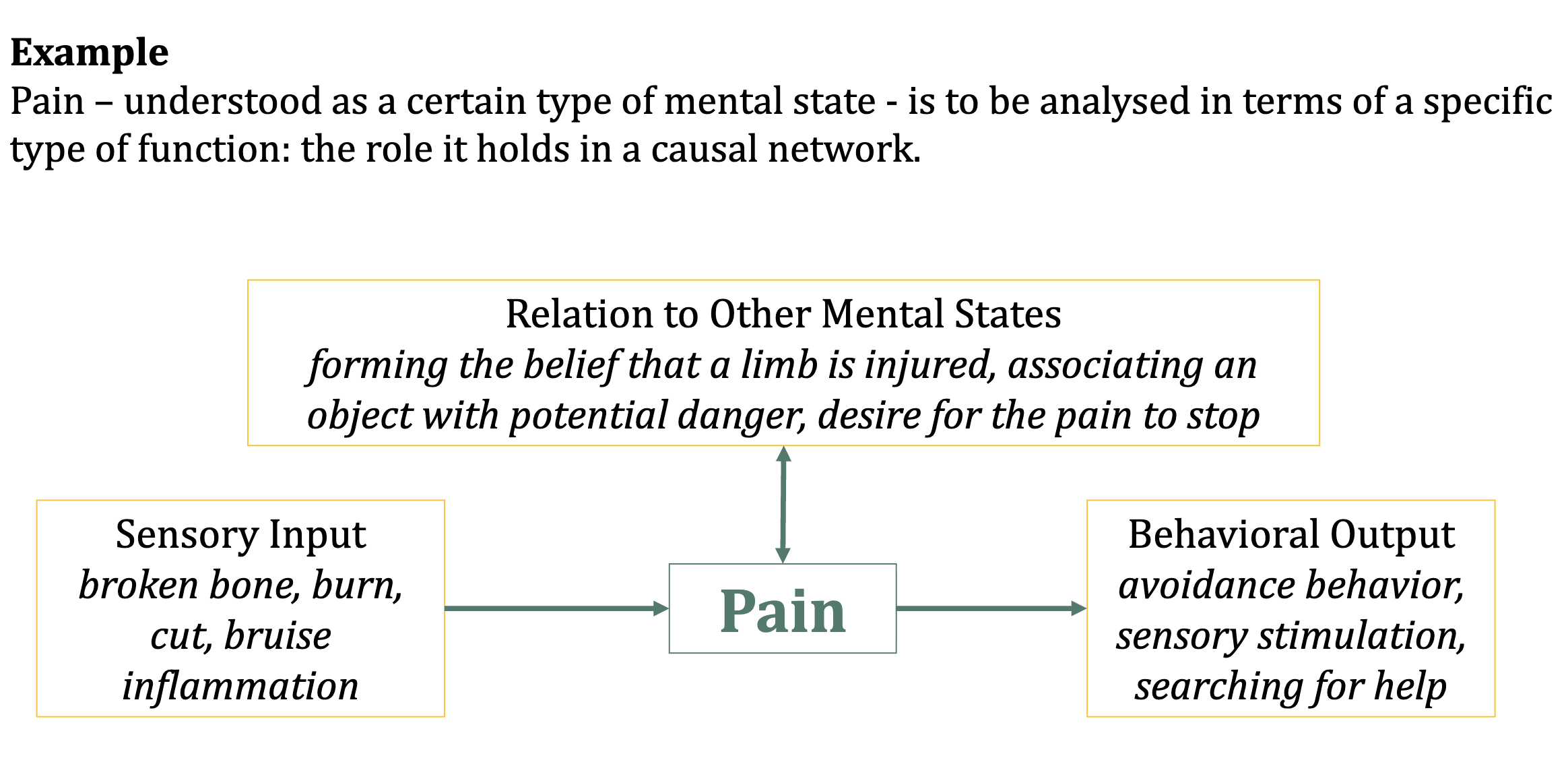
Mental states are identical to their functions or ‘causal roles’:
We should not characterize mental states in terms of what they are (made of soul-stuff or brain-stuff)
We should characterize mental states in terms of what they do
The functions of mental states are characterized in terms of
sensory input (i.e., what causes them)
verbal and non-verbal behavioral output (i.e., what they cause)
relation to other mental states
Mental states are functional kinds: claiming identity, but in terms of function, instead of brain states!
Instances of the same type of mental state fulfill the same type of function.
Everything that fulfills the same type of causal role is an instance of the same type of mental state – independent of their material
Functionalism and Physicalism
Mental states are understood in terms of what they do: their function. If two mental states play the same functional role, they are considered the same type of mental state.
In principle, functionalism is neutral about what physically realizes that function.
For example, whatever plays the causal role of "pain“, causing certain behaviors, reactions, and thoughts, is considered a "pain state“.
Functionalism is usually seen as a form of physicalism, because most assume that mental functions are carried out by physical things like brain states
However, functionalism does not rule out the possibility that something non-physical, like the states of an immaterial soul, could also perform the same functions.
→ We will focus on physicalist interpretations of functionalism
Functionalism combines the best of both worlds from behaviorism and identity theory.
In contrast to behaviorism, functionalism acknowledges the relevance of behavior, but does not define the mind in terms of behavior. It allows for mental states to exist internally to the person, realized, for example, by brain states
In contrast to identity theory, functionalism can acknowledge the multiple realizability of mental states. Functionalism acknowledges that internal mental states exist, but different types of brain states can fulfill the same functional role
Functionalism explicitly allows for multiple realizability!
Brain states realize mental states. However, the same mental state can be realized by multiple brain states
A brain state is a realization of a mental state when it realizes the respective causal role that defines the mental state
Explanatory Power & Functionalism
Functionalism does not lack explanatory power. The relation between mental states and brain states is not simply based on brute identity.
Different brain states are realizers of mental statesbecause they fulfill the same causal role.
Mind-Body problem & Functionalism
How is it possible that our mind exists as part of the natural world?
Functionalism: Mental states are identical to their complex causal roles that can be realized in multiple different manners
→ Implication for Psychology: Psychology can contribute to a deeper understanding of the mind by elucidating the causal roles of mental states
Challenges of functionalism: Liberalism
Attributing mental states to beings who clearly do not have them
Is merely fulfilling a causal role truly sufficient for being in a relevant mental state?
Is it irrelevant what exactly fulfills the function when attributing mental states?
→ Maybe we ascribe mental states to too many things!
Liberalism seems especially pressing in the light of phenomenal consciousness
"an organism has conscious mental states if and only if there is something that it is like to be that organism.”
“We may call this the subjective character of experience […] It is not analysable in terms of any explanatory system of functional states, since these could be ascribed to robots or automata that behaved like people though they experienced nothing.”
Challenges of functionalism: Chauvinism
Failure to ascribe mental states to beings who clearly have them
Do different instances of the same mental state really fulfil the same functional role?
Is every mental state defined in terms of only one role in a causal network?
→ Maybe we are excluding too many things from attributing mental states to them!
Maybe the physical properties of the organism, including brain and body, and their environment are relevant.
For example, human pain and octopus pain might not fulfill the same causal role, given the different bodies and environments of these organisms.
Ada Lovelace (1815–1852)
Worked on the Analytical Engine, an earlier version of a computer
She published what is considered the first algorithm intended for execution by a machine - the world’s first computer programmer
She was the first to realize that such a machine could go beyond pure calculation to solve a wider range of problems
“The Analytical Engine has no pretensions whatever to originate anything. It can do whatever we know how to order it to perform. It can follow analysis; but it has no power of anticipating any analytical relations or truths.”
Alan Turing (1912–1954)
Turing played a crucial role in breaking the German Enigma code during World War II, significantly aiding the Allied war effort
After the war, Turing contributed to the development of some of the first electronic computers, including work on the Automatic Computing Engine (ACE), influencing the design of future programmable machines.
Turing was prosecuted in 1952 for homosexuality, then a criminal offense in the UK. He underwent chemical castration and died under suspicious circumst ances in 1954.
Decades later, he was posthumously pardoned and is now widely honoured as a visionary in science and human rights
Turing Machine
A Turing machine manipulates symbols on a strip of tape according to a set of fixed rules. The material of the machine is irrelevant.
This looks exactly like functionalism!
Are the states of a machine mental states? Can machines think?
Calculating machines = computers

Functionalism & Computationalism
In the past 15 years a philosophy of mind called functionalism that is neither dualist nor materialist has emerged from philosophical reflection on developments in artificial intelligence, computational theory, linguistics, cybernetics and psychology
All these fields, which are collectively known as the cognitive sciences, have in common a certain level of abstraction and a concern with systems that process information
Functionalism, which seeks to provide a philosophical account of this level of abstraction, recognizes the possibility that systems as diverse as human beings, calculating machines and disembodied spirits could all have mental states
In the functionalist view the psychology of a system depends not on the stuff it is made of (living cells, mental or spiritual energy) but on how the stuff is put together
Computationalism
Computationalism is a version of functionalism defining the function of mental states in terms of computation
Computation is the rule-based manipulation of symbols:
Based on a fixed set of instructions, an incoming string of symbols is transformed into another string of symbols as the output
For example, calculation is a form of computation: Based on a set of rules (e.g., addition, multiplication, exponentiation), we can transform a string of symbols (numbers) into another string of symbols (numbers)
20 x 5 → 100
Both minds and machines have the same function – they do the same: computation.
1) Machines can think
2) The mind itself is a thinking machine
Brain = Computer (Hardware) vs. Mind = Computer Program (Software)
Thinking Machines
Computers can have mental states
Computers can think
Mental states are defined in terms of their functions, not the physical properties of their realizers. Mental states can be defined in abstraction from the brain
Mental states can also be ascribed to non-biological systems. We only need to build a computer that do the same thing as the human brain: computation.
Minds as Computer Programs
Perhaps we are calculating machines, or symbol-processing computers?
→ We can describe the human mind in terms of computational processes
“It is that neural tissues, synapses, cell assemblies, and all the rest are just nature’s rather wet and sticky way of building a hunk of honest-to-God computation.” Andy Clark (2000, p. 8) Mindware
→ Our brains are nothing but ‘meat machines’
Challenges of Computationalism
We can describe the human mind in terms of computational processes. Is this really convincing?
Computationalism explains human thinking in terms of a scientific discovery, which is the result of human thinking. Is it plausible to assume that this is more than a metaphor?
Computationalism faces the same problems as functionalism in being unable to account for phenomenal consciousness
Machines can think as they manipulate symbols based on a fixed set of rules. Is this really convincing?
Can a machine really think? Do we not only speak about computers ‘as-if’ they were think?
Is rule-based manipulation of symbols sufficient to ascribe the ability to think? Do we really want to accept that everything that computes thinks (e.g., calculators)?
→ Maybe: Machines can manipulate symbols, but they cannot understand what they mean?
Chinese Room Thought Experiment: Proponents of computationalism claim that (a) computers can think and (b) that computation can explain, in some sense, human understanding
(a) Computers understand nothing, just like the person in the Chinese Room does not understand Chinese. Computers and their programs are functioning, but there is no real understanding or thinking.
(b) Computation cannot help us to better understand the human mind. Understanding and computation are not the same thing. (Maybe human minds do not work like computer programs at all.)
Strong vs. Weak AI: According to Searle, human beings understand semantics (“what it means”) and computers do not.
→ Weak AI: Computers can simulate human intelligence, but they do not possess such intelligence.
→ Strong AI: Computers do not merely simulate human intelligence, they actually possess human-like intelligence
Does it make a difference if computers can ‘actually’ think when there is no difference to be recognized?
Turing Test
A human questioner asks a series of questions to a computer and a human respondent
If they cannot tell the difference between the human respondent and the computer, then the computer can think
→ Sellars would obviously reject this assumption…
Traditional Theories of the Mind
→ The concept of mind is conceived of in abstraction from body and environment
→ Brain-centric theories
Brain in the Vat (Gilbert Harman)
“A mad scientist removes my brain from my body, suspends it in a vat of life-sustaining liquid, and connect its neurons by wires to a supercomputer which provide it with electrical impulses identical to those the brain normally receives.“
Embodiment
In traditional theories of the mind, it is widely assumed that our mind is exclusively tied to the brain and can be defined independently of the body, its structure, and functioning.
The term "body" refers to all physiological components of an organism except the brain or the central nervous system (brain plus spinal cord) → Non-brain-based body
Several authors argue that the mind cannot be defined in abstraction from our body
The body constrains and structures our mental capacities and conscious experiences.
The body plays a central role in how we perceive the world and how we behave.
Beings with an entirely different body from humans might have an entirely different mind
The content and form of their minds might be very different from ours: for example, what they think / perceive / feel and how they think / perceive / feel
Two Types of Embodiment
Weak Embodiment: The way the body is represented in the brain, for example, in perception and action, plays a crucial role in understanding other mental capacities, such as language processing or reasoning
→ Focus remains on the brain and its representation of the body (e.g., in the somatosensory cortex and motor cortex)
Strong Embodiment: The body is assigned a central role regarding the content, structure, functioning, and physical realization of mental capacities, beyond their representation in the brain.
→ Focus is on the actual non-brain-based body
Weak Embodiment
Traditional theories of the mind commonly assume that our mental capacities, such as language processing, reasoning, or emotions, are independent of the properties of the perceptual and motor processes that they are causally related to.
→ A human, an octopus, an alien, and a robot could all have the same mental capacities with the same content and format, only being realized in different manners
→ The same amodal ‘software’ could run on any hardware, independent of the body that it is connected to.
→ Amodal = Independent of our bodily modalities = Independent of the way we perceive and interact with the world through our bodies
In contrast, several authors argue that various aspects of our mental capacities are shaped by the structure and function of the body: in particular, our sense modalities relevant for perception and motoric apparatus relevant for action
Some of our mental capacities have genuine bodily-based content and formats – and this does not only apply to perception and action-related processes, but also ‘higher-cognitive’ functions (Goldman 2012, 2014; Goldman & de Vignemont, 2009).
Neural Re-use Hypothesis
Neural processes that are involved in body-related tasks are reactivated for other mental capacities (Anderson, 2010).
Example: Embodied Concepts
Traditional theories of the mind assume that our concepts are processed in a language-like system independent of any processes involved in perception and action (think of traditional computationalists like Fodor and his Language of Thought).
In contrast, the idea of embodied concepts rests on two fundamental assumptions (Machery, 2006):
1. Our concepts rely on systems specific to each sensory modality (e.g., vision, taste, proprioception, touch) and motoric apparatus (e.g., kicking, licking, grabbing)
2. Mental processes, such as abstract thinking, reasoning, planning, and language comprehension, rely on concepts, reusing processes involved in perception and action
Linguistic Evidence
Our basic concepts are grounded in our “direct physical experience” and embodied interaction with the environment (e.g., spatial concepts)
UP - DOWN - Upright Posture
FRONT – BACK – Egocentric Orientation
Neuroscientific Evidence
Several neuroscientific imaging studies suggest that the processing of concepts relies on those modality-specific brain areas originally involved in perceiving and interacting with the corresponding objects.
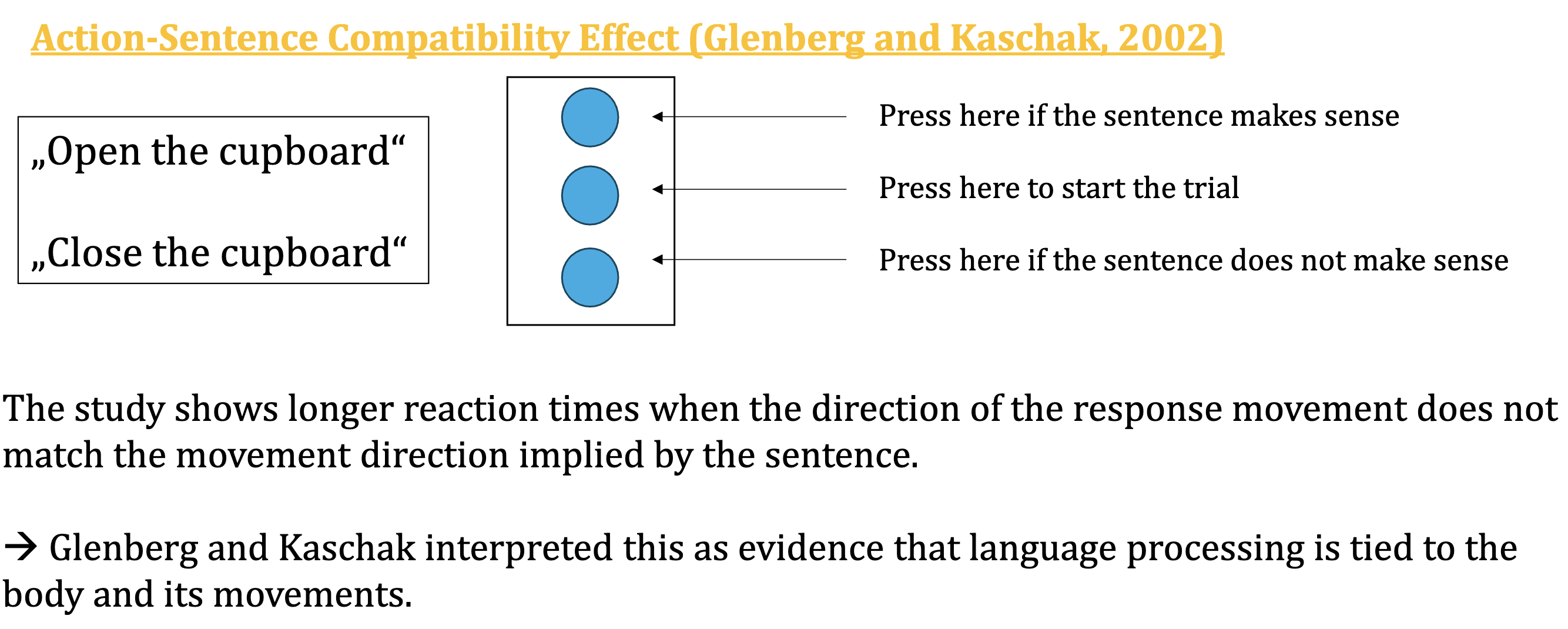
For example, the work of Pulvermüller (2005) shows that understanding certain words involves the activation of relevant action-related brain areas – e.g., when a person hears the word "kick," the sensory-motor areas associated with foot actions are also activated.

Strong Embodiment
The key point here is the role of the body itself. Theories of strong embodiment thus primarily oppose tendencies of brain-centric theories, which consider only the structure of the brain as the determining factor for mental processes.
Why should we assume that the non-brain-based body itself plays such a significant role?
How strong is the role that the non-brain-based body is supposed to play?
Causal Role: Are the contents, structures, and functions of mental processes significantly determined by the nature of our body?
Constitutive Role: Are mental processes constituted solely by processes in the brain or also co-constituted by processes in the body?
→ How can we distinguish between these two? This question will be addressed when discussing the difference between embeddedness and extendedness
Brain-Body Co-Evolution
Brain and body co-developed through human evolution.
Example: Upright Posture
Visual perception becomes more important: our visual range is extended, and the horizon is widened and distanced
Frees the hands for reaching, grasping, manipulating, using tools, and pointing
Free hands allow the use of fire, which influences the human sleep-wake rhythm and their use of low-light day times of day, as well as their social tolerance of others with whom they need to share fire
Action and Mind
Other proponents of the strong embodiment thesis examine how physical changes affect mental processes in real-time
Embeddedness
Our mental states and processes are in a relevant sense co-dependent upon entities beyond brain and body (e.g., objects, persons, structures, events, and processes).
The mind cannot be dissociated from the context in which it expresses itself. For example, human cognition is specialized in solving problems in human-specific contexts
The environment does not merely serve as a trivial background condition. Of course, without oxygen, we could not live and, thus, think, feel, reason, or perceive. However, our focus here is on specific effects where the nature of the environment contributes to shaping the nature of our mind in specific ways.
What matters is not simply that we are passively influenced by our environment. Far more important is that we continuously use, alter, and structure our environment to enable, support, enhance, or regulate specific mental capacities and experiences, both for ourselves and for others.
Mental Rotation Task
Kirsh & Maglio (1994) studied Tetris players to investigate whether interactions with the environment could make certain rotation tasks faster, easier, or more reliable.
The key finding: players often rely on actual rotation in the game, rather than mental simulation, to decide where to place pieces.
Conclusion: Some mental tasks are more efficiently solved through physical interaction with the environment rather than purely internal reasoning.
Human and Technology
Humans appear unique in the complexity, flexibility, variability, and radicality with which they transform their environment (Sterelny, 2018).
This is largely attributed to cumulative learning in social groups, enabling the creation and use of technological tools (Tomasello, 2000).
Scholars like Andy Clark (2004) argue that this capacity is a defining feature of our species, describing humans as "natural-born cyborgs."
Embeddedness & Extendedness
Claims about the environment can be distinguished by means of their strength:
1. Causal Role: The content, structure, and functioning of the mind are significantly influenced by the environment → Embedded Theories of the Mind
2. Constitutive Role: The mind is not only shaped by processes in the brain but is also constituted by processes in the environment → Extended Theories of the Mind
Extendedness
Body and environment (physical and social) are (literally) part of our mind.
The environment does not only shape our mind, but it is a constitutive part of it.
Clark & Chalmers (1998):
Cognition extends beyond ‘skull and skin’
The mind extents into environment
Starting from a Functionalist View
The causal roles that define our mental states are not only realized by the brain.
Bodily and extra-bodily entities can be realizers of mental states when they fulfill the same functional role
→ Extended Mind Hypothesis
→ Multiple realizability beyond the brain
Parity Principle
An element external to the brain can be considered a constitutive part of a mental state if it performs the same functional role as an internal, brain-based component
“If, as we confront some task, a part of the world functions as a process which, were it to go on in the head, we would have no hesitation in accepting as part of the cognitive process, then that part of the world is (for that time) part of the cognitive process.” (Clark & Chalmer, 1998)

Causal-Constitution-Fallacy
How could we empirically distinguish between an external entity being merely causally relevant for a mental process, or being an actual constitutive part of it?
How could we distinguish between cases of embeddedness and extendedness?
Is this a matter of empirical studies, or a conceptual or even normative matter?
Cognitive Bloat
Without the definition of clear boundaries, almost everything might prove to be part of our extended mind: e.g., our smartphones, Wikipedia, Google, …
→ Is this plausible?
→ What are the practical, ethical, and legal consequences?
Social Cognition
Many animals depend on their ability to interact and collaborate with others.
Humans are hyper-social beings: successful social interaction forms a fundamental part of human life
Social cognition characterizes the complex mental processes underlying our ability to understand others and interact with them (≈ mindreading)
How does human social cognition work?
How can we know what other people think or feel?
How can humans usefully predict, interpret, and react to the behavior of others?
Socio-Epistemic Strategies
1) Theory-Based Inference-Making (Theory Theory)
2) Simulation (Simulation Theory)
3) Direct Perception (Interaction Theory)
4) Pluralism (combination of the previous socio-epistemic strategies)
Theory Theory
The capacity to understand others is based on a folk psychological theory that specifies how mental states relate to behavior and other mental states
Mental states cannot be directly observed, but we postulate them to explain and predict the behavior of others.
→ We use our folk psychological theory to systematically infer the mental states of others and anticipate their future behavior
Folk psychological theory
An abstract and coherent system of law-like assumptions, similar to scientific theories
e.g., when people are in situation X, they tend to have the mental state Y and behave in manner Z e.g., ‘thirsty people seek to drink’
Socio-Epistemic Strategy
Inferring the mental states of others and predicting their behavior based on a set of law-like assumptions about the connections between mental states and patterns of behavior
Example:
Imagine you want to travel by bus to the university. You try to find the best time to travel when the buses are relatively empty so that you can properly study. You decide to take the bus half an hour earlier than usual
You hold the general assumption that first-year students desire to sleep as long as possible. Furthermore, you ascribe to them the erroneous belief that they do not need to wait very long at the elevators to reach their class on time. You predict that they will take a later bus.
Child psychology - Gradual Learning
Gopnik & Wellman (1992)
Children develop the ‘Theory-of-Mind’ ability during a constant learning process, similar to progress made by scientists
Children generate general assumptions about unobservable entities, formulate expectations, and adjust their theory in accordance with the evidential data they collect in practice
This finally leads to an abstract and coherent system of law-like assumptions
Support for Theory Theory
A chimpanzee was presented with videotaped scenes of a human actor struggling with a variety of problems: e.g., trying to obtain bananas out of reach
With each videotape, the chimpanzee was shown several photographs, one of which depicted a possible solution for the respective problem
The chimpanzee consistently chose the correct photographs
→ The chimpanzee has a ‘Theory of Mind’: “it recognized the videotape as representing a problem, understood the actor's purpose, and chose alternatives compatible with that purpose.”
Dennett’s Critique
It is unclear if this experiment can actually show whether the chimpanzee engages in the attribution of beliefs and desires
The chimpanzee might only rely on their own beliefs concerning behavioral regularities without attributing any mental state to the agent
What is missing in the experiment is the measurement of false-belief attribution: the attribution of false beliefs to others that differ from one’s own beliefs
False-Belief-Task (Wimmer & Perner, 1983), (Baron-Cohen, Leslie, & Frith, 1985)
Approximately around the age of 4 children pass the ‘false belief task’
Younger children typically give the wrong answer to the question where the protagonist will look for the object.
Traditional Interpretation: Children around the age of 4 years acquire an operational ‘Theory of Mind’
Objection to the False-Belief-Task
Bloom & German (2000): “The false belief test is an ingenious, but very difficult task that taps (only) one aspect of people’s understanding of the minds of others.”
→ If we use an easier test, younger children might already be able to ascribe mental states to others
Gallagher (2004): false belief tests “put us in an observational mode and do not capture the fuller picture of how we understand other people.”
→ Maybe the False Belief Task is not testing for central aspects of social cognition
Simulation Theory
In accordance with Theory Theory, Simulation Theory assumes that social cognition relies on mental state attribution by indirect means
However, not by making theory-based inferences, but by running simulations. We put ourselves ‘into the shoes’ of another person and simulate the beliefs, desires, or intentions that we would have if we were in the respective situation
This is a rather ‘information-poor’ mindreading, as we do not need to rely on an elaborate folk psychological theory, but simply on our own experiences in similar situations
Socio-Epistemic Strategy
What would I think, feel, or do if I were that person in that situation
You are on the bus, and you see a person coming out of their house near the bus stop. The person sees the bus approaching and quickly starts to lock the door
You ascribe to them the desire to catch the bus as well as the belief that they need to hurry up to be at the stop before the bus departs
You further predict that the person will start running as soon as they lock the door
You can do so by imagining what we would believe and desire in the respective situation, and how we would behave in the following
Goldman "Simulating minds" (2006)
To put ourselves into the shoes of another person, we create ‘pretend’ beliefs and ‘pretend’ desires, feed them into your own practical reasoning system, and finally attribute the ‘pretend’ outcome to the other person
“First, the attributor creates in herself pretend states intended to match those of the target.”
“The second step is to feed these initial pretend states into some mechanism of the attributor's own psychology [...] and allow that mechanism to operate on the pretend states so as to generate one or more new states.“
“Third, the attributor assigns the output state to the target (...).”
Support for Simulation Theory
Mirror-Neurons
Class of neurons that is active both during the performance of an action and during the observation of another individual performing this action, first discovered in macaque monkeys
It has been assumed that when we observe someone perform an action, activation in our mirror neuron system simulates the action ‘as if ’ we were performing it. As we internally mimic the other’s action, we have access to the basic goal-directedness of their actions.
Does research on mirror neurons provide support for the Simulation Theory?
Mirror neuron simulation is subconscious and does not involve
a) manipulating ‘pretend’ mental states (beliefs, desires, intentions)
b) understanding the self / other distinction
c) inference or interpretation of any sort
At best, mirror neurons allow for an immediate, automatic, and almost reflex-like understanding of others
Goldman
High-level simulation: conscious use of imagination
Low-level simulation: automatic, unconscious matching process
→ Mirror neurons can only provide evidence for low-level simulation, not high-level simulation
Theory Theory & Simulation Theory
Mental states are not considered to be directly observable, instead they need to be attributed based on some form of cognitive activity
Theory-Based Inference Making → Theory Theory
We infer the mental state of the other person based on a folk theory
Simulation → Simulation Theory
We simulate what we would think, feel, or do in the respective situation
The debate on social cognition was long stuck in the dispute between Theory Theory and Simulation Theory, or combinations thereof.
Limitations of Theory Theory & Simulation Theory
Theory-Theory: To consider inference-making as the only relevant socio-epistemic strategy constitutes an overintellectualization of human social cognition
Simulation Theory: If we understand simulation as a reflective, voluntary process, it might still require cognitive abilities that are too demanding to be ascribed to young infants or animals, for example.
Interaction Theory
Motivation: Observational Stance
Theory Theory and Simulation Theory both assume that we adopt the perspective of an observer in ascribing mental states to others (third-person perspective).
While this perspective is usually adequate in science, it is an exceptional perspective in everyday life. Our requirement for understanding others is most critical when we are dynamically interacting with them (second-person perspective).
→ Humans are frequently involved in second-person interactions
→ We need a more embodied, participatory approach
Motivation: Complexity
According to Theory Theory and Simulation Theory, we rely on complex inferences or simulations to ascribe mental states to others. According to these theories, observational behavior constitutes only the evidential basis for further theoretical considerations. Mindreading relies on the attribution of unobservable mental states
Theorizing and simulation processes are highly demanding in terms of computational complexity, whereas most of our social understanding and interaction seem more basic and ‘smooth’.
→ We need a theory that can account for these more primitive and fluent forms of social interaction
Direct Perception
In many social situations, we do not need to infer or simulate the mental states of others but can directly perceive them based on social cues such as facial expressions, body posture, or gestures.
Smart Perception
The content of our perceptual experience can be rich and include mental phenomena: we can directly perceive the internal states of other subjects
Socio-Epistemic Strategy
You can directly perceive the internal states of others displayed in their overt behavior
As you want to enter the bus, you see a person struggling to get their stroller into the bus. You ascribe to this person the desire to enter the bus with the stroller, the feeling of being stressed out, and the longing for help
You are able to do so as you observe the facial expressions and gestures of the person, enabling you to directly perceive what they feel
You offer your help, and you manage to jointly lift the stroller into the bus
You are able to coordinate your behavior accordingly as you can directly see the motor intentions of the other person based on how their bodily movement
Support for Interaction Theory
Intersubjectivity (Trevarthen & Hubley, 1978); (Trevarthen, 1979)
Primary Intersubjectivity (approx. 2 months)
Early capacity to interact with others based on perceptual processes: we can ‘see’ what other people intend or feel (e.g., facial imitation, detecting eye movement, detecting motor intention, reading emotions from gestures and facial expressions)
Secondary Intersubjectivity (approx. 9 months)
Early capacities are more and more embedded in social and pragmatic contexts. Interaction becomes ‘triadic’ involving an external object or event that can become the focus between people (e.g., joint attention, social referencing)
Tertiary intersubjectivity (approx. 4 years)
Children begin to employ an ethical stance by beginning to manifest explicit rationale about what is right and wrong, as well as explicit attitudes about others’ mental states
Limitations
Interactionists in particular aim to avoid the unnecessary overintellectualization of social cognition and argue for the primacy of interaction-based understanding of others.
However, the method described by Interaction Theory can hardly be the only relevant strategy for human social interaction.
Limits
Understanding people from other cultures
Written communication (e.g., email)
Absent person (e.g., thinking about when other students take the bus)
Complex multi-layered interaction (e.g., deception)
Pluralism
Traditional View: There is only one epistemic strategy underlying social cognition: theory-based inference-making, simulation, or direct perception.
Pluralism: We rely on a multiplicity of (intertwined) epistemic strategies when predicting, interpreting, and reacting to the behavior of others
→ Children acquire and unfold different socio-epistemic abilities during development, and these abilities remain in use during adulthood and influence each other
Advantages of Pluralism
The multiplicity of interrelated socio-epistemic strategies accounts for the complexity and flexibility of human social cognition
Pluralist approaches avoid the limitations of monist approaches that can only explain certain aspects of social cognition
→ Opens up new research lines on when the different socio-epistemic strategies are employed, how they are interconnected, and when they are employed
How we employ different strategies is subject to social biases:
For example, which general law-like generalizations we presuppose and which specific generalizations we rely on is the subject of social biases.
Individuals from different sociocultural backgrounds will show different patterns of employing law-like generalizations (Spaulding, 2017).
When we use different epistemic strategies is subject to social biases as well:
The selection and integration of epistemic strategies is shaped by our goals, such as our motivation to accurately interpret and predict the behavior of other people. What our goals in social interaction are might again depend on our socio-cultural background and the context (Spaulding, 2018).
There are socio-cultural differences concerning the usefulness of employing certain socio-epistemic strategies: e.g., mindreading vs. social roles in North America and China (Lavelle, 2021).
Free will: Ability to do otherwise
An agent could only act free willingly, when they could have acted otherwise: having free will implies alternative options to choose from
Imagine I do not show up for a lecture. Did I do so out of free will? If I just did not feel like it: yes. If I were hit by a bus on my way: no.
The philosophical debate focuses mostly on the question of whether we could have acted otherwise:
→ Are we the actual source of our actions?
→ Are we responsible for our actions?
Tension of Free Will and Determinism
Free Will
Having free implies alternative options to choose from. In order for you to act out of free will, it must be true that you could have done otherwise.
Determinism
In a (physically) deterministic world, every event is necessitated by antecedent conditions and the laws of nature. There is only one possible next state in which the world can be.
If the world is entirely determined by the laws of nature, how can an agent ever act otherwise? If the current state of the world prescribes the future states, there are apparently no options to choose from
→ Does determinism rule out the possibility of free will?
→ Are we forced to choose between a scientifically grounded view of a determined universe and our everyday belief that human beings have free will, and are therefore meaningfully responsible for their actions?
Incompatibilism and Compatibilism
Incompatibilism: free will is incompatible with determinism
a) Hard Determinism: free will does not exist, and determinism is true
b) Libertarianism: free will does exist, and determinism is false
Compatibilism: free will is compatible with determinism
Incompatibilism
Main Idea:
Free will is incompatible with determinism
Free will: having alternative possibilities, the ability to have acted otherwise
Determinism: everything that happens is necessarily the result of what has happened before
Which arguments might speak in favor of incompatibilism?
Consequence Argument
The argument has an ‘if-then’ structure. If determinism is true, then free will does not exist. Or, if free will exists, then determinism cannot be true (e.g. Burglar example)

Hard Determinism
Main Idea:
Free will does not exist, and determinism is true.
Physical Determinism
All physical states only have physical causes.
Together with antecedent conditions, the laws of nature determine the state of the world at any later point in time.
→ Saves basic assumptions of our scientific worldview!
→ Does this imply that we can no longer hold others responsible for their actions?
Moral Responsibility
Yes, we need to give up the idea that humans are in a ‘deep sense’ morally responsible for their actions.
We might still engage in practices of praise and blame, as they can fulfill important social functions
Our legal system is fundamentally based on the idea that we can act free-willingly.
Hard determinism requires a reform of this system (e.g., giving up the idea of retribution).
Punishment must be replaced by prevention: e.g., removing potential criminals from the general public to prevent future harm (similar to an ill person in quarantine).
Libertarianism
Main Idea:
Free will exists and determinism is false
Initial Worries
The most obvious libertarian solution is substance dualism: if mental processes are situated in an immaterial mind, they are not determined by physical facts and the laws of nature and can thus constitute independent causes for our actions
The central idea of substance dualism is commonly considered unscientific, as it contradicts our basic laws of science. Further, it remains unclear how the immaterial mind could interact with the material world and cause certain behaviors.
→ One reason why this position has been hardly defended for a long time
Legal, Moral, & Social Practice
Liberaltarianism saves central intuitions and practices of our legal, moral, and social life
→ Ascription of responsibility, at least with respect to central life decisions
A Compromise between Hard Determinism and Libertarianism?
Hard Determinism: Fits our scientific worldview
Libertarianism: Fits our everyday understanding of moral responsibility
Given the (dis)advantages of libertarianism and hard determinism, compatibilism might appear as a more attractive solution!
Compatibilism
Main Idea:
Free will is compatible with determinism.
Central Move: Reinterpretation of what it means to have free will
Free will does not require the ability to have acted otherwise. (e.g., The Overly Motivated Parent)
→ Thus, at the heart of the debate between compatibilism and incompatibilism lies the question of what free will is – at least, the kind of free will that is relevant for the ascription of moral responsibility
Hierarchical Model of the Will
There is an important distinction between freedom of action and freedom of will
Freedom of Action
To act freely means to be able to do what you want (Can be restricted through external force, bodily impairment, etc.)
Freedom of Will
To have free will means to be able to want what you want
Hierarchical Model of the Will
Human beings, in contrast to infants or many other animals, have second-order desires that are directed at our first-order desires
First-order desire
1. I do not want to go to the gym
2. I want to smoke
Second-order desire
1. I want to want to go to the gym
2. I do not want to want to smoke
Freedom of action is to act according to one’s first-order desires: if the person had desired differently, they would have acted differently
Freedom of will is to have one’s first-order desires align with one’s second-order desires. We act free-willingly when we act on the desires we desire to be effective
→ Freedom of will: Mesh between first-order and second-order desires
→ Simply put: We act freely when we not only have desires but also endorse them: when we want certain desires to guide our actions, and those are the ones that actually do.

Objections to Compatibilism
Manipulation of second-order desires
It only matters whether first-order and second-order desires are aligned, not how a person comes to have this mesh. It does not matter how our second-order desires are determined.
"Imagine that an agent is brainwashed or manipulated through some means or another, say by hypnosis, or by aliens zapping a person into having a different set of psychological preferences than those that she would otherwise have. In all of these cases — just call them manipulation cases—Frankfurt seems committed to the view that such agents act of their own free will and are morally responsible so long as the appropriate psychological mesh is in place, no matter what sort of (merely apparent) freedom and responsibility-undermining history gave way to an agent’s having that particular mesh.” - McKenna & Coates, “Compatibilism”, The Stanford Encyclopedia of Philosophy