VTPB 221 Exam 1
 Call Kai
 Learn
Learn Practice Test
 Spaced Repetition
 Match
Match Flashcards
 Knowt Play
1/110

There's no tags or description
Looks like no tags are added yet.
Name | Mastery | Learn | Test | Matching | Spaced | Call with Kai | Chat |
|---|
No analytics yet
Send a link to your students to track their progress
111 Terms
Pandemic
epidemic of infectious disease spread across multiple continents
Two meanings of medicine
1) Science of Healing
2) Medications, drugs
Australopithecus
(Latin australis "southern", Greek "ape") closely related to the human genus Homo and may be ancestor around 3.5 to 4.9 millions years ago
Lucy
Ethiopia 3.2 million years ago, one of oldest relatives
Australopithecus apheresis
extinct species that lived between 3.9 and 2.9 million years ago
Why humans migrate
population growth
disease outbreaks
drought/climate change
crop failure
Fertile Crescent
modern Iraq, Syria, Egypt, Turkey, Iran
Tigris and Euphrates
two rivers that form the outside border of Mesopotamia
Wheat, Rye, Barley
First grain crops to be domesticated
Pulses (legumes), beans, lentils, chickpeas
Modern agriculture domestication of
Effect of Agriculture
1) Increase in population
2) animal husbandry (zoonoses)
3) social organization
Lethal gift of agriculture
1) communities and crowding
2) decreased variability of plants and animals
3) night soil and manure use - parasitic diseases, bacterial diseases, flies
4) water contamination
5) zoonotic diseases
Geophagy
the practice of eating earth, dirt or clay
Trepanning
Ancient practice where holes were drilled into ill person's head
Release evil spirits
18-25, -40
life expectancy prehistoric
Yarrow, mallow, rosemary, birch polypore
prehistoric medicinal herbs
Shaman
prehistoric Medicine-man in charge of their tribe's health and gathered plant- based medications, carried out rudimentary surgical procedures, and casted spells and charms
Disease
any condition that damages the normal function of the body
Infectious diseases
diseases caused by infections with pathogens (virus, bacteria, fungi, protozoa, helminths)
Causative agents
pathogen that causes infectious disease
Why diseases emerge
how we live, cultural and technological advancements
32, 71
life expectancy in 1900 vs 2021
heart disease, Alzheimers, stroke
three top causes of death in high income country
Miasma Theory
diseases were caused by a "miasma", a poisonous form of "bad air" or "night air" emanating from decaying organic matter- encouraged clenliness
Humorism
Hippocrates "Father of Medicine" began the belief that health was maintained by a balance of the four humors: blood, black bile, yellow bile, and phlegm.
Theory of Contagion
Fracastoro - observing patients with syphilis, proposed that each disease was caused by a different type of rapidly multiplying minute body and that these bodies were transferred by contact, soiled clothing, and air
Antonie van Leeuwenhoek (1673)
Father of Microbiology- invented early microscope and discovered bacteria, sperm cells, blood cells, roundworms
Theory of Spontaneous Generation
Aristotle- life can arise from nonliving matter
Francesco Redi
Italian physician who was the first to attempt to disprove the Theory of Spontaneous Generation; experiment to check whether maggots (baby flies) really came from decaying meat
Lazzaro Spallanzani
showed that a sealed flask of meat broth sterilized by boiling failed to grow microbes
Louis Pasteur
A French chemist who began The Germ Theory by spoilage of wine, developed a process for killing germs by boiling wine and then cooling it down
Robert Koch
Developed the culture plate method to identify pathogens (tuberculosis, anthrax, cholera), discovered microbes cause wounds to go septic, established new Science of Modern Bacteriology
Koch's Postulates
1. A particular microbe must be found in all cases of the disease and must not be present in healthy animals or humans
2. The microbe must be isolated from the diseased animal or human and grown in pure culture in the laboratory
3. The same disease must be produced when microbes from the pure culture are inoculated into healthy susceptible laboratory animals
4. The same microbe must be recovered from the experimentally infected animals and grown again in pure culture
Joseph Lister
introduced antiseptic solution to infection by using carbolic acid as disinfectant
viruses, bacteria, fungi, protozoa, helminths, (prions)
Five major categories of pathogens
Prions
infectious proteins (Kuru, Creutzfeld-Jakob, Mad Cow, CWD)
Viruses
-very small (20-400nm)
-genome DNA or RNA with protein shell and membrance
- need living host
-measles, smallpox, rabies, ebola
Bacteria
- larger, self sufficient, single celled
- prokaryotes
- treated with antibiotics
- part of microbiome
- E. coli, Salmonella, Listeria, Yersinia, Borrelia, Mycobacterium
- tuberculosis, plague, leprosy, cholera, syphilis
Fungi
- eukaryotes
- Yeast: unicellular (Candida)
- Molds: multicellular (Ringworm, Aspergillus)
Protozoa
- eukaryotic
- free-living/parasitic
- need to extract nutrients from host to survive and reproduce
- Plasmodium (malaria), Toxoplasma, Giardia (diarrhea)
Helminths
- eukaryotic
- multicellular, worm-like
- free living/parasitic
- Pinworms, Hookworms, Tapeworms
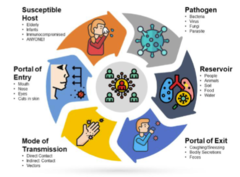
Chain of Infection
infectious agent, reservoir, portal of exit, mode of transmission, portal of entry, susceptible host
Susceptible, Infected but not infectious, Infected and infectious, immune
Types of hosts in infection spread
Asymptomatic (also: silent,inapparent,subclinical)
no symptoms of disease
overt
symptoms of disease
Carrier
individual who is infected with an organism but shows no evidence of disease, although the disease may have been present earlier, and can be a source of infection to others
Reservoir
habitat in which the agent/pathogen normally lives, grows, and multiplies
Methods of disease transmission
- Direct: person to person, droplet
- Indirect: fecal, airborne, fomites
- Vector: insect
Zoonotic Disease
disease that can be passed between animals and humans
Incubation period
interval between initial infection and first signs and symptoms
Latent Period
time from infection to onset of infectiousness or communicability
Infectious period
time during which the host can infect another host
Endemic Disease
infection or disease that occurs regularly at a low or moderate frequency in the human population (common cold)
Epidemic
occurs when there are sudden increases in frequency above endemic levels in the human population
Agent, Host, Environment
epidemiological triad causing disease
The Immune System
-Cells: leukocytes, macrophages, dendritic cells, mast cells
-Tissues: blood, bone marrow, tonsils, mucous membranes
-Organs: lymph nodes, thymus, spleen
-Molecules: antibodies, cytokines, complement
Antibodies, Complement, Cytokines
Plasma molecules immune system
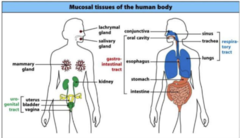
mucosal surfaces or skin
How a pathogen gains access to the body
Physical/mechanical/chemical/microbiological barriers, innate, adaptive
Three layers of body's defense
neutrophils, eosinophils, basophils, monocytesm lymphocytes
immune cells in blood
1st Layer Defense
-Lysozyme enzyme digests cell wall of bacteria
-tears and saliva wash away
-fatty acids in sebum, antimicrobial peptides, microorganisms on skin
-urine flushes
cilia and goblet cell
Mucous defenses in respiratory epithelium
Innate and Adaptive Immunity
Innate - bacteria, viruses, fungi, parasites
Adaptive - unique molecular features of different pathogens
innate immunity
-general types of pathogens recognized
-results in inflammation
-does not cause lasting immunity
-activates adaptive immunity
Adaptive immunity
- specific response
-delayed-at least 5 days
- immunological memory and long lasting immunity
-B cells, T cells, Antibodies, cytokines
Hematopoiesis
process of formation of blood cells from bone marrow derived stem cells
Phagocytosis and Inflammation
Innate Immune Response results in
Cytokines
Chemicals released by the immune system communicate with the brain.
Complement
a part of the immune system that enhances (complements) the ability of antibodies and phagocytic cells to clear microbes and damaged cells from an organism, promotes inflammation, and attacks the pathogen's plasma membrane.
Humoral (Antibody) and Cell-Mediated (T-cell)
Two arms of Adaptive immunity
Humoral immunity
specific immunity produced by B cells that produce antibodies that circulate in body fluids (viruses, toxin bacteria, large parasites)
Cell-mediated immunity
type of immunity produced by T cells that attack infected or abnormal body cells (viruses, intracellular bacteria, fungal)
Antibodies
Specialized proteins secreted by B cells that bind to antigens with high specify
T cell antigen recognition
- requires processed foreign peptides to be present on host cell surface in association with MHC molecules
- MHC molecules influence your ability to produce T cell responses to an antigen

Cytotoxic T cells
kill pathogen infected host cells
Principle of Vaccination
Administration of a formulation to induce pathogen-specific adaptive immunity and memory B and T cell responses
Edward Jenner's Experiment
-pus from cowpox infected milkmaid collected
-used to inoculate boy who gets mild case
-inoculated then with smallpox and is unaffected
Edward Jenner
Father of Vaccinology
Pasteur Fowl Cholera Experiment
Vaccinated chickens with aged cholera bacteria-first attenuated bacterial vaccine
1978
Smallpox eradicated, costing 300 million
2010
Rinderpest eradicated
Herd immunity
The resistance of a group to an attack by a disease to which a large proportion of the members of the group are immune
R0
the number of secondary infections that result from a single infected individual entering a population of entirely susceptible individuals
Live attenuated vaccines
Weakened pathogen
Closely mimic an actual infection
Confers lifelong cellular and humoral immunity
Inactivated vaccines
killed form of pathogen
Subunit vaccines
purified proteins of pathogen
Recombinant vectored vaccines
harmless viruses producing proteins of the pathogen
Nucleic Acid Vaccine
DNA or mRNA coding for protein of pathogen
Effects of Vaccines
-local effects: swelling, sore
-systemic effects: fever, malaise, anaphylaxis
GUILLIAN-BARRE' SYNDROME
Peripheral nerve irritation to the epineurium leads to sensory and LMN losses
Andrew Wakefield
Created a scare through his false scientific research stating the MMR vaccine was linked to autism.
Flu types
-A: humans and animals, moderate to severe
-B: humans, moderate
-C: rarely humans
-D: cattle
Influenza A
-8 RNA segments
-subtypes of HA and NA proteins
Hemagglutinin
One of the enzymes found on the surface of the Influenza virus. It is responsible for binding the virus to the cell that is being infected.
Neuraminidase
One of the enzymes found on the surface of the Influenza virus. It promotes the release of progeny viruses from infected cells.
Type/Origin/StrainID/Year (HANA)
flu naming for human origin
Type/host/origin/strain/year (HANA)
flu naming for non-human origin
water birds
natural reservoir for influenza A with Subtypes H1-H16 and N1-N9
18, 11
Influenza A viruses of humans, mammals, and birds represent combinations of 1 of __ HA subtypes and 1 of __ NA subtypes
H1N1
1918 Spanish Flu