EKG Chapter 1-5 exam questions
 Call Kai
 Learn
Learn Practice Test
 Spaced Repetition
 Match
Match Flashcards
 Knowt Play
1/49

Name | Mastery | Learn | Test | Matching | Spaced | Call with Kai | Chat |
|---|
No analytics yet
Send a link to your students to track their progress
50 Terms
The Apex of the Heart is formed ny the
Tip of the left Ventricle
the left atrium receives blood from the
Pulmonary Vein
The Heart is divied into ____ chambers but functions as a ___ sided pump
Four;two
Blood Pressure is determined by _____ multiplied by ____
cardiac output; peripheral vascular resistance
The right atrium recives venous blood from the head, neck, and thorax via the ___, the remainder of the body from the ____and from the heart via the _______.
superior vena cava; inferior vena cava; coronary sinus
the intrinsic rate of the atrioventricular (AV) node is
40-60 bpm
______ is the ability of the cardiac pacemaker cells to spontaneously initiate any electrical impulse without being stimulated from another soruce, such as a nerve
automaticity
The normal pacemaker of the heart is the node, which is found in the _____ atrium and has an intrinsic firing rate of _____ beats/min
sinoatrial (SA); right; 60-100
On the ECG, what is the first negative deflection seen after the p wave
Q wave
on the ECG the T wave represents
Ventricular Repolarization
The rate of Sinus Tachycardia is _____ beats/min
faster than 100
An ECG rhythm strip shows a ventricular rate of 46 beats/min, a regular rhythm, a PR interval of 0.14 seconds, a QRS duration of 0.06 seconds and one upright P wave before each QRS. This rhythm is __________.
sinus bradycardia
PR interval of 0.16 seconds, a QRS duration of 0.08 seconds, and one upright P wave before every QRS. This rhythm is sinus ______
Tachycardia
The rate of a Sinus rhythm is ____ beats/min
60-100
the rate of sinus bradycardia is ___ beats/min
slower than 60
How are frequent PACs usually managed?
correcting the underlying cause
identify the following rhythm (lead II)
sinus rhythm with a PAC
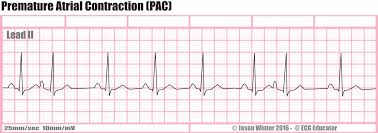
Upon conversion of atrial fibrillation to sinus rhythm, the patient should be observed for signs of a possible stroke
true
Identify the following rhythm
Atrial Flutter
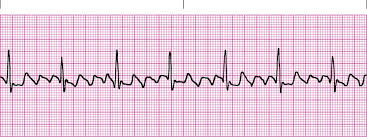
P waves in this sinus rhythm strip ____
vary in size and shape
A beat originating from the AV junction that appears later than the next expected sinus beat is called a ____
junctional escape beatPr
common causes of acute junctional dysrhythmias include acute coronary syndromes and ________.
digitalis toxicity
Which oif the following medications increases heart rate by accelerating the SA node and blocking the vagus nerve?
Atropine
Identify the following rhythm (lead II)
Accelerated Junctional Rhythm

Identify the following rhythm (lead II)
Sinus tachycardia with premature junctional complexes
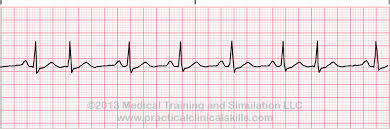
Whta is the function of the right Atrium?
Receives Blood
Which is a branch of the left coronary artery?
Circumflex
A conduction problem above the level of the bundle branches lagerly affect the P wave and PR interval
True
The period of time during the cardiac cyclewhen the cells cannot respomnde to a stimulus, no matter how strong, is the relative refractory period
False: its the ACTIVE relative refractory period
Indivduals with Preexcitation syndrome are predisposed to tachydysrhythmias
True
IF the wave of depolarization (electrical impulse) moves towards the3 positive electrode, the waveform recorded on ECG graph paper will be upright (Positive deflection)
True
The thick, muscular middle layer of the heart wall that contains the atrial and ventricular muscle fibers necessary for contraction is the ____.
Myocardium
Blood flows from the right atrium through the _____ valve into the right ventricle.
Tricuspid
Which of the following are semilunar valves?
Pulmonic and Aortic
Multifocal atrial Tachycardia is another name for atrial fibrillation
False
A junctional escape rhythm occurs because of
Slowing of the rate of the heart’s primary pacemaker
The usual rate of nonparoxysmal junctional tachycardia is ______ beats/min.
120-140
The atrioventricular (AV) junction consists of the
AV node and the non branching porton of the Bundle of His
If seen the P wave of a rhythm originating in the AV junction will appear _____ in Lead II
inverted
WHich of the following may cause a sinus bradycardia?
Hypothermia
Which of the following corrects describes multifocal atrial tachycardia?
Atrial and ventricular rhythms are irregular
The most common type of supraventriculae tachycardia (SV) is ___/
AV nodal reentrant tachycardia (AVNRT)
Which of the following are possible causes of sinus tachycardia?
Fever, pain, anxiety
Leads I, aVL, V5, and V6 veiw the ______ surface of the left ventricle
Lateral
The absolute refractory period begins with the onset of the ____and terminates ____.
QRS complex; at approximately the apex T wave
The QT interval is measured from the beginning of the ____
ORS complex to the end of the T wave
In an adult, the normal duration of the QRS complex is _____.
0.10 seconds or less
The intrinsic rate of the Purkinje fibers is ____ beats/min
20-40
The intrinsic rate of the SA node is ___ beats/min.
60-100
On the ECG, the time necessary for the speed of an electrial impulse through the AV node, bundle of His, right an left bundle branches, and the Purkinje fibers is reflected by the
PR segment