AURLTA101 (engine fundamentals)
 Call Kai
 Learn
Learn Practice Test
 Spaced Repetition
 Match
Match Flashcards
 Knowt Play
1/24

Earn XP
Description and Tags
automotive mechanical systems
Name | Mastery | Learn | Test | Matching | Spaced | Call with Kai | Chat |
|---|
No analytics yet
Send a link to your students to track their progress
25 Terms
key principle of an engine
conversion of chemical energy to mechanical energy
explosion generates force to move rotating assembly in order to generate power (crankshaft)
List the Petrol OTTO cycle and piston / valve movement
intake - piston moving from tdc to bdc , intake valve opens at tdc and closes js after bdc
Compression , piston moving from bdc to tdc all valves closed
Power - piston nearly tdc , explosion forces piston back towards bdc
exhaust - piston moves from bdc to tdc to expel gases whilist exhaust valve open
what happens to valves after the end of one 4 stroke cycle
Valve overlap: exhaust and intake valves stay open simultaneously to allow for a vacuum to be created so the cycle can be repeated
exhaust gases being expelled creating a vacuum to draw the new AFM in
key events of the otto cycle
intake - AFM drawn in as piston moves down
Compression - AFM compressed as piston moves up
Power - Ignition of afm forces the piston back down, turning the crankshaft
exhaust - as piston goes back up, exhaust gases are expelled
list the formula
calculate total displacement of a V8 engine with a stroke length of 186mm and radius of 186mm
Pi R squared X stroke length
total displacement = Ans(number of cyl)
type answer
define bore and stroke
bore - the radius of the cylinder
stroke - the length of travel of the piston (or the depth of the cyl at BDC)
list the formula
calculate the compression ratio of an engine with a swept volume of 325 and a clearance volume of 75
(swept volume plus clearance volume) divided by clearance
(325 + 75) / 75 = 5.3
5.33:1
why are compression ratios important for a car
they determine the hardness of motor components as well as the fuel economy and power output
Anatomy of Overhead valve trains
A tappet (lifter) - consists of a spring and a cap , its purpose is to transfer motion from the cam lobes to actuate rocker arms
rocker arm ,- acts as a linkage to valve lifters to valves on top
valves - open and close the ports
why are OHC better than ohv
less moving parts - no rockerarm needed
directly driven by cam gears , so more efficent
lead , lag , overlap
refers to valve positions in respect to eachother
lead - the valves open before tdc / bdc
lag - valves remain open for a short time after
overlap - valves are briefly open at the same time
what happens to the crankshafts rotation as it gets closer to tdc / bdc
the crankshaft has to travel more degrees for leverage in order to move the piston
characteristics of two stroke engines
has ports instead of traditional valves
no camshafts
the piston skirting seals against ports acting as a valve
Afm is compressed twice before ignition / power
simmilar to rotaries
Two stroke anatomy
Ports:
intake port , trasnfers AFM into the crank case
transfer port , transfers crankcase afm into coombustion chamber
exhaust port , transfers expent afm out of the exhaust
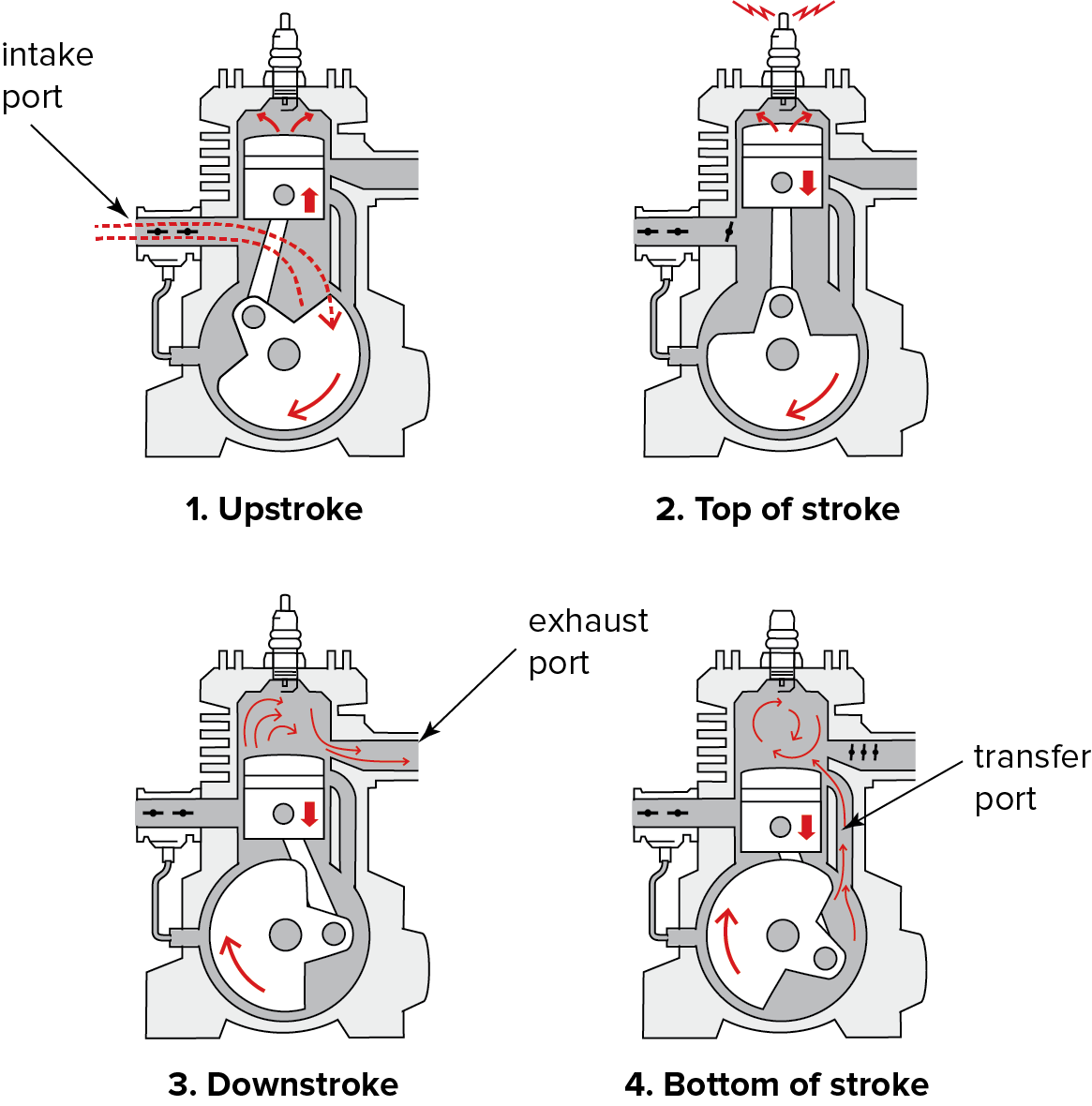
two stroke cycle
up stroke , piston moving towards tdc ,compressing combustion chamber afm , drawing in crank case afm
top stroke , ignition of chamber afm , intake port convered drawing afm into crankcase
downstroke, piston forced down as a result of ignition , passing / uncovering the exhaust port , exhausting the spent gases , downward pressure compresses crank case afm to make it suitable for transfer to chamber
bottom stroke
crankcase situated afm drawn into chamber, whilist exhaust port is still opened , most gases excaped
reed valve purpose
1 way valve that lifts up whilist piston is moving up , which causes low pressure creating a vauum to let afm in
rotary engine anatomy
Eccentric shaft - serves as a crankshaft, which has eccentric lobes which allow the rotor to move in an eccentric pattern around the housing
rotor , the piston of the rotary engine , rotates and serves to push afm around the rotor housing
seals - they are on each rotors verticies and seal against the rotor housing
rotary anatomy
no camshaft (like two strokes)
has the main rotor to seal against ports (like a two stroke)
no crankshaft - has a eccentric shaft
has 3 seals to mate the surface between rotor and housing
2 spark plugs for each rotorhousing
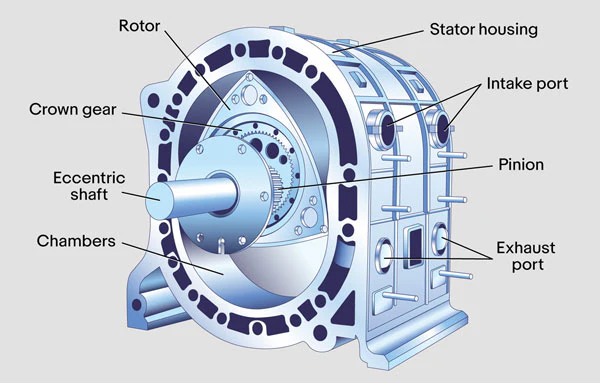
rotary engine cycles
*cycle happens in a clockwise direction
Intake
Afm is introduced through the intake port and is pushed by one vertex / flank of the rotor towards the right side of the housing
Compression
at the right side of the housing , the rotor face compresses the pushed afm between the rotor face and the rotor housing - making it suitable for combustion
Expansion/ power
compressed afm ignited twice (by leading and trailing plugs) as fuel makes it past unbornt,
the gases force push against the rotor face, driving it clockwise towards the exhaust port
Exhaust
the rotor face pushes the spent gases through thhe exhaust port, which is on the same side as the intake port
5 rotary characteristics (disadvantages)
challenges
Sealing: the seals on the tip of the rotor are constantly in contact with the rotor housing, no lubrication = wear
Thermal management: rHigh RPM = high heat , this heat can thin the oil and worsen lubrication
Low torque as lacks mechanical leverage of conventional ice,
rotaries get raped by knock.
5 Rotary characteristics (advantages
High volumetric efficiency
lacking small conventional valves, they can cram more AFM through the intake port. this is good for smoother higher rpm power
Power to weight
their engines produce alot of power for very little weight and size making most applications lighter and less cramped.
simple
less moving parts compared to conventional engines, making them easier to assemble
Fueling (performance applications)
can handle alternative fuels alot better, making them highly versatile
Knock
exceptionally devestating as force is directly trasnferred onto seals, which can instantly ruin the motor, this also makes it hard to knock test a rotary when tuning
Four stroke diesel characteristics
utilises compression ignition - a form of spontaneous combustion , ignition occurs without a spark plug
same anatomy as piston engines, except running higher compression ratios
valves overlap significantly less due to small clearance volume
valves stay open for less time to build compression
heavier than petrol counterparts as parts are more denser/ durable to handle the higher comp
they have shorter stroke for more torque
four stroke diesel cycles
intake - intake pure air as piston moving to BDC , which is then full of air
compression , just after bdc intake valve closes to begin high compression of air
power
piston is moving towards tdc , compressing air, then just before tdc, fuel charge sprayed to mix with air , afm ignites from high heat and pressure.
after bdc, piston pushes spent afm out exhaust valve.
Engine configurations
Inline
cylinders are lined up , block can be slanted slightly to accomodate room
V Bank
2 angled 90 degree banks, with each bank contain cylinders paralell to eachother
wider and shorter compared to inline
W bank
2 v engines combined to form a total of 4 individual bankse-
2 outermost banks are typically 72 degrees apart, whereas inner and outer banks on their respective side are 15 degrees apart
crams more cylinder into a smaller space, negating size concerns
compactness introduces simmilar concerns to rotaries (except for sealing
boxer
flatt engines with cylinder banks 180* apart.'
wider and lower, offering a better balanced engine and lowering the vehicles center of mass
servicibility is compared with rotary engines, as crucial maintenance such as belt changes or gasket removal becoming tedious
Over square vs under square
Oversquare
bore diameter bigger than piston stroke,
good for high rpm application requiring alot of speed, as crankshaft doesnt need to rotate as much to generate power
produces less leverage as crankshaft isnt turning conrods that far , lower torque
Undersquare
bore diameter smaller than piston
good for high torque applications
requires more effort for crankshaft to turn the piston between dead centers.