biology ch. 4
 Call Kai
 Learn
Learn Practice Test
 Spaced Repetition
 Match
Match Flashcards
 Knowt Play
1/88

There's no tags or description
Looks like no tags are added yet.
Name | Mastery | Learn | Test | Matching | Spaced | Call with Kai | Chat |
|---|
No analytics yet
Send a link to your students to track their progress
89 Terms
what does deoxyribose directly translate to?
lacking oxygen
what is a nucleoside
a combination of a sugar and base
what do nucleoside triphosphates do
they are the molecules that are used to form DNA and RNA
what is a phosphodiester bond
links the backbone of DNA together
what is a 5’ end and a 3’ end
5’ end is the end where the nucleotide at the top has a free 5’ of the sugar
then the 3’ end is the end where the nucleotide at the bottom has a free 3’ of the sugar
what gives the dna strand polartity
the phosphodiester linkages and the differences in the 5’ end v.s the 3’ end
are the strands in a double helix parallel
no, they are anti parallel, meaning the 3’ end of one strand is always opposite the 5’ end
dna is always built
5’ to 3’
what bonds hold nucleic bases together
hydrogen bonds
2 between A&T
3 between C&G
base stacking
the interactions between bases and the same strand of DNA. occurs bc the nonpolar, flat surfaces of the bases tend to group together away from water molecules and end up stacking on top of each other as tight as possible
DNA polymerase
makes the daughter stands of DNA from the parent strands
what unzips DNA
helicase
is and expressed gene turned on or off?
on
where do transciption and translation occur in prokaryotes? what about eukaryotes
the cytoplasm in prokaryotes, in eukaryotes the processes are spatially separated
whats so special about how eukaryotes transcribe and translate in different areas
it allows for additional levels of gene regulation no possible in prokaryotes
is the sequence of the bases on a single strand of dna regulated?
no, this allows for tons of diversity
are RNA molecules longer of shorter than DNA?
shorter
can RNA molecules fold
yes they can fold into complex 3D structures
at the begining of time what what the original nformation storage molecule?
RNA
is RNA a catalyst?
yuh
is RNA more or less stable than DNA?
less
RNA polymerase
builds RNA
what is the strand of DNA copied to make mRNA called?
the template strand
stages of transcription
initiation
elongation
termination
initiation stage of transcription
RNA polymerase and other proteins are attracted to double-stranded DNA, RNA polymerase is then binded to the promoter and DNA is opended up
elongation stage of transcription
successive nucleotides are added to the 3’ end of the growing RNA transcript as the RNA polymerase proceeds along the template strand
the actual process of the mrna being made
termination stage of transcription
the RNA polymerase encounters a sequence in the template strand that causes transcription to stop and the RNA transcript to be released
basically just when it stops
which what is the DNA read to make RNA and which way is the RNA built
they are made antiparallel to each other
DNA is read 3-5, RNA is built 5-3
what are the codes for stop and start regarding transcription in DNA
the promoter (start) and the terminator (end)
TATA box
its a promoter
A DNA sequence present in many promoters in eukaryotes and archaea that serves as a protein-binding site for a key general transcription factor.
sigma factor
A protein that associates with RNA polymerase that facilitates its binding to specific promoters.
recognizes the sequences in the promoter, directs the RNA polymerase to the start of the gene by binding to the promoter and opens the DNA
after this the sigma factor can fall off, it’s not needed for elongation, just initation
general transcription factors
A group of proteins that binds to the promoter of a gene whose combined action is necessary for transcription.
helps RNA polymerase to find the gene and say like “hey transcibe me!”
transcriptional activator protein
A protein that binds to an enhancer to enable transcription to begin.
gene specific, will determine if a gene is turned on or off. far upstream from the promoter
recruits mediator complex

enhancer
A specific DNA sequence located upstream, downstream, or within a gene that is necessary for transcription.
mediator complex
A complex of proteins that interacts with the Pol II complex and allows transcription to begin.
recruits rna polymerase
pol II
protein coding genes
what is the final thing that needs to happen before transcription is initiated
When the mediator complex and Pol II complex are in place
how does RNA polymerase work?

4^n
how many ways you can put nucleotides together
is RNA more or less flexible than DNA?
more, due to being single stranded
nucelotide vs nucleoside
nucleotide= phosphates
nucleoside= no phosphates
where does the energy come from to make rna
the RNA nucleotides have 3 phosphates, 2 are broken off when the RNA is synthesizes. the breaking of those phosphates creates energy
exon
protein coding reigion
intron
noncoding region
purpose of the 5’ cap and the 3’ tail
protection and facilitate translation
splicing
removal of introns
translocating
moving stuff around the cell
what is the 5’ cap made of
basically, a modified GTP that has been put on backwards
binding site for ribosomes for translations
what does splicing
splicsosomes, complex of proteins and small RNAs
is snRNA ever translated into proteins?
no
how many genes in a human cell
20000
how many proteins made from the genes in a cell
70000
types of RNA’s and their functions
informational: mRNA
functional: snRNA- small nuclear RNA
4 levels of protein structure
primary: the order of the amino acids
secondary: the coils and folds due to hydrogen bonds between atoms in the backbone
tertiary; interactions among the side chains of the protein and the exclusion of hydrophobic residues by water causing it to curl more
quaternary: interaction of multiple polypeptides to form a functional protein
2 types of secondary structure
alpha helix, beta sheets
what is denauturing of a protein? how does it happen?
protein unwinds, caused by change in PH, salt concentration, temperature,
denature= protein no longer work
chaperone proteins
help proteins fold properly and prevent inappropriate aggregation

what energy drives the reaction of transcription
GTP
what is the start codon
AUG
what is tRNA
the translator
helps carry the amino acids to the ribosomes
ribosomes structure
consist of 2 subunits
consist of 20-50 proteins and 1-3 rRNAs

3 binding sites for tRNA
Aminoacyl site
• Peptidyl site
• Exit site

anticodon of tRNA
pairs with a matching codon on mRNA
ex: if the mRNA is AUG the tRNA anticodon is UAC, it binds and brings methienine and brings it to the ribosome
three stages of translation
Initiation
• Elongation
• Termination
translation in eukaryotes
initiation factors bind to the 5’ cap then recruit the small subunit and the met-tRNA
small subunit moves 5’ to 3’ until the P site is centered over the first AUG
The ribosome large subunit then binds to the small subunit forming the complete enzyme
translation initiation in prokaryotes
The ribosome small subunit binds to an internal RNA
sequences known as the Shine-Delgarno sequence
• A met-tRNA binds to the P site and then the large
completes the initiation complex
• The ribosome moves to the next AUG on the mRNA

shine delgarni
the small ribosome subunit that binds to internal RNA sequences in prokaryotes
Monocistronic mRNA
Codes for one polypeptide
• Eukaryotes
Polycistronic mRNA
Codes for more than one polypeptide
• Prokaryotes
elongation

what are the binding sites on mRNA and what do they do
A= the new tRNA enters here and brings the next amino acid that matches the mRNA codon
P= carries the growing protein chain
E= the tRNA that has already dropped off its amino acid moves here and then it leaves the ribosome
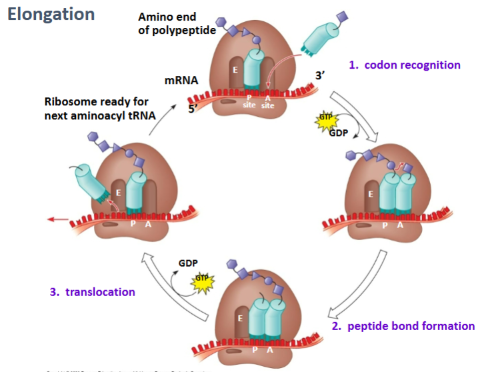
how does termination of translation work?

polyribosomes
A number of ribosomes can translate a single mRNA
simultaneously, forming a polyribosome (or polysome)
a bunch of ribosomes translating the same mRNA at the same time for efficiency purposes
tRNA
Charging
Amino acids are
added to tRNAs by
highly specific and
accurate enzymes
called tRNA
synthetases
• Most cells have one
tRNA synthetase for
each amino acid
• Fidelity is extremely
importan
what does tRNA synthetase do?
makes sure the correct amino acid is bound to the right tRNA
what is the bond that holds a water molecules together?
polar covelant bonds
frederick griffith
did the virulent mouse experiment that showed dna transformation
nice bacteria + mouse= live
bad bacteria + mouse = die
killed bad bacteria + mouse= live
killed bad bacteria + nice bacteria= dead mouse
killed bad bacteria left behind its dna and gets recovered by the nice bacteria that copies it
showed dna is the genetic material because if the DNA of the bad bacteria was destroyed the mouse would live
3 parts of a nucleotide
phosphate group
sugar
nitrogenous base
pyrimidine always pairs with
a purine
What kind of bonds hold the two strands of DNA together?
hydrogen bonding
abreviation for any base
dNTP or NTP
nucleotide abbreviations
adenine dATP ATP
guanine dGTP GTP
cytosine dCTP CTP
thymine dTTP
uracil UTP
where does the energy used to bind nucleic acids come from
the energy stored in the nucleotide’s phosphate bonds
sigma factor
directs the RNA polymerase
to the start of the gene by binding to the
promoter and opens the DNA duplex
Energy to drive RNA
synthesis comes from
the hydrolysis of the
NTPs
spilcing
(removal of
introns)
which end of mRNA has the cap?
5’
Spliceosome
A
complex of proteins
and small RNAs that
splice the exons
togethers
what does alternative splicing do?
allows the cell to make more that one protein for each gene