Emerging Infectious Diseases Exam One
 Call Kai
 Learn
Learn Practice Test
 Spaced Repetition
 Match
Match Flashcards
 Knowt Play
1/48

There's no tags or description
Looks like no tags are added yet.
Name | Mastery | Learn | Test | Matching | Spaced | Call with Kai | Chat |
|---|
No analytics yet
Send a link to your students to track their progress
49 Terms
A state health department tracks an arbovirus through a single reporting system which combines human case reports, dead bird submissions, sentinel chicken serology, and mosquito trapping. which One health principle does this design put into practice, and what does it provide that human case reporting alone does not?
→ It puts food safety oversight to the farm-to-table chain into practice, and it provides a record of pathogen movement through animal food systems before those products reach human consumers.
→ It puts into practice the principle that federal health recommendations should be legally binding on local jurisdictions, and it provides the enforcement authority that voluntary human case reporting lacks
→It puts integrated surveillance across the human, animal, and environmental sectors into practice, and it provides detection in animals and vectors that can register before or alongside the first human cases
→It puts a standardized method for measuring the holistic benefits of one health into practice, and it provides the quantitative cross-sector indicator that the approach has otherwise lacked
It puts integrated surveillance across the human, animal, and environmental sectors into practice, and it provides detection in animals and vectors that can register before or alongside the first human cases
A National rabies program spends its budget on mass vaccination of domestic dogs rather than on wider distribution of post-exposure prophylaxis for people. Within the spillover framework, which determinant does this choice act on, and why does acting there work?
→It acts on human susceptibility, because vaccinating the animal reservoir cross-primes the adaptive immune response of people living alongside those animals and raises the dose required to establish infection
→It acts on environmental persistence, because an unvaccinated dog population maintains a reservoir of virus in soil and water that vaccination clears from a shared environment
→It acts on the dose-response relationship, because a vaccinated dog that does bite delivers a smaller quantity of virus in its saliva and therefore a lower inoculum to the person bitten
→It acts on pathogen pressure, because it lowers the amount of virus circulating in the reservoir population and so reduced reservoir to human transmission before any person is exposed
→It acts on the pathogens capacity for sustained transmission, because fewer human infections means fewer opportunities for the virus to adapt to efficient person to person spread
It acts on pathogen pressure, because it lowers the amount of virus circulating in the reservoir population and so reduced reservoir to human transmission before any person is exposed
A district clears several thousand hectares of forest and replaces it with high-density commercial pig production. Lecture 01 places intensive agriculture among the environmental drivers of emergence. Mechanistically, what does intensive farming contribute that makes it a drive rather than simply a change in land use?
→It accelerates the intrinsic mutation rate of any pathogen introduced to the herd, because livestock body temperature and metabolism differ enough from those of wild reservoir species to destabilize pathogen genomes
→It removes reservoir species from the surrounding landscape, which lowers total pathogen diversity in the region and therefore concentrates whatever pathogen remains into the human population
→It assembles a large, dense, and uniformly susceptible animal population in which a pathogen arriving from wildlife can amplify, which is why the framework links intensive farming to Nipah virus, avian influenza and antimicrobial resistance
→It raises the economic standing of rural workers, so the framework counts it as a socioeconomic rather than an environmental driver and treats it disease effects as secondary to poverty reduction
→It shortens the duration of infectiousness in individual animals, because commercial herds receive prophylactic treatment, and this lowers pathogen pressure at the human-animal interface
→It assembles a large, dense, and uniformly susceptible animal population in which a pathogen arriving from wildlife can amplify, which is why the framework links intensive farming to Nipah virus, avian influenza and antimicrobial resistance
In an outbreak of encephalitis, nearly all cases are workers on a commercial pig farm. The same virus is later recovered from fruit bats roosting in orchard trees that overhang the pug pens, yet no patient reports any contact with a bat. Which transmission pathway does this pattern indicate, and what follows for control?
→An intermediate vertebrate host route, in which the virus amplifies in a domestic animal before reaching people, so the pigs are the accessible point of intervention between the bat reservoir and the workers
→A direct transmission route from the reservoir, in which the absence of reported bat contact reflects unrecognized nocturnal exposure, so control should center on excluding bats from human sleep quarters
→An arthropod vector route, in which an invertebrate bridges bats and humans, so control should center on insecticide treatment of the orchard and the surrounding farm buildings
→An environmental route, in which virus shed into water and soil is acquired through contact, so control shoulder center on decontaminating farm surfaces and treating the water supply
→Sustained human to human transmission is already established among the workers, since a cluster confined to a single occupational group is the signature of person to person rather than repeated introduction
→An intermediate vertebrate host route, in which the virus amplifies in a domestic animal before reaching people, so the pigs are the accessible point of intervention between the bat reservoir and the workers
A funding agency proposes to concentrate zoonotic surveillance in the worlds largest cities, reasoning that spillover risk should rise wherever the greatest number of people is available to be infected. Which finding from the global hotspot analysis presented in lecture 01 argues most directly against that reasoning?
→Around 75 percent of emerging infectious diseases are zoonotic in origin, which shows that surveillance resources belong with animal populations rather than with any particular category of human settlement
→International travel and trade allow a pathogen to reach the entire world within weeks, so a pathogen emerging anywhere will appear in large cities regardless of where surveillance has been placed
→Emergence events have risen by decade and are driven by several distinct causes, so no single geographic targeting rule should be expected to capture the majority of future events
→Bushmeat hunting and the domestication of animals both create sustained contact at the human-animal interface, and both practices are found in rural and urban settings alike
→Human population density entered the hotspot model as a negative predictor while evergreen broadleaf tree cover was positive, so remote areas of recent human encroachment into tropical forest carried a higher risk
Human population density entered the hotspot model as a negative predictor while evergreen broadleaf tree cover was positive, so remote areas of recent human encroachment into tropical forest carried a higher risk
A public briefing describes R0 as the transmissibility of the virus itself, a fixed value that can be looked up for any pathogen. Which observation provides the strongest evidence against that description?
→The same pathogen yield different R0 values in different populations and settings, because the quantity is calculated under assumptions of full susceptibility and homogenous mixing that real populations violate to differing degrees
→R0 values differ widely between pathogens, from roughly 12 to 18 for measles down to roughly 1.5 to 2.5 for ebola, which shows how much transmissibility varies across the pathogens that have been studied
→Published R0 values are usually reported as a range rather than as a single figure, which reflects the uncertainty in the case data available while an outbreak is still under way
→The threshold at an R0 of 1 separates outbreaks that grow from those that die out, which gives the number a clear and testable epidemiological meaning in any population
→R0 is denied for a fully susceptible population, so it is fixed before an outbreak begins and is assumed in advance from laboratory measurements of the pathogen rather than estimated from case data
The same pathogen yield different R0 values in different populations and settings, because the quantity is calculated under assumptions of full susceptibility and homogenous mixing that real populations violate to differing degrees
Lecture 02 groups rabies, most human H5N1 infections, and Hendra virus together as one spillover outcome, and groups HIV, SARAS-COV-2, and measles as the other. What separates the two groups?
→Whether the pathogen reaches people through an arthropod vector or through direct contact with the reservoir species, since a vector-borne pathogen depends on the invertebrate to move between hosts
→Whether the pathogen, having infected a person, then transmits from that person to others, or infects the individual without spreading within the human population
→Whether the infection produces severe disease in the human host, since pathogens that kill quickly fall into the first group and those causing milder illness into the second
→Whether the pathogen persists in the environment outside a host, since environmental survival is what allows a pathogen to reach enough people to sustain a chain of transmission
→Whether an intermediate vertebrate host was involved, since amplification in livestock is what converts a single introduction into a self-sustaining human outbreak
Whether the pathogen, having infected a person, then transmits from that person to others, or infects the individual without spreading within the human population
A new antiviral shortens the period over which a treated patient sheds virus from about ten days to about four. It leaves the probability of transmission per contact unchanged, and treated patients report the same number of daily contacts as before. Using the formulation of R0 given in lecture 04, how does this drug change r0, and through which term?
→It leaves R0 unchanged, because R0 is a property of the pathogen rather than of the treatment given to individual patients, so a drug can alter observed case counts without altering the reproduction number
→It lowers R0 by acting on D, the duration of infectiousness, and since R0 is the product of transmission probability, contact rate, and duration, cutting the infectious period cuts R0 in proportion
→It lowers R0 by acting on Beta, the transmission probability, because a patient who clears virus sooner necessarily transmits less efficiently during each contact that occurs while shedding continues
→It lowers R0 by acting on c, the contact rate, because a shorter illness returns the patient to normal activity sooner and so shifts contacts into a period when that patient is no longer infectious
→It raises R0m because treated patients feel well enough to circulate while still infectious, and that increase in effective contacts outweighs the shorter shedding period
It lowers R0 by acting on D, the duration of infectiousness, and since R0 is the product of transmission probability, contact rate, and duration, cutting the infectious period cuts R0 in proportion
Over three weeks on a single hospital ward, carbapenem resistance appears in Klebsiella, E.Coli and Enterobacter isolates taken from different patients. The same resistance gene is recovered from all three species carried on a large plasmid. Which mechanism best accounts for this pattern?
→Spontaneous point mutation under antibiotic pressure in each of the three species, since carbapenem exposure on the ward selects independently within every bacterial population it reaches
→Transformation, in which the three species took up free resistance DNA released into the ward environment by dead bacteria, a route that requires no contact between donor and recipient cells
→Induction of a resistance that all three species already carried, since sustained antibiotic exposure switches on genes that stay silent while the drug is absent
→Conjugation, the direct cell-to-cell transfer of a resistance plasmid through a pilus, which moves an intact gene between cells and across species and is the usual route for rapid spread of resistance genes
→Transduction, in which a bacteriophage packed the resistance gene and carried it between species, since phage host range on a hospital ward is broad enough to bridge unrelated genera
Conjugation, the direct cell-to-cell transfer of a resistance plasmid through a pilus, which moves an intact gene between cells and across species and is the usual route for rapid spread of resistance genes
A country holds one of the lowest rates of human antibiotic consumption in Europe, yet its veterinary antibiotic use has been historically high, and resistance rates in its human population, although low, are gradually rising. What does this combination establish about where selection is happening, and what follows for policy?
→That resistance in this setting is intrinsic to the bacterial species involved rather than selected by drug exposure, so policy should move away from restricting use and toward developing replacement compounds
→That veterinary antibiotics exert their selection within pathogens confined to animal hosts, so the rising human rates are better explained by importation of resistant strains through travel and trade
→That human prescribing figures are unreliable as a measure of true consumption, so policy should first invest in better human surveillance before any conclusion about agriculture can be drawn
→That restriction of human consumption has already succeeded, and that the gradual rise simply reflects the expected lag before restrictive prescribing products a measurable fall in resistance
→That selection pressure applied outside the human healthcare system, in animals and the shared environment, reaches human populations, so restricting human prescribing alone is insufficient and agricultural use must be addressed at the same time
That selection pressure applied outside the human healthcare system, in animals and the shared environment, reaches human populations, so restricting human prescribing alone is insufficient and agricultural use must be addressed at the same time
What is a positive and negative predictor for a zoonotic EID hotspot?
Positive predictor: evergreen broadleaf tree cover (tropical rainforest), representing high wildlife-pathogen diversity
Negative predictor: human population density, counterintuitively, remote areas with recent human encroachment pose higher spillover risk
→Global hotspot analysis reveals that the highest risk of zoonotic EIF events correlates with tropical forest regions and areas of high wildlife diversity
What are some examples of the human-animal interface?
Hunting & Bushmeat: Historically linked to zoonotic EIDs (ebola, Marburg). This trade in developing countries remains a risk
Domestication: Bridging the gap between wild and human populations, increased pathogen transmission dynamics (Taenia tapeworm)
Occupational exposure: Farmers, veterinarians, and slaughterhouse workers face elevated exposure. H5N1 in U.S dairy cattle is current example
What are some environmental drivers of emergence?
Climate change: Altered weather patterns affect pathogen reproduction, survival, and vector distribution. Particularly impacts vector-borne and waterborne diseases
Deforestation and land use: Habitat conversion increases contact between humans and reservoir hosts carrying novel pathogens
Agriculture: Intensive farming creates conditions for pathogen amplification, linked to Nipah virus, avian influenza and antimicrobial resistance
What are some socioeconomic and behavioral factors that drive infectious diseases?
Poverty and Displacement: Conflict and climate displacement disrupt healthcare, sanitation and expose populations to new disease vectors
Cultural practices: Stigmatization, misinformation and distrust shape disease spread, seen with HIV/AIDS, Ebola, and COVID-19
Globalization: International travel and trade enable rapid worldwide pathogen dissemination. COVID-19 spread globally within weeks
Government response: Delayed action, politicization, and inadequate infrastructure vary significantly across nations
What is zoonotic spillover and what are its three determinants?
Definition: Transmission of pathogens from animals to humans through complex ecological, epidemiological and behavioral interactions
Three determinants: Pathogen pressure (availability in time/space), exposure mechanisms (human/vector behavior), and human susceptibility (genetic/immune factors)
Scale: Approximately 75% of emerging infectious diseases originate from animal reservoirs
What are the ecological dynamics of a reservoir host?
Host density: Higher densities of infected reservoir animals increase pathogen availability for spillover
Prevalence and shedding: Infection prevalence and pathogen shedding intensity directly affect environmental pathogen load
Habitat disruption: Urbanization and deforestation bring humans into closer contact with wildlife reservoirs, elevating risk
How does a infectious disease spillover from a nonhuman organism into humans?
Think about swiss cheese. There are several barriers that infectious diseases have to cross in order to spill over to humans.

What are some ways of pathogen release and survival?
Shedding routes: Pathogens are released through excretions, respiratory secretions, during slaughter or via arthropod vectors
Environmental persistence: Survival outside the host depends on temperature, humidity, UV exposure, and substrate, varies dramatically by pathogen
Examples: Rabies virus is shed in saliva (bite transmission); avian influenza spreads via respiratory secretions and feces; Leptospira persists in contaminated water
Human behavior that leads to exposure
Occupational risk: Farmers, veterinarians, and slaughterhouse workers face elevated zoonotic exposure
Cultural practices: Bushmeat hunting and consumption, live animal markets and cohabitation with livestock increase contact frequently
Dose-response: Likelihood of infection increases with pathogen dose, influenced by route, duration and proximity of exposure
What are some within-host barriers to infection?
Genetic Factors: Host genetic variation influences receptor compatibility and susceptbility to specific pathogens
Innate Immunity: Physical barrier, inflammatory responses, and interferon signaling provide the first line of defense
Adaptive Immunity: Prior exposure or cross-reactive immunity can prevent or limit infection from related pathogens
What are bottlenecks and intervention points for infectious diseases?
Bottleneck concept: Pathogens must overcome sequential barriers to achieve spillover, each bottleneck is a potential intervention point
Environmental triggers: Floods, droughts, and El Nina events can disrupt normal bottlenecks, creating spillover surges
Public Health leverage: Vaccination of reservoir hosts (rabies in dogs), environmental management, and behavioral interventions target specific bottlenecks
What are some transmission pathways after spillover occurs?
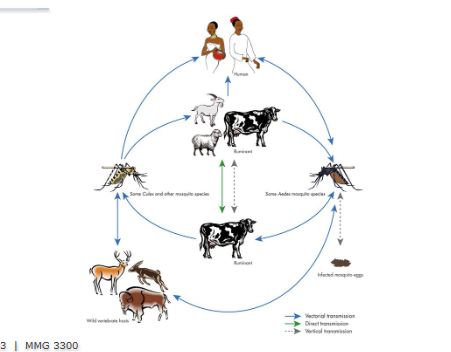
Direct transmission: Pathogen passes directly from source host to human
Intermediate Vertebrate host: Pathogen amplifies in a domestic or peridomestic animal before reaching humans
Arthropod vector: Invertebrate vector bridges the gap between animal reservoir and human (mosquito)
Environmental route: Pathogen shed into the environment and acquired through contact
What are some outcomes of spillover?
Sustained transmission: Pathogen adapts to human host and spread person to person. Requires favorable social, biological and environmental conditions. EX: HIV, SARS-Cov-2, measles
Dead-end spillover: Pathogen infects human but fails to spread within the population. Lacks conditions for adaptation or efficient transmission. EX: Rabies, most H5N1 human cases, Hendra virus
Spillover case studies
Rabies: Controlled through mass vaccination of domestric dogs, a bottleneck targeted intervention reducing reservoir to human transmission
Leptospirosis: Flood mobilized Leptospira causes spillover surges; human exposure through contaminated water is the ciritical bottleneck
H5N1 avian influenza: Sustained transmission in US dairy cattle with 71+ human cases, occupational exposure at the livestock-human interface
Hendra virus: Mathmatical models predicting bat-to-horse-to human spillover have been essential for outbreak control in australia
What is One Health?
Core principle: Human and animal health cannot be discussed separately, there is only one health, shared across species and ecosystems
CDC definition: A collaborate, multisectoral, transdiscipilinary approach working at a local, regional, natural, and global levels to achieve optimal health outcomes
Key recognigition: The interconnection between people, animals, plants, and their shared environmental demands integrated approaches to health challenges
What are the core domains of One Health?
Zoonotic diseases: ~70% of known biological security threats are zoonotic. One health integrates epidemiological studies, diagnostics and targeted immunization
Food safety: Oversight of the farm-to-table production chain to mitigate pathogen propagation across animal and human food systems
Antimicrobioal resistance: Addressing antibiotic use in both human medicine and agriculture, resistance develops across species boundaries
Environmental Health: Understanding how climate change, deforestation, and habitat disruption influence disease emergence and vector distribution
What are the strengths and limitations of One health?
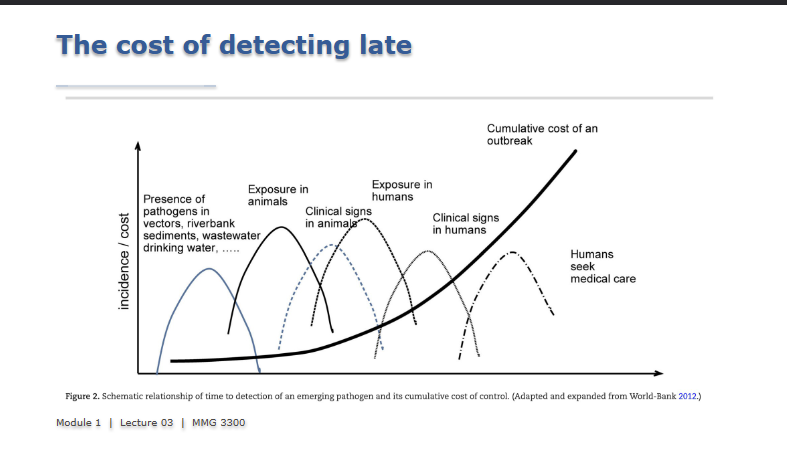
Strengths: Timely disease detection and cross-sector response. Enhanced collaboration between health sectors. Focus on zoonotic disease prevention at the source. Cost-effective through integrated surveillance
Limitations: No standardized methods to measure holistic benefits. Leadership and resource allocation disagreements across sectors. Insufficient indicators t quantify cross-sector health impacts. Implementation requires sustained political will and funding
Rwanda Case study
Stategic Framework: Rwanda developed Africa’s first national one health strategic plan, integrating human, animal and environmental health sectors
Intersectoral coordination: goverment, community/NGO and academic levels each have defined roles, from policy to surveillance to curriculum integration
Rift valley fever response: Combined cattle vaccination, farmer education, and mosquito net distribution, a model multi-sector intervention
Sustainability: Rwanda’s one health strategic plan II continued the framework with emphasis on community health workers and university curricula
Netherlands Case study
Paradox: The netherlands has one of Europes lowest human antibiotic consumption rates but has a historically high veterinary antibiotic use
Outcome: low human resistance rates, but there are gradually increasing, demonstrating that veterinary use creates environmental pressures
One health less: restrictive human antibiotic use alone is insufficient; agricultural antibiotic practices must be addressed simultaneously
One health in the United states
CDC role: Federal agency providing research, guidance, and emergency response, recommendations are advisory, not legally binding
OHCU: The one health coordination Unit operates under joining CDC/DOI/USDA leadership for cross-agency coordination
ArbotNET: National arboviral surveillance system tracking infectious in humans, animals, mosquitoes and sentinel species across the United States
Why does One health matter for pandemics?
Transmission understanding: One health reveals how diseases spread among humans, animals, and the environment, essential for identifying origins and transmission routes
Targeted intervention: enables strategies like animal vaccination, advanced surveillance and spillover investigation before human transmission occurs
Adaptive governance: Fosters collaborative decision making among diverse experts; tools like the One health index enable ongoing policy evaluation
Mechanisms of antibiotic resistance MUTATION
Spontaneous mutation: DNA replication errors can produce mutations conferring survival advantage under antibiotic pressure
Selection pressure. Antibiotic exposure selects for resistant mutants, the drug eliminates susceptible competitors, allowing resistant clones to dominate
Clinical example: Rifampicin resistance in Mycobacterium tuberculosis arises from point mutations in the rpoB gene, altering RNA polymerase structure
Mechanisms of Resistance HGT
Conjugation: Direct cell-to-cell transfer of resistance plasmids via pilus, the most common mechanism for rapid spread of resistance genes
Transduction: Bacteriophages (viruses) accidently package and transfer host resistance genes between bacteria
Transformation: Uptake of free DNA from the environment, less common but important in naturally competent species
What are some drivers for resistance?
Over-prescription: unnecessary antibiotic prescriptions in healthcare settings accelerate resistance selection
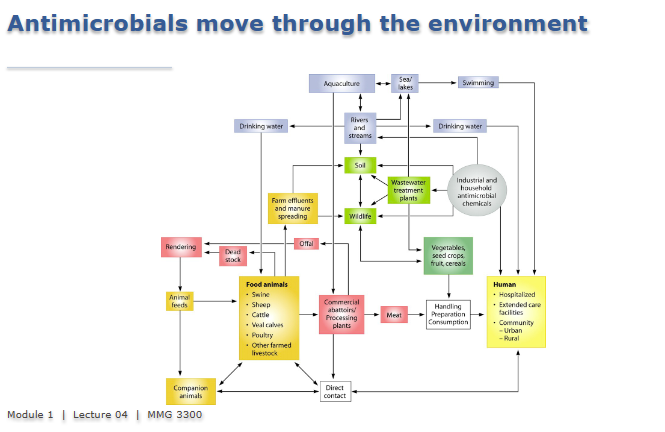
Agricultural use: Antibiotics in livestock for growth promotion and prophylaxis create environmental reservoirs of resistance genes
Patient misuse: Incomplete courses and self-medication with antibiotics contribute to sublethal selection pressure
Environmental dissemination: Antibiotics and resistant bacteria from hospitals, farms and wastewater contaminate soil and water systems
Viral and Fungal Resistance
Viral Resistance: HIV develops resistance to antiretrovirals through mutation during treatment interruptions. Treatment adherence is critical, even single interruptions can establish resistance. Nucleotide analogs face resistance through reverse transcriptase mutations
Fungal resistance: Candida aruis: multi-drug resistant fungal pathogen with high mortality in immunocompromised patients. Limited antifungal drug classes make resistance especially dangerous. Resistance mechanisms include target modification, efflux pumps and biofilm formation
Implications and Mitigation of antibiotic resistance
Escalating severity: resistant infections are harder to treat, require longer hospitalizations, and carry higher mortality, shrinking the available drug arsenal
Stewardship: Antimicrobial stewardship programs in human and veterinary medience are the frontline strategy for slowing resistance emergence
Research frontier: New antibiotics, monoclonal antibodies, phage therapy and novel treatment modalities are under active development
One Health imerative: effective AMR control requires coordinated action across human medicine, agriculture and environmental management
What is R0?
R0 quantifies the average number of secondary infections from a single infected individual in a fully susceptible population
Epidemic threshold: If R0>1, the disease spreads; if R0 <1, the diseases dies out. This threshold is the foundation of epidemic prediction
Formula: R0= Beta x c x D where Beta= transmission probability, c=contact rate, D= duration of infectiousness

What are some R0 assumptions and limitations
Key assumptions: Fully susceptible population at outbreak start; constant parameters during infectious period; homogeneous mixing (everyone contacts everyone equally)
Why it matters: Real populations violate these assumptions, heterogeneous contact patterns, super spreaders, and behavioral changes all affect actual transmission
R0 is a model, not a biological property of a pathogen

Behavioral Feedback from an infectious virus
Static models fail: Classic SIR/SEIR models assume individuals do not change behavior in response to disease risk, this is unrealistic
Behavioral response: When people perceive risk, they reduce contact, adopt protective measures, alter mobility, flattening the epidemic curve
Public Health implication: Interventions that shift behavior (communication, mandates, incentives) can reduce peak prevalence even without changing biological parameters
What are the two approaches to disease surveillance?
Traditional (Macros View)
→How many? When?
→Method: Compartmental models (SIR/SEIR) simulate population flow through disease states
→Strength: Forecasts epidemic size, speed and healthcare burden
→Limitation: Biologically static, assumes fixed pathogen characteristics
Genomic (Micro View)
→Who? Where from? What is it?
→Method: whole-genome sequencing identifies transmission chains and tracks evolution
→Strength: Detects outbreaks without a case spike; provides biological proof and linkage
→Limitation: Forensic, not forecasting, requires epidemiological context to be actionable

Traditional models of disease surveillance
Compartmental models: SIR/SEIR divide populations into susceptible, exposed, infected, recovered compartments, a top-down approach to epidemic dynamics
Agent-based models: Bottom-up simulation of individual agents and their interactions, more flexible for modeling heterogeneous behavior and superspreading
Key limitation: The ‘variant problem’: traditional models assume fixed pathogen traits. When a new variant emerges, core assumptions break
What is genomic surveillance?
Definition: Systematic monitoring of a pathogen by sequencing its genome to track evolution, identify variants and map transmission
Core technology: Next-generation sequencing (NGS) rapidly and affordably sequences the entire pathogen genome from patient or environmental samples
Key output: Phylogenetic trees that provide definitive biological proof of transmission chains and evolutionary relationships
Sample to response surveillance
Sample collection: biological samples from patients, animals, or environment (including wastewater)
Sequencing: Pathogen genome sequenced via NGS/WGS to identify lineage, variant and resistance markers
Data linkage: Genetic data integrated with clinical metadata (symptoms, outcomes) and epidemiological context (location, travel, contacts)
Reporting and response: Integrate analysis track variant proportions over time; reports provide actionable intelligence for targeted interventions
How are samples used to track surveillance?
Paradigm shift: from reactive, population-level public health to proactive, granular interventions using pathogen genomic data
Capabilities: Identifies transmission links between cases with no obvious epidemiological connection, individuals who visited the same location at different times
Applications: Foodborne illness source attribution, TB transmission chain mapping, influenza vaccine strain selection and AMR surveillance
What are some roadblocks in the sample to surveillance pipeline?
Biased sampling: Convenience based collection (urban hospitals only) skews data and misses community-level variant prvalence
Bioinformatic bottlenecks: Lack of computing power or trained staff creates lag between sequencing and variant identification
Metadata silos: Clinical and genomic data stored in separate, incompatible systems cannot be merged for integrated analysis
Reporting delays: by the time a variant is identified and reported, it may have been spreading for weeks
What are data deserts and what are their consequences?
Data Deserts: Vast regions within minimal genomic surveillance, economic, logistical and political barriers create dangerous blind spots in surveillance
Weakest-link system: Global health surveillance fails at its weakest point; a variant emerging in a data desert can spread globally before detection
Consequences: Delayed variant detection, incomplete evolutionary picture, and biased global datasets that undermine AI and analytical tools
What are the steps in phylogenetic workflow?
Data collection: Acquire pathogen sequence data (DNA or RNA) from clinical or environmental samples
Multiple sequence alignment: Align sequences to infer positional homology, each column represents a position descended from a common ancestor
Model selection: Choose a mathematical model of molecular evolution (nucleotide substitution model) to correct for multiple hits
4-5: Tree inference and evaluation: Construct the phylogenetic tree using NJ or ML methods, then assess branch reliability via bootstrapping
Reading a phylogenetic tree
What a phylogeny can tell you
→Relatedness: which sequence share a more recent common ancestor
→Transmission clusters: group of cases too similar to be coincidental
→Introduction events: Whether an outbreak is one importation or several
→Timing: with dated tips, roughly when lineages diverged
What it cannot tell you
→Direction: who infected whom, without dated tips and dense sampling
→Truth: Support values measure resampling stability, not correctness
→Completeness: the tree is conditional on what was sampled so data deserts distort it
→Certainty: method and model choice can change the topology
How do you integrate both lenses of surveilence?
Phase 1, Emergence: genomic surveillance identifies the novel pathogen and characterizes first clusters; traditional models estimate initial R0
Phase 2,acceleration: Traditional models forecast peak and hospital demand; genomic data refines transmission parameters
Phase 3, Evolution: Genomic surveillance becomes the early warning system for new variants, traditional models update forecasts accordingly