Experiment 3. Caffeine
 Call Kai
 Learn
Learn Practice Test
 Spaced Repetition
 Match
Match Flashcards
 Knowt Play
1/19

There's no tags or description
Looks like no tags are added yet.
Name | Mastery | Learn | Test | Matching | Spaced | Call with Kai | Chat |
|---|
No analytics yet
Send a link to your students to track their progress
20 Terms
During the extraction procedure, which layer (water/ ethyl acetate) is on top?
Ethyl acetate
Acetone is miscible with water. Would it be better or worse to use acetone (rather than ethyl acetate) for extraction of caffeine from water? Explain your answer.
It would be worse to use aceton since its miscible in water they will mix and wont form the serpate layers.
Which method(s) will you use to determine purity of the isolated caffeine?
Thin Layer Chromatography
A molecular formula for ethyl acetate is
C4H8O2.
molecular formula for caffeine?
C8H10N4O2
In Step 1 of the procedure, you are asked to measure Na2CO3. Why is the role of this compound?
-it extracts caffeine inro aqueous layrt
-extracts gallic acid into aqueous layer
In Step 2 of the procedure, which layer is organic in the separatory funnel?
top, Ethyl acetate
Predict what would happen with the Rf values of your isolated caffeine and pure caffeine samples, if instead of ethyl acetate you used hexanes as eluting solvent.
Both Rf values will decrease, due to hexanes being less polar solvent than ethyl acetate.
Caffeine is a member of a
alkaloids
the caffeine is first extracted into a
hot aqueous solution, which is made basic with
with sodium carbonate or sodium hydroxide.
caffine is more solbulbe in
non polar solvents like ethyl acetate
in TLC plate which componenet moves faster
less polar compound
why does more polar compunds move slower in TLC
due to hydrogen bonds and dipole dipole interactions
how to calcualte Rf
length from baseline to finial/ total baseline to top line
how much space is left on top and bottom of the silica gel TLC
1cm
caffeine strucutre
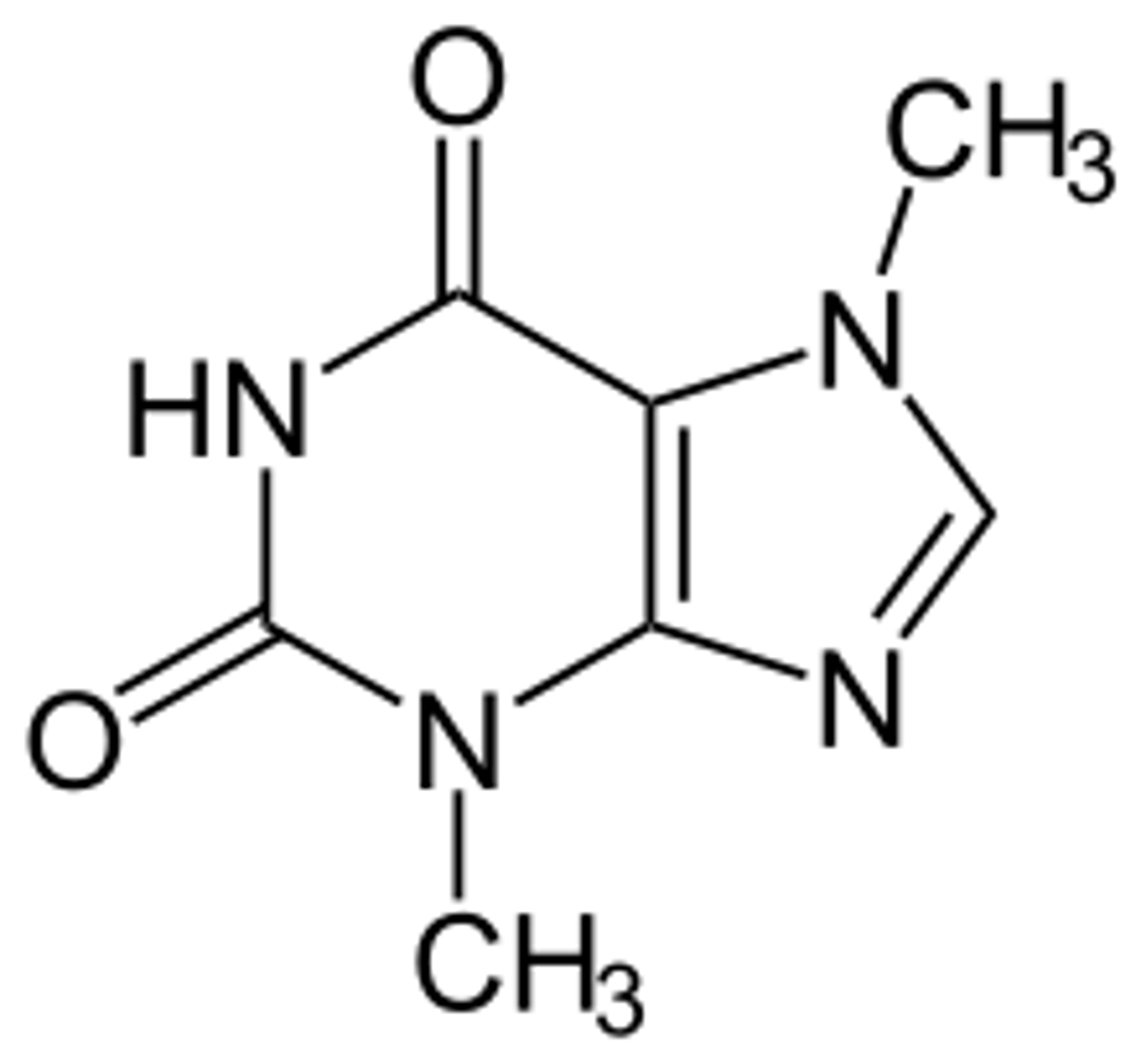
Na2CO3
anhydrous sodium
carbonate
solubility of caffeine in water is
22mg/mL at 25 C
what color do you want the limus to turn after placing the teabags in water
blue
blue lithmus =
basic solution