The Last 100
 Call Kai
 Learn
Learn Practice Test
 Spaced Repetition
 Match
Match Flashcards
 Knowt Play
1/29

Earn XP
Description and Tags
This can be edited to fit what I currently need to remember and practice right now, if I only had 100 swipes.
Name | Mastery | Learn | Test | Matching | Spaced | Call with Kai | Chat |
|---|
No analytics yet
Send a link to your students to track their progress
30 Terms
Periodization cycle and training focus areas
Preparatory period (first phase) - high volume, low intensity to start building a base of endurance, does not need to be sport specific
Preparatory period (later phase) - strength & power, shift to sport specific activities.
Competition period - maintain strength & endurance & power
Off season - encouraged to stay active
In periodization, the early preparatory period is also termed the hypertrophy/endurance phase. The foundation of this phase is high-volume, low-intensity conditioning with activities that may be general or directly related to the sport. The purpose of this phase is to build a foundation of endurance for ramping up volume and intensity in the next phase.
List and define the different type of budget models
• Spending-ceiling model: requires justification only for those expenses that exceed those of the previous budget cycle (also known as incremental model) – often results in falling behind due to prices of supplies rising faster than inflation
• Spending-reduction model: financial crisis model; requires reallocation of institutional funds, resulting in reduced spending levels for some programs (should identify areas that could be cut w/o serious impact)
•Zero-based budgeting: requires justification for every budget line item without reference to previous spending patterns; requires documentation of actual program needs and development of priorities (rank each item)
• Fixed budgeting: expenditures and revenues are projected on a monthly basis, thereby providing an estimate of cash flow; most appropriate for large, well-established sports medicine clinics during economic certainty
• Variable budgeting: requires adjustment of monthly expenditures so that they do not exceed revenues; rarely used by school-based programs (very difficult to estimate costs in advance)
• Lump sum budgeting: allocates a fixed amount of money for an entire program without specifying how the money will be spent; gives freedom to spend where it is needed most
• Line item budgeting: allocates a fixed amount of money for each subfunction of a program (Expendable supplies, equipment repair, team physician services, and insurance. Easy to understand and prepare; the AT has limited flexibility in responding to midyear financial crises)
•Performance budgeting: allocates funds for discrete activities; not commonly used due to expense and difficulty of analyzing specific activity costs (Prepractice and pregame team preparation, rehabilitation, injury treatment, administration, patient education, emergency first aid.)
In human resources and personnel issues: define validity, and reliability
-Validity (in staff selection): criteria that predict how well a candidate will perform in a role
-Reliability (in staff selection): consistency of staff selection procedures
List the 6 elements of the PPE & examples
Health History: past/existing medical problems; athletes should be reassured info is held in confidence
Physician’s Examination
-general review of systems, including examination of the head, eyes, ears, nose, throat, chest and abdomen, and genitalia
-height, weight, body composition, blood pressure, pulse, heat & lung function, urinalysis & blood workCardiovascular Screening: critical task of identifying life threatening conditions (recognition of abnormal heart sounds and other signs of pathology)
-Possible findings: hypertrophic cardiomyopathy, aortic stenosis, Marfan’s syndromeMaturity Assessment: commonly used methods include the circumpubertal (sexual maturity), skeletal & dental
Orthopedic Examination: ROM, joint stability, leg length, previous injury history, postural observation
Wellness Screening: evaluate healthy lifestyle behaviors (drug use, eating/exercise habits, stress control, safety)
Intrinsic vs Extrinsic factor
Extrinsic factor: type of activity, amount of exposure to injury, environmental & equipment factors
Intrinsic factor: refers directly to athlete; age, gender, neuromuscular aspects, structural aspects, performance aspects, and mental & psychological aspects
To prove negligence, the components to prove are
Conduct
Existence of duty
Breech of duty
Causation
Damage
As an athletic trainer, what are you responsible for strategies of risk reduction?
1. Preparation for activity a. Administer PPEs b. Monitor fitness levels c. Assess activity areas d. Monitor environmental conditions
2. Conduct of the activity a. Maintain equipment b. Use proper instructional techniques c. Provide adequate work-rest intervals Product Liability
3. Injury management a. Have a physician supervise all medical aspects of program b. Evaluate and treat injuries correctly and promptly c. Supervise student athletic trainers
4. Records management a. Document physician orders b. Document the treatment plan c. Document the treatment record d. Document the patient’s progress
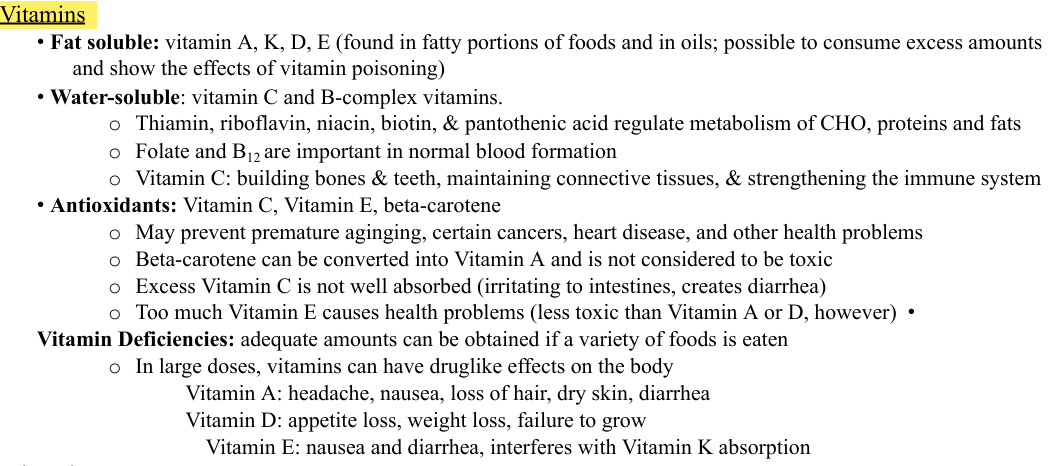
Discuss vitamins
List and identify the synovial joint types
1) Ball and socket: allow all possible movement (glenohumeral and hip joint)
2) Hinge: flexion and extension (elbow)
3) Pivot: rotation about an axis (cervical atlas and axis, proximal ends of radius & ulna)
4) Ellipsoidal: elliptical convex head in an elliptical concave socket (wrist)
5) Saddle: reciprocally concavoconvex (carpometacarpal joint of thumb)
6) Gliding: small amount of gliding back and forth or sideways (joints b/w carpal & tarsal bones, intervertebral jts)
Define the types of acute bone fractures and etiology of each
Depressed fracture: often in flat bones; caused by falling and striking body part on unyielding surface or by being
hit with hard object
• Greenstick fracture: incomplete break in bones that have not completely ossified; often occurs in convex bone
surface while concave surface remains intact
• Impacted fracture: caused from fall from a height (force directed up long axis). Require immediate splinting by
athletic trainer and traction by physician to ensure normal length of injured limb
• Longitudinal fracture: bone splits along its length; often result of jumping and stress directs up long axis
• Spiral fracture: S-shaped separation; common in football & skiing (sudden rotation of body with foot planted)
•Oblique fracture: occur when one end of the bone receives sudden torsion while other is fixed or stabilized
• Serrated fracture: two bony fragments have a saw-tooth, sharp-edged fx line; usually caused by direct blow. Sharp bone edges can cause extensive internal damage (severance of blood vessels and/or nerves)
• Transverse fracture: occur in a straight line at right angles to the bone shaft; caused by direct blow
• Comminuted fracture: ≥ 3 fragments at fx site. Caused by hard blow or fall in awkward position. Difficult healing situation because of displacement of bone fragments (soft tissue b/w them – incomplete healing)
• Contrecoup fracture: occur on side opposite to the point at which trauma was initiated; fx of skull
•Blowout fracture: occur to the wall of the eye orbit as a result of a blow to the eye
• Avulsion fracture: separation of a bone fragment at an attachment of ligament or tendon. Usually occurs as a result of a sudden, powerful twist or stretch of a body part
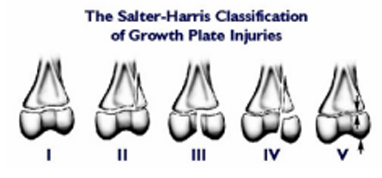
Define the Salter Harris classifications of growth plate injuries
o Type 1: separation of physis
o Type 2: separation of growth plate & small
part of
metaphysis
o Type 3: fracture of physis
o Type 4: fracture of portion of physis &
metaphysis
o Type 5: crushing force (growth deformity)
Primary survey vs secondary survey
Primary: Assesses life-threatening injuries (airway obstruction, no breathing, no circulation, profuse bleeding, shock)
unconscious athlete: note body position and determine level of responsiveness, check ABCs Do not remove helmet until neck/spine injury has been ruled out (okay to remove face mask) Supine/not breathing – check ABCs; Supine/breathing – wait til consciousness returns Prone/not breathing – logroll to supine and check ABCs; prone/breathing – wait til awakening
Check, call, care!
Secondary:
recognize vital signs (pulse, respiration, bp, temp, skin color, pupils, LOC, movement, abnormal nerve response
musculoskeletal assessment (HOPS) & treat or splint
transport, if needed
What are expectations to breach of confidentiality?
• Violation of a commitment to privacy and protection of information or communications
• Exceptions to the rule of confidentiality:
o Reason: the basis or explanation for an action; excuse: a reason that is considered justifiable
o When there is a clear and imminent danger to the client
o When there is a clear and imminent danger to the other person
o When legal requirements demand that confidential information be released
• Difficult to maintain confidentiality because:
o Confidential information might be personal, private, and sensitive (handle carefully!)
o Many people are usually involve dint he care of an athlete
o High profile of athletes and of the athlete industry in our society
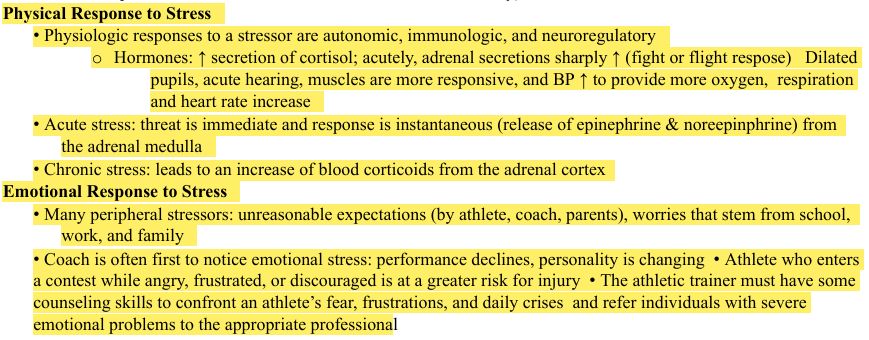
What are the physical responses to stress, and the emotional responses to stress
What are examples of conflict of interest
When the interests of one individual or group are in competition with those of another individual or group.
Examples:
o Discussing private information with another party
Patient’s best interests vs. your job - breach of confidentiality
o ATC receiving financial gain to utilize a particular product
o Allocation of resources for head/supervising ATC
• What can the AT do to avoid breach of confidentiality and conflict of interest situations?
oRefer the athlete to a counselor. Preferably not affiliated with the institution or team
Define PNF stretching
• PNF stretching takes advantage of two additional neurophysiologic phenomena
o Maximal isometric contraction stimulates GTO to effect a reflex relaxation of antagonist muscle even before the muscle is placed in a position of stretch (autogenic inhibition)
o During relaxing phase, as isotonic contraction of agonist pulls extremity further into agonist pattern, a reflex relaxation of the antagonist (muscle being stretched) must occur to allow for agonist movement (reciprocal inhibition)
• Practical application: static stretching is most widely used (simple, no partner needed)
o studies suggest that PNF stretching can produce greater improvement in flexibility over an extended training period (disadvantage= requires a partner)
Karvonen equation
The Karvonen equation is a method used to calculate a patient’s target heart rate range using their heart rate reserve, which takes resting heart rate into account. The Karvonen method is relevant to cardiorespiratory exercise such as continuous endurance training or high-intensity interval training, as it could be used to assess that an athlete is working within the desired range for the activity.
Khyphosis muscle corrections and to target
(Google)
Key Target Muscles
Thoracic Erector Spinae: Straightens and extends the mid-back away from a hunched shape.
Rhomboids and Trapezius: Retract and squeeze the shoulder blades together to fix rounded shoulders.
Deep Neck Flexors: Aligns the head and stops forward neck posture. [1, 2, 3, 4, 5]
Core Rehab Exercises
Prone T and W Raises: Lying face down and lifting arms to form a "T" or "W" shape to work the upper back and traps.
Shoulder Blade Squeezes: Pinched backward movements to engage mid-back stabilizers.
Thoracic Extensions: Using a foam roller to gently arch and mobilize the mid-spine
Thoracic kyphosis changes the position of the scapula (shoulder blade) by causing scapular protraction, internal rotation, and anterior tipping. These changes lead to rounded shoulders, muscle imbalances, and a higher risk of shoulder pain. [1, 2, 3, 4, 5]
Structural Changes
Protraction: The shoulder blades move away from the spine and slide forward around the rib cage.
Internal Rotation: The back of the shoulder blade rotates inward, changing how the shoulder joint lines up.
Anterior Tipping: The top of the shoulder blade tilts forward, which reduces the space inside the shoulder joint
Traumatic injuries and the forces that causes them
There are numerous types of fractures, but compression fractures happen when bones are crushed or compressed by forces that exceed their strength, like trauma from direct blows. Contusions, also known as bruises, occur from direct impacts that compress soft tissue against underlying hard tissue, causing bleeding under the skin. Muscle strains and ligament sprains are typically caused by tension, where tissues are overstretched or torn, not by compression. Blisters, abrasions, and vertebral disc injuries are typically caused by shearing forces, where surfaces move in parallel directions. Chondromalacia patella and other degenerative changes to cartilage can be caused by repeated compressive forces, but this is an overuse injury rather than a traumatic injury.
SCAT6
The Sport Concussion Assessment Tool, 6th edition (SCAT6) is the most widely used test for evaluating both physical and cognitive symptoms of a concussion. Its comprehensive format includes assessments of cognitive and neurological function, balance, and coordination. The Glasgow Coma Scale is an assessment tool that evaluates the level of consciousness to determine whether a brain injury is present; it is included within the SCAT6. It does not measure aspects like balance, coordination, or memory. The Romberg test assesses balance with a protocol that has the patient stand still with eyes closed. This only assesses one potential physical sign of concussion. The vestibular-ocular motor screening (VOMS) evaluates eye movements in the patient to assess for the presence of concussion, but it only addresses one aspect of possible concussion symptoms. Similar to the rationale for the Romberg test, the Balance Error Scoring System (BESS) only assesses balance and stability. It does not assess cognitive or neurological function.
Nasopharyngeal airway (NPA) is selected by measuring from
Nostril to ear lobe (or jaw curve)
A nasopharyngeal airway, or NPA, needs to be inserted with lubricant so that the nasal mucosa is not injured. These are typically water-based lubricants such as sterile lubricating jelly. A bag/valve mask and pocket mask are both used to administer supplemental oxygen, whether through an oxygen cylinder or the responder providing breaths. A thermometer measures skin temperature or internal temperature and is not part of using an NPA. A pulse oximeter, which measures oxygen saturation in the blood, is not part of using an NPA.
PICO
PICO is a framework used to develop a clinical question and stands for Patient/Problem, Interventions, Comparison, Outcome. Comparison is not always needed, so in that case, PIO would be used instead. Developing a clinical question is the first step in using evidence-based practice for an athletic trainer. In this situation, the athletic trainer’s clinical question could focus on healthy college athletes (Patient), percussive massage guns (Intervention), comparing this modality to other forms of self-myofascial release (Comparison) and injury prevention or performance improvement (Outcome). As for the other acronyms, SORT (Strength of Recommendation Taxonomy) is a type of scale used to rank the quality of research-based evidence.
CPT (Current Procedure Terminology) refers to specific codes that identify medical procedures used in treatment. SOAP (Subjective, Objective, Assessment, Plan) is a standard documentation format to record information on injury or treatment. PROMs (patient-centered/rated outcome measures) are means of direct information gathering that an athlete would fill out, such as on quality of life or injured area of the body.
Methods to assess athlete’s body composition
Assessing body composition is used to determine the proportions of a patient’s body that are fat mass and fat-free mass. This can be done through a variety of methods, though some are more accurate or accessible than others. For example, DXA is the gold standard method for accuracy but requires specialized equipment and can be expensive. BMI is not a body composition method, as it only calculates a ratio of the patient’s weight to height, not an estimate of fat mass and fat-free mass. BMR is also not a body composition method, as this is used to calculate the minimum daily caloric requirements for a patient to sustain vital body processes.
bioelectrical impedance
skinfold measurements
hydrostatic (underwater) weighing
BOD POD
ultrasouund
DXA
Guidelines for exercise
National recommendations on moderate-intensity cardiorespiratory exercise for most adults is at least 5 days a week for at least 30 minutes a day, for a total of 150 minutes each week. While this specific question is asking only about moderate-intensity exercise, adults can choose instead to engage in vigorous intensity cardiorespiratory exercise for at least 3 days per week for at least 20 minutes a day, for a total of 75 minutes each week. Patients who are sedentary or have risk factors or other health conditions should start at a lower intensity and gradually progress over time. Adults can also choose to do a combination of moderate-intensity and vigorous-intensity exercise to reach the guidelines.
Functional movements
Functional movements are considered to be those that use multiple planes of motion, use the entire kinetic chain rather than being isolated to a single muscle group, and promote not only strength adaptations but neuromuscular adaptations as well due to the requirement for stabilization and control. There are movements that can be beneficial for improving various aspects of fitness but are not considered functional movements, as they occur in a single plane and/or isolate one muscle group. This includes high knee runs, calf raises, leg presses, and triceps extensions. There are also movements that are beneficial in rehabilitating injuries or regaining neuromuscular control, such as static single-leg balance on a Bosu athletic trainer or pelvic tilts; however, these are not considered functional movements, as they are isometric or isolate a single muscle group.
SAID principle
The SAID principle stands for specific adaptation to imposed demands and describes that the body will adapt to gradual overload placed upon it. The type of overload must be specific to the desired outcome. For example, having a weightlifter do aerobic cardiovascular activity will not be specific to the outcome of building strength, but having the weightlifter gradually increase weight will be specific to this outcome. The other situations listed illustrate other principles that are important in conditioning: intensity, individuality, specificity, and consistency.
SAID stands for specific adaptation to imposed demands. It is related to the overload principle, which states that the body will gradually adapt to the stresses imposed upon it. In a therapeutic setting, SAID is important for gradually overloading healing tissue without overstressing it, which could be done by progressively making the type of resistance more challenging (i.e., from bodyweight to banded resistance). While the other examples illustrate types of therapeutic care that an athletic trainer would provide, they do not specifically illustrate gradually overloading a healing injury.
Define extrinsic risk factors
Extrinsic risk factors are those that occur outside of athletes, such as the environments they are in or the sports they play. All other listed options are intrinsic risk factors, which are those within athletes, such as their health status or medical conditions. Both extrinsic and intrinsic risk factors can make an athlete more susceptible to injury.
Isotonic movements are
Isotonic movements involve a change in muscle length with both concentric and eccentric contractions. In the eccentric contraction, the prime mover muscles are lengthening. A Romanian deadlift with a slower tempo on lowering the bar emphasizes the eccentric contraction of the hamstrings. Movements like side planks, where the muscle does not change in length, are isometric movements, not isotonic. Double-leg lateral hop-overs emphasizing speed are not the most specific for emphasizing the eccentric contraction, as the tempo would need to be slower for this movement to permit that emphasis. Back squats with a bar with an explosive tempo when standing up emphasize a rapid concentric contraction, not an eccentric one. A power clean is a full-body movement that cannot feasibly be modified to emphasize only the eccentric contraction due to its explosive nature.
Isokinetic exercise is used in specialized machines that provide a fixed speed of movement. Speeds can be altered as needed. For example, the injured shot putter might start with slower velocities and progress to ones whose speed better mimics the high velocities of throwing. Isokinetic exercises are typically done seated on a machine and do not promote balance and postural control, nor do they use free weights or compression. Isokinetic exercise also does not use static muscle contractions; instead, the muscle contractions in the fixed speed are dynamic and involve movement.
OKC vs CKC
Closed kinetic chain exercises are ones where the distal extremities are in contact with the ground or a surface. In this case, closed kinetic chain exercises for the lower body in knee rehabilitation all include having feet on the ground or a surface like a step. A weight machine leg extension has the feet free and not affixed to anything, so it would be an open kinetic chain exercise.
Scapular stability means to target muscles of
The rhomboids, serratus anterior and posterior, levator scapulae, and trapezius are all considered scapular muscles and are specifically implicated in providing scapular stability, whether through rotating, adducting, abducting, or elevating the scapula. While other muscles attach to the scapula, this particular group works synergistically to maintain scapular alignment and stability relative to the axial skeleton. The coracobrachialis primarily flexes and adducts the arm and does not play a significant role in scapular stability. The pectoralis major does attach to the scapula but is not typically targeted for specific scapular stability exercises in rehabilitation. The teres major adducts, extends, and medially rotates the arm. The deltoid abducts, rotates, flexes, and extends the arm. Neither of these muscles is a significant contributor to scapular stability.
rhomboids
serratus anterior and posterior
levator scapulare
trapezius