Membrane Potentials
 Call Kai
 Learn
Learn Practice Test
 Spaced Repetition
 Match
Match Flashcards
 Knowt Play
1/37

There's no tags or description
Looks like no tags are added yet.
Name | Mastery | Learn | Test | Matching | Spaced | Call with Kai | Chat |
|---|
No analytics yet
Send a link to your students to track their progress
38 Terms
Cells have an excess of ______
negative charge (-)
What is membrane potential (Vm)?
the electrical diequilibrium that exists between the extracellular fluid and intracellular fluid of living cells...always report with respect to outside!
The ECF has a slight excess of...
cations (+)
The ICF has a slight excess of...
anions (-)
Where does this negative membrane potential come from?
K+ leakage - K+ starts to move out of the cell down its concentration gradient
What is diffusion potential?
membrane potential is the result of a small amount of K+ ions diffusing out of the cell
An electrical gradient is in the....
OPPOSITE direction from the concentration gradient - K+ wants to move back into the cell because there is MORE NEGATIVE charge now that most of the K+ has left the cell
What is the formula for a concentration gradient?
[ion] out - [ion] in
*difference in concentration between the inside and outside of the cell
What is the formula for an electrical gradient?
[charge] out - [charge] in
*difference in net charge between the inside and outside of the cell
What is an electrochemical gradient?
combination of concentration and electrical gradient that determines an ion's movement across the membrane
What is an equilibrium potential (Ex)?
cell membrane voltage that perfectly balances the concentration gradient (prevents ion from moving downs its concentration gradient) across the membrane
How is cell membrane voltage (Ex) determined?
Nernst equation
Nernst equation
Z: ion valence (charge +/-)
x: molecule concentration across the membrane (inside cell and outside cell)
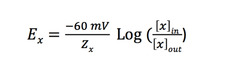
When the membrane potential (Vm) MATCHES the equilibrium potential (Ex), then the ion is in in...
EQUILIBRIUM, movement of the ion across the membrane will be ZERO!
How do you calculate resting membrane potential (Goldman-Hodgkin-Katz equation)?

Cells are HIGHLY permeable to ____
K+
Cells are NOT very permeable to ____
Na+ and Cl-
Most cells have a ______ potential at rest
negative
Resting Vm is usually around...
90 mV
What is the conductance (g, units = mS/cm2)?
the ease at which ions flow through a channel across the membrane
proportional to permeability, but easier to measure
What is current (i, units = uA/cm2)?
the flow of electrical charge carried by an ion
direction of ion movement depends on the electrochemical gradient for the ion
How do you calculate current (i)?
ix = gx (Vm-Ex)
How do you calculate the resting membrane potential (Vm)?

What 3 rules does the resting membrane potential (Vm) formula adheres by?
1. Vm represents a weight average of all equilibrium potentials (Na, K, and Cl)
2. Vm must be in the range of values provided by the individual equilibrium potentials
3. Vm is closest to the Ex of the ion with the greatest conductance across the membrane
When calculating the resting membrane potential (Vm), you should never calculate something...
MORE NEGATIVE than your most negative ION
MORE POSITIVE than your most positive ion

What does depolarization mean?
a cell becomes more POSITIVE
What does repolarization mean?
a cell is going from a more positive state back to normal
What is hyperpolarization?
a cell becomes MORE NEGATIVE
Uncharged solutes rely SOLELY on a...
concentration across the membrane for diffusion to occur (think glucose!)
Charged solutes rely on BOTH...
a concentration difference AND the electrical potential across the membrane
The bigger the difference between Vm and Ex, the...
LARGE the movement of charged solute
In order to see a movement across the membrane, the membrane must...
be at a DIFFERENT potential than Vm
What is the calculation of net driving force (mV)?
Vm - Ex
Ions will move across the cell membrane through ion channels when two conditions are met:
1. There is a driving force for the ion
2. The membrane has a conductance to that ion (ex. the ion channels are open)
Negative currents (ix) = Inward currents =
Inward flow of POSITIVE (+) charge
Positive currents (ix) = Outward currents =
Outward flow of POSITIVE (+) charge
In an OUTWARD current, the cell should always become more
NEGATIVE (-)
How are concentration gradients restored?
The Na+-K+ ATPase