Exam 3- Abdomen
 Call Kai
 Learn
Learn Practice Test
 Spaced Repetition
 Match
Match Flashcards
 Knowt Play
1/97

There's no tags or description
Looks like no tags are added yet.
Name | Mastery | Learn | Test | Matching | Spaced | Call with Kai | Chat |
|---|
No analytics yet
Send a link to your students to track their progress
98 Terms
What is the shape of the Diaphragm?
Umbrella-shaped muscle
Should the psoas muscle be visible on an X-ray?
Yes
What are the 3 parts of the small intestine?
duodenum, jejunum, ileum
What sits in the C loop of the duodenum?
The pancreas
Duodenum length
10 inches, which is the shortest and widest
What drains into the duodenum?
Ducts drain
About the Jejunum (small intestine)
2/5 of the small intestine, feather like
About the ileum (small intestine)
3/5 of the small intestine, area of the ileocecal valve
What does enter/o mean?
small intestine
Where is the appendix hanging off of?
The cecum
What side is the hepatic flexure on?
right
What side is the splenic flexure on?
left
What does splen/o mean
spleen
What system is the spleen apart of?
lymphatic system
What are the accessory organs of the digestive system?
liver, gallbladder, pancreas
What does Pancreat/o mean?
pancreas
What does Hepat/o mean?
liver
What is the largest solid organ of the body?
Liver
What does the liver produce?
Produces bile and breaks down fat
What does the pancreas do?
produces enzymes for digestion
What does the spleen do?
Filters bacteria out of the blood
What does cholecyst/o mean?
gallbladder
Where is bile made?
liver
What does the gallbladder do?
stores and concentrates bile
What does ren/o and nephr/o mean?
Kidneys
How many kidneys are there?
two
Are the kidneys peritoneal or retroperitoneal?
retroperitoneal very posterior
What kidney is lower and why?
Right kidney due to the large right lobe of the liver
How many ureters are there?
2 (one for each kidney)
Where do the ureters enter the bladder?
posterior wall
What does ureter/o mean?
Ureters
What does cyst/o mean?
bladder
What does urethr/o mean?
Urethra
Does a male or a female have a longer urethra?
male, has to go through penis
What are the 2 suprarenal (adrenal glands) apart of?
The endocrine system
What 4 terms are part of the abdominal cavity?
Peritonitis, mesentery, omentum, mesocolon
What are the 2 types of the peritoneum?
parietal and visceral
What is Ascites?
accumulation of serous fluid in the peritoneal cavity
What does the mesentery do for the abdominal cavity?
Double fold peritoneum to stabilize and support the small intestine
Greater and Lesser what?
Omentum
What does the greater omentum connect?
connects the transverse colon to the greater curvature of the stomach inferiorly
The organs on the test:
Kidney, pancreas, spleen, stomach
retroperitoneal organs
Pancreas and kidney
intraperitoneal organs
Spleen and stomach
How many quadrants are there?
4
What is located in the RUQ?
Liver, gallbladder, hepatic flexure, duodenum, head of pancreas, right kidney, and right suprarenal glands
What is located in the RLQ?
Ascending colon, appendix, cecum, and 2/3rd of ileocecal valve
What is located in the LUQ?
spleen, stomach, splenic flexure, tail of pancreas, left kidney, and left suprarenal gland
What is located in the LLQ?
Xiohoid process of sternum
T9-T10
Inferior costal margin location
L2-L3
Iliac crest location
L4-L5
Landmark ASIS:
Anterior superior iliac spine, on the iliac crest.
Landmark Greater trochanter:
Use for inferior margin of KUB
Landmark symphysis pubis:
Inferior margin of abdomen
Landmark ischial tuberosity:
symphysis pubis used for prone positioning
Breathing considerations for abdomen:
1: prevent voluntary motion (breathing)
2: prevent involuntary motion (heart beat)
3: use shortest exposure time to control involuntary motion
4: expose on expiration
For shortest exposure time do you use high or low mA?
Highest mA that you can
What is the kVp for an abdomen?
70-85 kVp
The parietal peritoneum adheres to what?
the abdominal cavity wall
The visceral peritoneum covers what?
covers an organ
Peritoneum:
a large serous, double-walled, saclike membrane that covers the abdominal cavity and contains most of the abdominal structures and organs.
What is cholelithiasis?
presence of gallstones in the gallbladder
Retroperitoneal means?
retro= behind
Infraperitoneal means?
infra=below
What organs are located infraperitoneal?
located in the true pelvis: lower rectum, urinary bladder, and reproductive organs
Intraperitoneal means?
intra=within
What organs are located intraperitoneal?
Liver, gallbladder, spleen, stomach, jejunum, ileum, cecum, and transverse and sigmoid colon: organs within the abdominal cavity that are covered by some type of visceral peritoneum
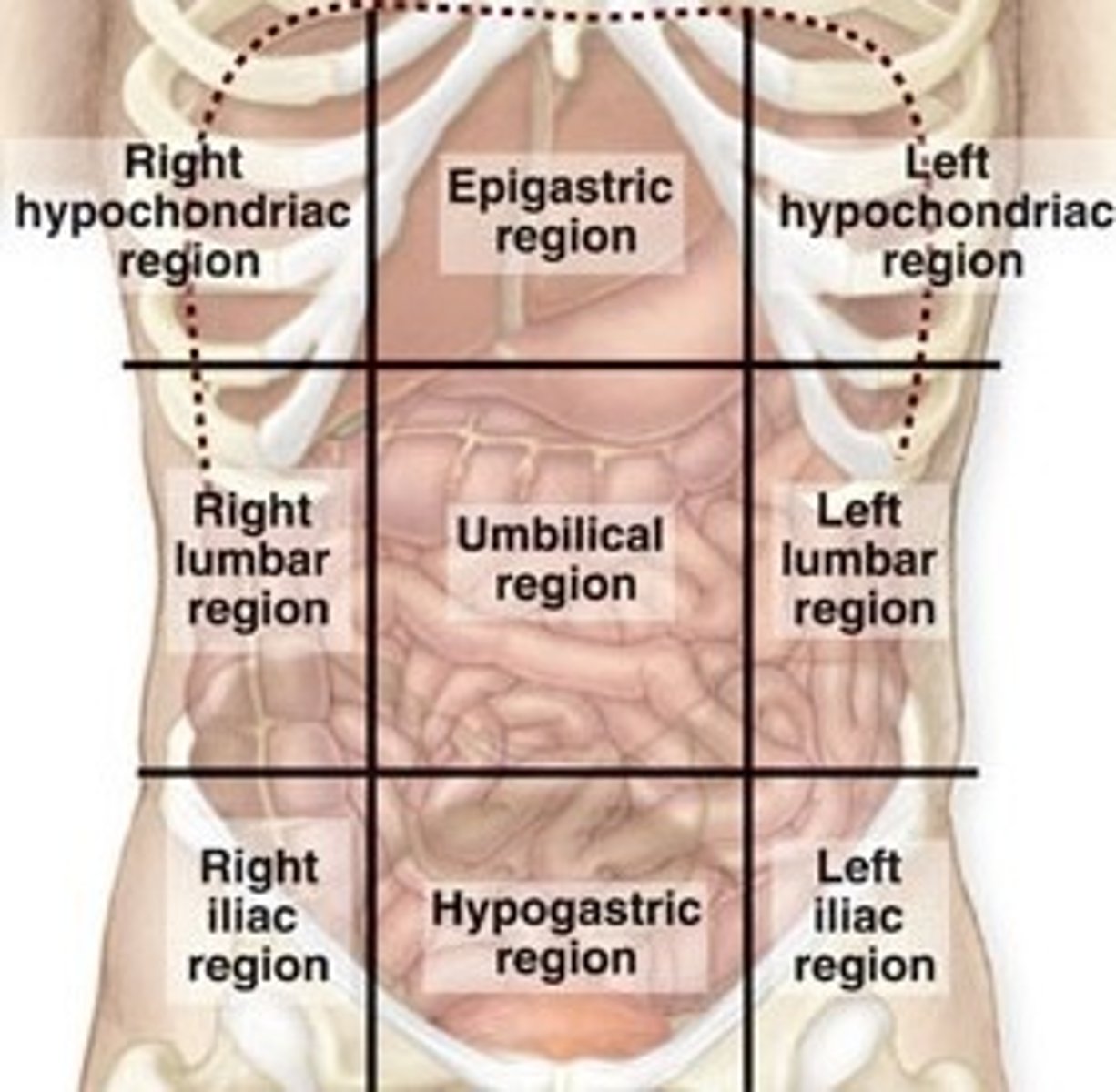
How many abdominal regions are there?
9
What are the 9 abdominal regions?
1. right hypochondriac
2. epigastric
3. left hypochondriac
4. right lumbar
5. umbilical
6. left lumbar
7. right iliac
8. hypogastric
9. left iliac
How many landmarks are used for the abdomen?
7
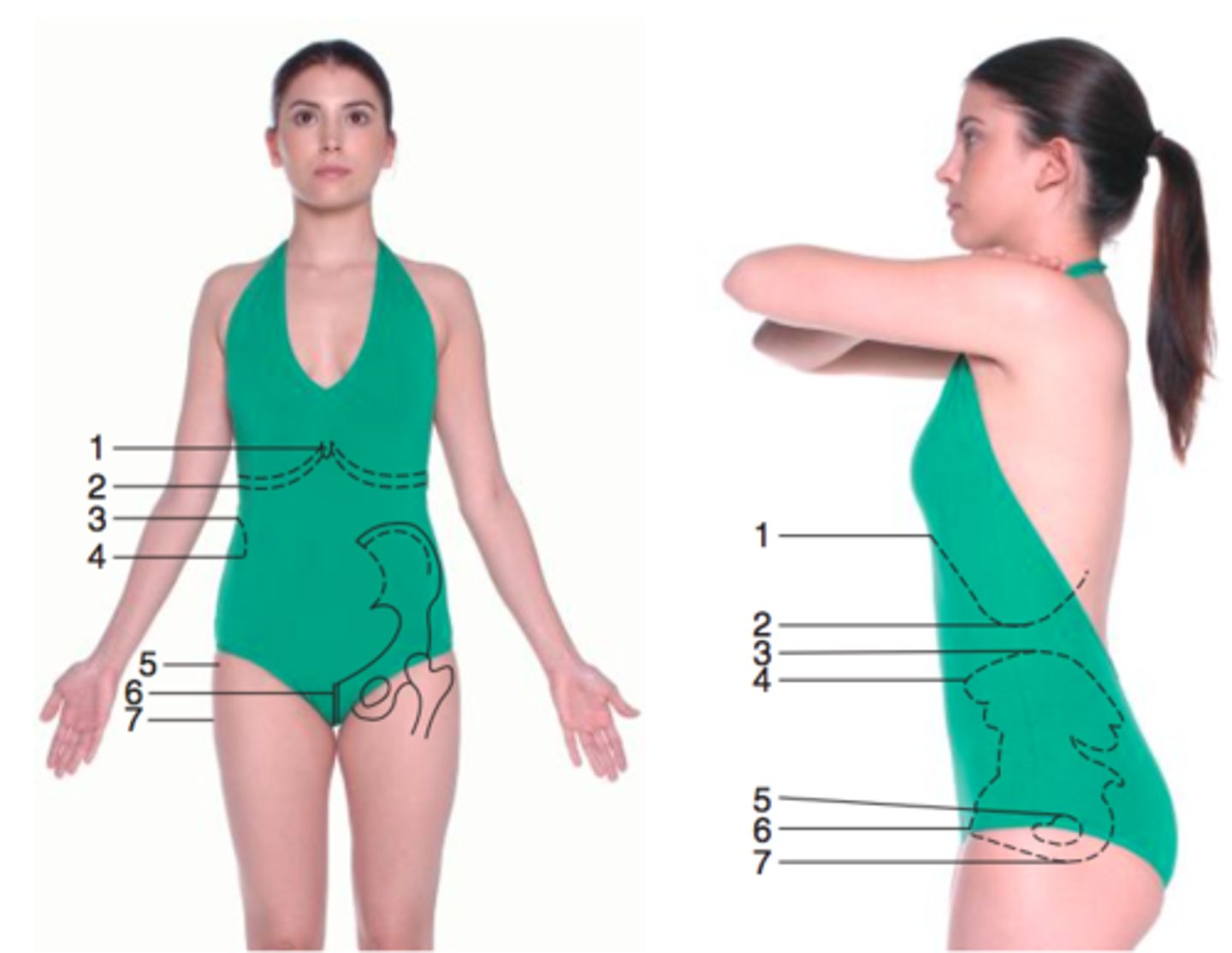
Anterior superior iliac spine (ASIS) location:
anterior aspect of the ilium- it is a prominent bump
Greater trochanter location:
rotate leg to feel it- at the same level of the pubis symphysis
Symphysis Pubis location:
the most superior anterior portion of the pubis
Ischial tuberosity location:
determines the lower margin on a PA abdomen or pelvis
What is easier to palpate on a bariatric (obese) patient?
ASIS; take two exposures both landscape
What needs to be performed if a patient has ascites?
An acute abdominal series- increase exposure factors
Pneomoperitoneum:
free air or gas in the peritoneal cavity.
best demonstrated in a horizontal beam decub, erect ab, or erect chest to see air rise
What should be performed for a pneumoperitoneum?
an acute abdominal series (erect); there will be a thin, crest-shaped radiolucency under the dome of the right hemidiaphragm on the erect images
Dynamic or mechanical bowel obstruction:
complete or nearly complete blockage of the flow of intestinal contents
What are the 4 types of dynamic blockage?
1. fibrous adhesions
2. Crohn's disease
3. Intussusception
4. Volvulus
Fibrous adhesions:
the most common cause of mechanically based obstruction, in which a fibrous band of tissue interrelates with the intestine, creating a blockage
Crohn's Disease:
chronic inflammation of the intestinal wall that results in bowel obstruction in at least half of affected patients
Intussusception:
telescoping of a section of bowel into another section or loop, creating an obstruction
Ileus (nonmechanical bowel obstruction):
Adynamic ileus and most frequently caused by peritonitis or paralytic ileus which is caused by lack of intestinal motility.
What does ileus mean?
intestinal obstruction
When does a nonmechanical bowel obstruction occur?
most in postoperative patients usually 24-72 hours after abdominal surgery.
Where does the large intestine begin?
begins in the RLQ at the junction of the small intestine and the ileocecal valve
Cecum: RLQ
is attached to the posteromedial aspect of the cecum
Ascending colon joins....
joins the transverse colon at the hepatic flexure (right)
Transverse colon joins...
descending colon at the splenic flexure (left).
What does colic mean?
pertaining to the colon
What is the transverse colon found between?
the hepatic and the splenic flexure
Descending colon continues as...
the S- shaped sigmoid colon in the lower abdomen
How long is the rectum?
final 6 inches
Where does the rectum end?
anus; sphincter muscle at the terminal opening of the large intestine
Is the transverse colon high or low in wide hypersthenic body types?
high in the abdomen
Is the transverse colon high or low in slender hyposthenic and asthenic body types?
low in the abdomen