Dermis
 Call Kai
 Learn
Learn Practice Test
 Spaced Repetition
 Match
Match Flashcards
 Knowt Play
1/9

There's no tags or description
Looks like no tags are added yet.
Name | Mastery | Learn | Test | Matching | Spaced | Call with Kai | Chat |
|---|
No analytics yet
Send a link to your students to track their progress
10 Terms
Dermis
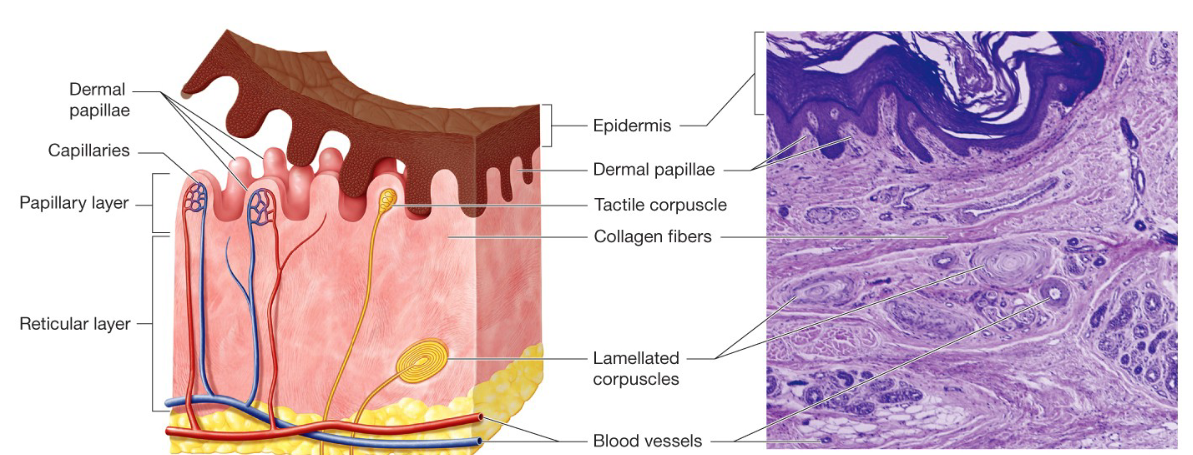
Deep part of the skin
Houses the blood supply of the epidermis
Contains sensory receptors
Anchors the epidermis in place
Divided into 2 layers:
papillary and reticular

Papillary Layer
Superficial layer of the dermis
Makes up about 20% of the depth of the dermis
Made of loose connective tissue
At the dermis-epidermis junction, special collagen fibers extend into the basement membrane to anchor the epidermis
Repetitive trauma disrupts these fibers and causes a fluid-filled pocket called a blister
The surface of the papillary layer folds into projections that push into the epidermis called Dermal Papillae

Dermal Papillae
Provide blood supply to the epidermis
House Tactile (Meissner) Corpuscles, which respond to light touch, and distinguish shape and texture of objects (Numerous in fingertips, lips, face, and external genitalia)
Reticular Layer
Deep layer of the dermis
Made of dense irregular connective tissue, which strengthens the dermis and allows it to stretch, and pockets of adipose tissue
Blood vessels, sweat glands, hairs, sebaceous glands, and sensory receptors, including Lamellated (Pacinian) Corpuscles, which respond to deep pressure and vibration, are prominent

Skin Markings
Interactions between the epidermis and dermis are visible as small lines in the epidermis
Most obvious are on the thick skin because dermal papillae are prominent and arrange into Dermal Ridges
The epidermis then indents to produce Epidermal Ridges that occur in patterns unique to each individual
Sweat pores open along these ridges and leave a Fingerprint on surfaces
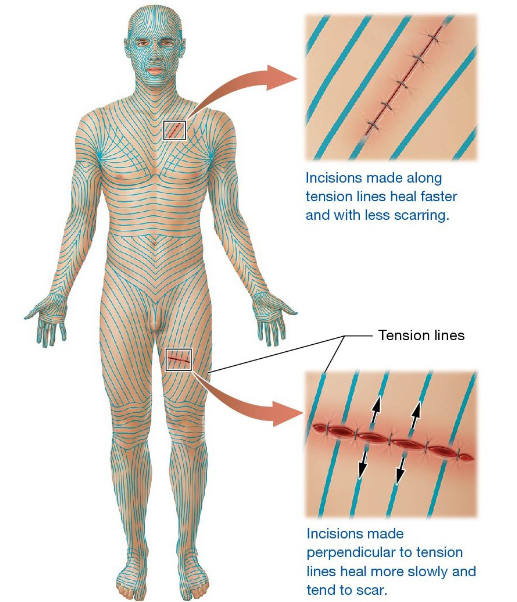
Gaps between collagen bundles in the reticular layer form Tension, or Cleavage Lines (Run in a circular pattern in the neck and trunk and longitudinally in the head and limbs)
Flexure Lines are deep creases found on areas such as the palms

Wrinkles
Result from age-related decreases in collagen and elastic fibers, proteoglycans, and adipose tissue in the dermis
Exposure to UV radiation and cigarette smoking accelerate formation of wrinkles
The appearance of wrinkles can be diminished by:
Botox®, fillers, peels, and topical creams
Botox
contains a bacterial toxin that paralyzes facial muscles for 4-6 months, causing the overlying skin to appear smoother
Fillers
Fillers containing adipose tissue, collagen, and/or proteoglycans are injected into wrinkles to temporarily “fill” them
Peels
use lasers, chemicals, or abrasion to remove the epidermis and superficial dermis to cause formation of new, hopefully firmer, skin
Topical Creams
contain ingredients that claim to reduce the appearance of wrinkles
however, most creams, particularly nonprescription products, have little effect on wrinkles