SKIN HAIR NAILS MOUTH NOSE HEAD NECK LYMPH THROAT & SINUSES
 Call Kai
 Learn
Learn Practice Test
 Spaced Repetition
 Match
Match Flashcards
 Knowt Play
1/43

Earn XP
Description and Tags
Health Assessment
Name | Mastery | Learn | Test | Matching | Spaced | Call with Kai | Chat |
|---|
No analytics yet
Send a link to your students to track their progress
44 Terms
Hirsutism
exessive hair growth in women
spoon shape nails
iron deficiency anemia
clubbing
oxygen deficiency
Beau’s lines
vitamin deficiencies
Thick Nails
fungal infections
Thin nails
nutritional anemia and decreased peripheral circulation
Pallor
Pale: anemia; low iron or hemoglobin
Erythema
Red: inflammation, fever, infection, allergic reaction, or sunburn
Cyanosis
Blue: breathing problems or heart failure
Jaundice
Yellow: liver disease
Mobility and Turgor
pinching and letting go of collarbone- shows dehydration
Macule
flat and a different color
Patch
a macule larger than 1cm
Papule
solid, elevated lesion raised less than 0.5 cm
Plaque
papules coming together to form a plateau like dic shaped lesion
Nodule
elevated skin papule that extends into the dermis
Tumor
lesion larger than a few centimeters in diameter deep into the dermis
Pustule
pus filled
vesicle
small clear fluid filled
Bulla
vesicle bigger than 0.5 centimeters
Wheal
superficial raised short lasting red lesion with irregular shape
Cyst
encapsulated fluid filled cavity in the dermis or subcutaneous layer that tensely elevated the skin
Annular

Confluent
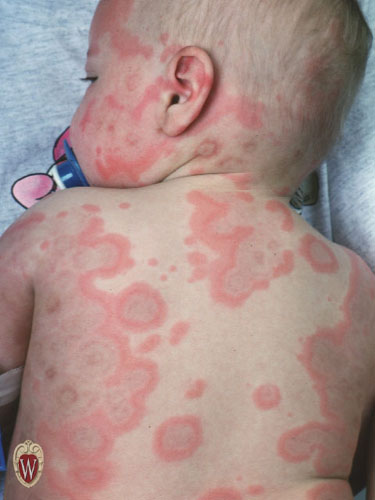
Linear

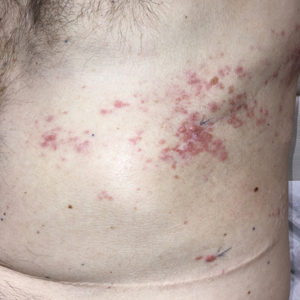
Dermatomal / Zosteriform
Shingles
Discrete

ABCDEs of Melanoma
Asymmetry, Border, Color, Diameter, Evolving (any change in size, shape, elevation or any new symptoms like itching, bleeding, crusting) Elevated
Basal Cell Carcinoma
a nodular ulcerative red/pink lesion with raised pearly margins. it is locally invasive and usually slow growing
Squamous Cell Carcinoma
arise from actinic keratosis as hardened red papules, plaques, or nodules. They are ulcerative and crusted and may metastasize
Melanoma
have irregular borders and colors and readily metastasize
The only two sinuses accessible to examination
frontal and maxillary
Normocephalic
Normal head shape
Anacephalic
large portion of brain/skull missing
Microcephalic
small head shape
Hydrocephalic
large fluid filled
Color of nose when you have an upper respiratory infection
bright red mucosa
color of nose when allergies
pale lavender mucosa
Halitosis
bad breath
Tonsils
mass of lymphoid tissue
Thyroid Assessment
extending the neck and swallowing
Normal Lymph Nodes
painless, small, and moveable
Lymph Nodes when Sick
Cancerous Lymph Nodes
big, no pain, and fixed in place