Motor Speech (+ Voice Final)
0.0(0)
Studied by 3 people Call Kai
 Learn
Learn Practice Test
 Spaced Repetition
 Match
Match Flashcards
 Knowt Play
Card Sorting
1/163

Earn XP
Description and Tags
Last updated 11:38 PM on 4/1/23
Name | Mastery | Learn | Test | Matching | Spaced | Call with Kai | Chat |
|---|
No analytics yet
Send a link to your students to track their progress
164 Terms
1
New cards
Who is the father of modern neurology?
Charcot
2
New cards
Dysarthria
motor speech disorder/speech production deficit that results from neuromotor damage to the PNS or CNS
Involves the five components of speech production.
Involves the five components of speech production.
3
New cards
Standardized tests for dysarthria (4)
1. Frenchay Dysarthria Assessment-2
2. Assessment of Intelligibility of Dysarthric Speech
3. The Speech Intelligibility Test for Windows
4. DDK rate
4
New cards
Apraxia of speech (definition and cause)
NOT due to ??
NOT due to ??
Inability to sequence movement of articulators for voluntary speech.
NOT due to muscle weakness/slowness. Caused by CNS damage.
NOT due to muscle weakness/slowness. Caused by CNS damage.
5
New cards
The only standardized test for apraxia is
Apraxia Battery for Adults-Second Edition (ABA-2)
6
New cards
Five components of speech production
Hint: It's a wrap!
Hint: It's a wrap!
RRAPP
respiration, resonance, articulation, phonation, prosody
respiration, resonance, articulation, phonation, prosody
7
New cards
Respiration
Provides subglottic air pressure needed to set vocal folds into vibration
8
New cards
Phonation
Production of voiced phonemes through vocal fold vibrations in larynx
9
New cards
Resonance
placement of oral or nasal tonality onto phonemes
\
\
\
\
10
New cards
Articulation
the shaping of the vocal air stream into phonemes
11
New cards
Prosody
The melody of speech (stress and intonation)
12
New cards
Salient features: STAR__SS__ (for motor eval)
How do you assess each? (What are its compromises?)
How do you assess each? (What are its compromises?)
•__Strength__: press tongue against a tongue blade, or stress test
(affects all 5 components)
•__Tone__: Listen to speech or assess body parts
(rigidity/spasticity = hypertonia, paralysis/weakness = hypotonia)
•__Accuracy of movement__: inaccurate movement can be assessed with AMR and SMR tasks, conversation, or reading
(distorted consonants, hypernasality)
•__Range of motion__: Assess reduced ROM by extending/holding articulators in various positions
(inability to completely open jaw or completely adduct vocal folds)
•__Speed of movement__: AMR and SMRs
(reduced speed of movement)
•__Steadiness:__ Hold a position or prolong a vowel
(tremors/involuntary movement, tremulous vocal quality)
(affects all 5 components)
•__Tone__: Listen to speech or assess body parts
(rigidity/spasticity = hypertonia, paralysis/weakness = hypotonia)
•__Accuracy of movement__: inaccurate movement can be assessed with AMR and SMR tasks, conversation, or reading
(distorted consonants, hypernasality)
•__Range of motion__: Assess reduced ROM by extending/holding articulators in various positions
(inability to completely open jaw or completely adduct vocal folds)
•__Speed of movement__: AMR and SMRs
(reduced speed of movement)
•__Steadiness:__ Hold a position or prolong a vowel
(tremors/involuntary movement, tremulous vocal quality)
13
New cards
Alternate Motion Rate (AMR) - definition and usefulness
assessment of patient's ability to move articulators rapidly and smoothly in repetitive motion ( p^ p^ p^)
Useful to see dysarthria symptoms
Useful to see dysarthria symptoms
14
New cards
Sequential Motion Rate (SMR) - definition and usefulness
Assesses patient's ability to move articulators in a rapid smooth sequence (p^ t^ k^)
Useful to see apraxia of speech symptoms
Useful to see apraxia of speech symptoms
15
New cards
CNS consists of the ____ and _____
brain and spinal cord
16
New cards
The PNS consists of _________ and ______
cranial nerves and spinal nerves
17
New cards
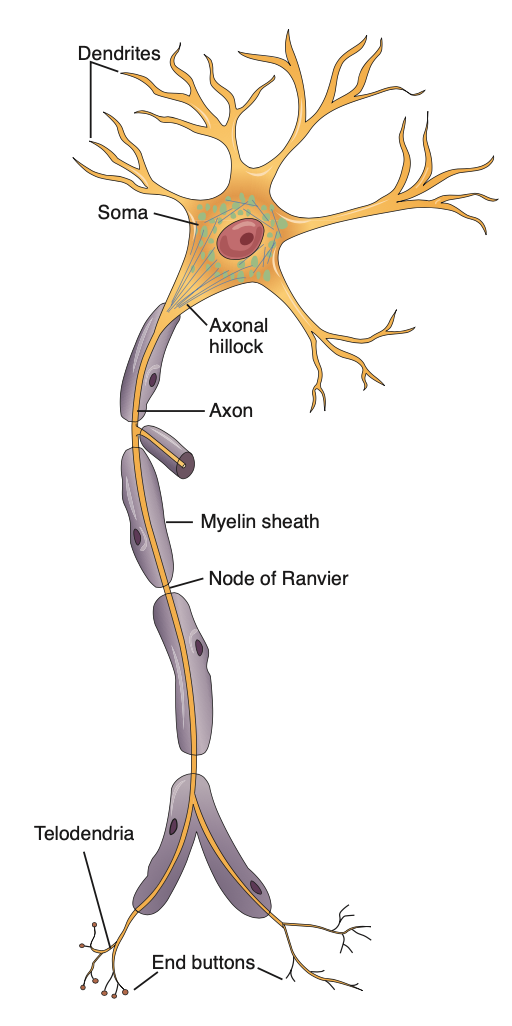
Neurons: Function and 3 parts
Transmits electrochemical signals that control body functions
Parts: Cell body, dendrites, and the axon (which is covered by myelin)
Parts: Cell body, dendrites, and the axon (which is covered by myelin)
18
New cards
Efferent neurons vs Afferent neurons
Efferent neurons transmit their impulses __away__ from the CNS
\*Hint: Get the __eff__ away from me!
\
Afferent neurons transmit their impulses __toward__ the CNS
\*Hint: Afferent = __Affe__ction (you want to be close)
\*Hint: Get the __eff__ away from me!
\
Afferent neurons transmit their impulses __toward__ the CNS
\*Hint: Afferent = __Affe__ction (you want to be close)
19
New cards
12 Cranial Nerves
\
Note which CN controls pharynx and velum.
\
Note which CN controls pharynx and velum.
Oh, oh, oh, to take a family vacation go vegas and hawaii
1. Olfactory - smell
2. Optic - sight
3. Oculomotor - ability to move eyes
4. Trochlear - *up and down* eye movement
5. Trigeminal - Jaw, chewing muscles 3 sensations (touch, temp, pain)
6. Abducens - *side to side* eye movement
7. Facial - facial muscles
8. Vestibulocochlear - hearing and balance
9. Glossopharyngeal - swallowing, shaping pharynx, __controls pharynx and velum__
10. Vagus - heart rate, respiratory rate, digestion (think of winning jackpot in Vegas)
11. Accessory/Spinal - Head, neck, shoulder movements (think of where you wear accessories)
12. Hypoglossal - tongue muscles
1. Olfactory - smell
2. Optic - sight
3. Oculomotor - ability to move eyes
4. Trochlear - *up and down* eye movement
5. Trigeminal - Jaw, chewing muscles 3 sensations (touch, temp, pain)
6. Abducens - *side to side* eye movement
7. Facial - facial muscles
8. Vestibulocochlear - hearing and balance
9. Glossopharyngeal - swallowing, shaping pharynx, __controls pharynx and velum__
10. Vagus - heart rate, respiratory rate, digestion (think of winning jackpot in Vegas)
11. Accessory/Spinal - Head, neck, shoulder movements (think of where you wear accessories)
12. Hypoglossal - tongue muscles
20
New cards
Cranial nerves for speech production (5, 7, (8), 9, 10, 11, 12)
\
Kahoot Q: Which one is the most important for speech production?
\
Kahoot Q: Which one is the most important for speech production?
"Take family vacation***, go Vegas and Hawaii"
CN V - Trigeminal
CN VII- Facial
CN VIII - Vestibulocochlear\* (Not on PPT)
CN IX - Glossopharyngeal
CN X - Vagus
CN XI - Accessory spinal
CN XII - Hypoglossal
\
Kahoot: Vagus
CN V - Trigeminal
CN VII- Facial
CN VIII - Vestibulocochlear\* (Not on PPT)
CN IX - Glossopharyngeal
CN X - Vagus
CN XI - Accessory spinal
CN XII - Hypoglossal
\
Kahoot: Vagus
21
New cards
3 Branches of the Vagus Nerve are…..
\-What does the Vagus nerve innervate? Which other CN works with Vagus to innervate these?
\-Damage to which of these branches will result in damage to the velum?
\-What does the Vagus nerve innervate? Which other CN works with Vagus to innervate these?
\-Damage to which of these branches will result in damage to the velum?
Recurrent nerve branch, the Superior laryngeal nerve branch, and the Pharyngeal branch
\
Innervates pharynx, larynx, and velum. Spinal Accessory nerve works with Vagus to innervate these as well.
\
pharyngeal branch innervates the velum and pharynx
\
Innervates pharynx, larynx, and velum. Spinal Accessory nerve works with Vagus to innervate these as well.
\
pharyngeal branch innervates the velum and pharynx
22
New cards
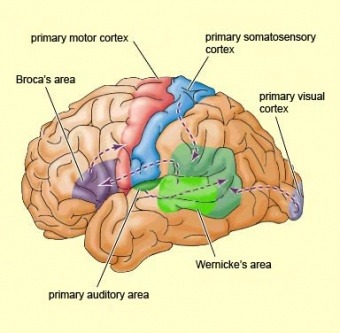
Primary Cortex (Function)
\
What are the 4 primary cortices?
\
What are the 4 primary cortices?
Areas of cerebral cortex that first receive sensory impulses from the body
1. Primary visual cortex
2. Primary motor cortex
3. Primary auditory cortex
4. Primary sensory cortex
\*Think VMAS - visual, motor, auditory, sensory - and how it’s a big show that *first gives you sensory impulses*
1. Primary visual cortex
2. Primary motor cortex
3. Primary auditory cortex
4. Primary sensory cortex
\*Think VMAS - visual, motor, auditory, sensory - and how it’s a big show that *first gives you sensory impulses*
23
New cards
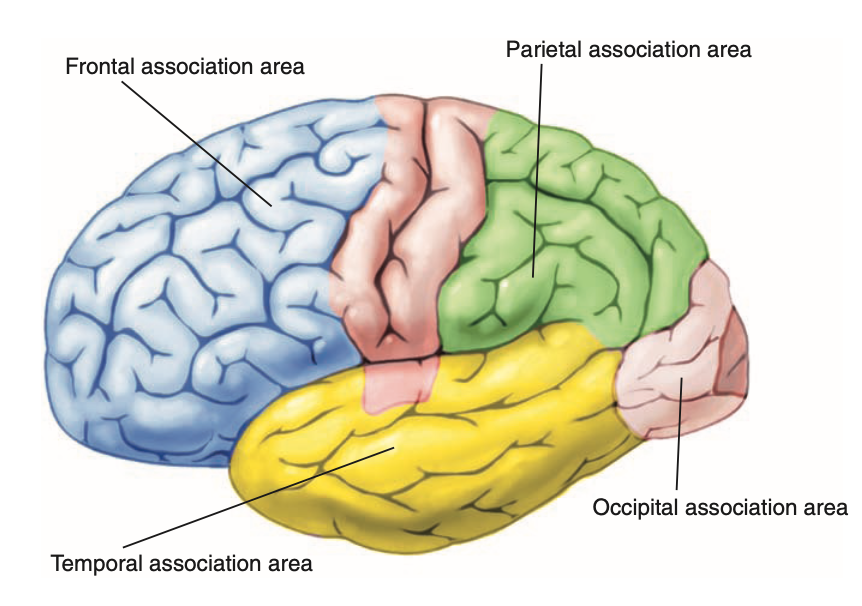
Association Cortex (Function, Areas)
\
Sends neural signals of intended motor movements to __________ and _________
\
Sends neural signals of intended motor movements to __________ and _________
Interprets and integrates sensory info from the primary cortex
\
1. Frontal association
2. Parietal association,
3. Occipital association
4. Temporal association
\*Think FPOT - fuck pot since it affects your ability to *interpret and integrate sensory info*
\
basal ganglia and cerebellum
\
1. Frontal association
2. Parietal association,
3. Occipital association
4. Temporal association
\*Think FPOT - fuck pot since it affects your ability to *interpret and integrate sensory info*
\
basal ganglia and cerebellum
24
New cards
Basal Ganglia: 3 Parts
\
What 2 parts make the striatum?
\
What 2 parts make the striatum?
putamen, caudate nucleus, and globus pallidus
\
striatum: caudate nucleus and putamen
\
striatum: caudate nucleus and putamen
25
New cards
Basal Ganglia: Function and Compromises (2)
Acts like a filter to prevent unwanted movements
Compromises: Huntington's (hyperkinetic dysarthria) and Parkinson's (hypokinetic dysarthria) disease
Compromises: Huntington's (hyperkinetic dysarthria) and Parkinson's (hypokinetic dysarthria) disease
26
New cards
BG: Parkinsonism causes _______________ and ________________ movements while Huntington's disease causes ___________ and _________________ movements
PD: rigid, restricted
HD: Rapid, dance-like
HD: Rapid, dance-like
27
New cards
Basal Ganglia: To function properly it needs a balanced interaction of __________________ and _____________________.
Dopamine (inhibitory) and Acetylcholine (excitatory)
28
New cards
Cerebellum ("little brain") function and compromises
Coordinates movement of limbs
Compromises: ataxia and intention/essential tremors
Compromises: ataxia and intention/essential tremors
29
New cards
Intention/Essential tremors vs Resting tremors
Intention/Essential: Occurs during voluntary movement. Absent at rest
Resting: Occurs at rest
Resting: Occurs at rest
30
New cards
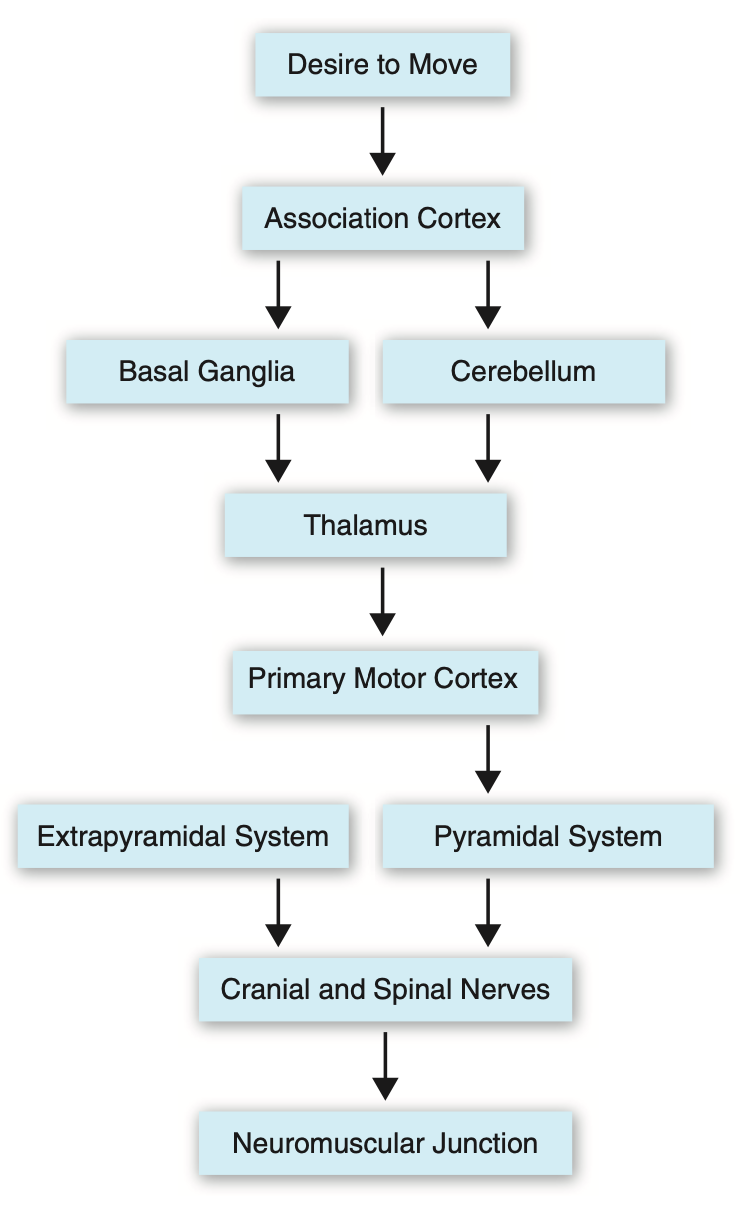
Thalamus: Function and 2 compromises
Receives neural inputs of planned motor movements from BG and cerebellum on its way to the primary cortex; “sensory gateway”, refines?
Compromises: Thalamic aphasia, thalamic pain syndrome
Compromises: Thalamic aphasia, thalamic pain syndrome
31
New cards
Dysarthria Main Assessment Tasks (3)
• AMRs
• Conversational speech or reading
• Vowel prolongations
• Conversational speech or reading
• Vowel prolongations
32
New cards
Upper Motor Neurons (UMN) definition and damage
CNS motor neurons that descend to the lower motor neurons in the PNS
Damage: spasticity, spastic dysarthria
Damage: spasticity, spastic dysarthria
33
New cards
Lower Motor Neurons (LMN) definition and damage
PNS motor neurons that connect the UMNs in the CNS to the innervated muscle to perform a movement
damage: muscle paralysis/paresis, flaccid dysarthria
damage: muscle paralysis/paresis, flaccid dysarthria
34
New cards
Flaccid Dysarthria is caused by damage to _______________
Lower motor neurons in the PNS, which cause muscle weakness
35
New cards
Causes of Flaccid Dysarthria (8)
What is the most common cause?
What is the most common cause?
• Surgical/physical trauma (most common cause)
• Strokes
• Tumors
• Muscular Dystrophy
• Myasthenia Gravis
• Guillain-Barré Syndrome
• Progressive Bulbar Palsy
• Polio
• Strokes
• Tumors
• Muscular Dystrophy
• Myasthenia Gravis
• Guillain-Barré Syndrome
• Progressive Bulbar Palsy
• Polio
36
New cards
SLPs stress test (ex: counting quickly from 1-100) the motor speech mechanism to screen for what?
Myasthenia Gravis (A cause of Flaccid dysarthria)
37
New cards
All cranial nerves are affected in which dysarthria?
Flaccid
38
New cards
Ischemic Stroke vs Hemorrhagic Stroke
Ischemic: blocked artery in brain
Hemorrhagic: ruptured artery in brain (causes bleeding)
Hemorrhagic: ruptured artery in brain (causes bleeding)
39
New cards
Myasthenia Gravis is a cause of _______________ dysarthria
What is MG?
What is MG?
Flaccid dysarthria
NMJ disease causing progressive muscle weakness
NMJ disease causing progressive muscle weakness
40
New cards
Guillain-Barré Syndrome is a cause of ________________ dysarthria
What is GBS?
What is GBS?
Flaccid
Disease due to progressive demyelination in the PNS
Disease due to progressive demyelination in the PNS
41
New cards
Polio is a cause of _____________ dysarthria
What is Polio?
What is Polio?
Flaccid
Viral disease that attacks LMNs
Viral disease that attacks LMNs
42
New cards
Progressive Bulbar Palsy is a cause of ________________ dysarthria and _________________ dysarthria
What is Progressive Bulbar Palsy?
What is Progressive Bulbar Palsy?
Flaccid and Mixed (flaccid-spastic)
Disorder that can affect both LMNs and UMNs.
Disorder that can affect both LMNs and UMNs.
43
New cards
Flaccid Dysarthria Speech Characteristics (5)
•Hypernasality (most evident)
•Breathy phonation
•Imprecise consonants
•Abnormal prosody
•Shallow breath support
•Breathy phonation
•Imprecise consonants
•Abnormal prosody
•Shallow breath support
44
New cards
Flaccid Dysarthria: Treatments
Surgical treatment for velopharyngeal incompetence:
\- Pharyngeal flap procedure
\- Teflon injection
\*\*\*\*\*\*\*\*\*\*\*\*\*\*\*\*\*\*\*\*\*\*\*\*\*\*\*\*
\- Palatal Lift
\- Velar strengthening exercises (CPAP)
\- Hard glottal attacks
\- breathy cough, frequent inhalations
\- Pharyngeal flap procedure
\- Teflon injection
\*\*\*\*\*\*\*\*\*\*\*\*\*\*\*\*\*\*\*\*\*\*\*\*\*\*\*\*
\- Palatal Lift
\- Velar strengthening exercises (CPAP)
\- Hard glottal attacks
\- breathy cough, frequent inhalations
45
New cards
Spastic Dysarthria is caused by _________________
Bilateral damage to the upper motor neurons (in pyramidal and extrapyramidal systems of the CNS)
- Must have had more than one stroke!
- Must have had more than one stroke!
46
New cards
Spastic Dysarthria Causes (6)
What is the most common cause?
What is the most common cause?
•Strokes (most common)
•ALS and MS (degenerative diseases)
•TBIs
•Infections
•Tumors
•Cerebral anoxia
•ALS and MS (degenerative diseases)
•TBIs
•Infections
•Tumors
•Cerebral anoxia
47
New cards
Amyotrophic lateral sclerosis (ALS) is a cause of _____________dysarthria and _____________dysarthria
\
What is ALS?
\
What is ALS?
Spastic and Mixed (flaccid-spastic)
\
Degenerative disease that results in progressive degeneration of LMNs and UMNs
\
Degenerative disease that results in progressive degeneration of LMNs and UMNs
48
New cards
Should patients with ALS learn AAC with no detectable speech sound disorder?
Yes
49
New cards
Multiple Sclerosis (MS) is a cause of ___________dysarthria and __________ dysarthria
\
What is MS?
\
What is MS?
Spastic and mixed
Progressive degeneration of CNS myelin sheath
Progressive degeneration of CNS myelin sheath
50
New cards
Spastic Dysarthria Speech (5) & Muscle (2) Characteristics
Speech
•Harsh or strained-strangled phonation
•Slow rate, effortful speech
•Imprecise consonants
•Hypernasality (no nasal emissions)
•Abnormal prosody
Muscle
•Abnormal/Hyper reflexes
•Hypertonia/Spasticity in articulators
•Harsh or strained-strangled phonation
•Slow rate, effortful speech
•Imprecise consonants
•Hypernasality (no nasal emissions)
•Abnormal prosody
Muscle
•Abnormal/Hyper reflexes
•Hypertonia/Spasticity in articulators
51
New cards
Spastic Dysarthria Non-Speech Characteristics (2)
Pseudobulbar affect (uncontrollable laughing/crying)
Drooling
Drooling
52
New cards
Spastic Dysarthria Treatment
Primary treatment goals: Target 4 or 5 components of speech production
reduce hyperadduction and hypertonia via relaxation/stretching exercises
reduce hyperadduction and hypertonia via relaxation/stretching exercises
53
New cards
Spastic vs Flaccid dysarthria (3 things each)
Spastic
•Bilateral UMN lesion
•Strained, strangled, and/or harsh vocal quality
•Emotional lability (Pseudobulbar affect)
Flaccid
•LMN lesion
•Hypernasality + nasal emissions
•Breathy vocal quality
•Bilateral UMN lesion
•Strained, strangled, and/or harsh vocal quality
•Emotional lability (Pseudobulbar affect)
Flaccid
•LMN lesion
•Hypernasality + nasal emissions
•Breathy vocal quality
54
New cards
Unilateral UMN Dysarthria is caused by _____________
Unilateral damage to the upper motor neurons
55
New cards
UMN Dysarthria Causes (3)
What is the most common cause?
What is the most common cause?
•Stroke - frontal lobe (most common cause) •Tumors
•TBI (least common cause)
•TBI (least common cause)
56
New cards
UMN Dysarthria: Speech Characteristics (4)
Most common is ____________
Most common is ____________
•Imprecise consonants (most common)
•Mild-moderate harsh vocal quality
•Mild Hypernasality
•Irregular articulatory breakdowns
•Mild-moderate harsh vocal quality
•Mild Hypernasality
•Irregular articulatory breakdowns
57
New cards
UMN dysarthria is primarily a disorder of __________________________
Articulation
58
New cards
UMN dysarthria: If lesion is on left side of brain, the lower _____ side of the face and tongue and limbs show weakness.
right
59
New cards
UMN Dysarthria: Damage in left vs right hemisphere
Left hemisphere: Aphasia and apraxia
Right hemisphere: Visual and cognitive deficits
Right hemisphere: Visual and cognitive deficits
60
New cards
Unilateral UMN Dysarthria vs Spastic Dysarthria (lesion sites)
UMN: Damage to UMNs on one side of the brain
Spastic: Damage to UMNs on both sides of the brain
Spastic: Damage to UMNs on both sides of the brain
61
New cards
Unilateral UMN: Extra Assessment Tasks
Know the site of lesion!
62
New cards
Unilateral UMN Dysarthria: Articulation Treatment Tasks (4)
Traditional articulation tasks such as
• Phonetic placement
• Intelligibility drills
• Over-articulation
• Minimal contrast drills
• Phonetic placement
• Intelligibility drills
• Over-articulation
• Minimal contrast drills
63
New cards
Ataxia
poor muscle control, impaired coordination (clumsy movements)
64
New cards
Ataxic Dysarthria is caused by damage to the __________________
cerebellum
65
New cards
Cerebellar Ataxia: Symptoms (6)
* problems coordinating voluntary movements
* problems controlling timing and force of speech movements
* staggering, wide-based gait
* intention tremors
* hypotonia
* problems with motor learning
* problems controlling timing and force of speech movements
* staggering, wide-based gait
* intention tremors
* hypotonia
* problems with motor learning
66
New cards
Ataxic dysarthria: Causes (6)
Most common causes are ______________ and ___________________.
Most common causes are ______________ and ___________________.
•Degenerative diseases (most common)
•stroke (most common too)
•toxic conditions
•TBI
•Tumors in cerebellum
•Infections
•stroke (most common too)
•toxic conditions
•TBI
•Tumors in cerebellum
•Infections
67
New cards
Ataxic dysarthria:
What are the two main speech deficits?
Speech characteristics (5)
What are the two main speech deficits?
Speech characteristics (5)
Main deficits are in: Articulation and Prosody
• Drunken/slurred speech
• Imprecise consonants
• Abnormal prosody (monotone)
- Equal stress!!!
• Distorted vowels
• Irregular articulatory breakdowns
• Drunken/slurred speech
• Imprecise consonants
• Abnormal prosody (monotone)
- Equal stress!!!
• Distorted vowels
• Irregular articulatory breakdowns
68
New cards
Ataxic dysarthria: Scanning speech is _________
slow deliberate production of syllables with each syllable in a word receiving equal stress
69
New cards
Friedrich's ataxia is a cause of ________ dysarthria and ________ dysarthria
\
What is FA?
\
What is FA?
Ataxic, mixed (ataxic-spastic)
\
Progressive disease that affects spine and cerebellum
\
Progressive disease that affects spine and cerebellum
70
New cards
Olivopontocerebellar Degeneration/Atrophy
is a cause of ____________dysarthria
\
What is Olivopontocerebellar degeneration?
is a cause of ____________dysarthria
\
What is Olivopontocerebellar degeneration?
Ataxic.
\
A progressive cerebellar disorder
\
A progressive cerebellar disorder
71
New cards
Ataxia dysarthria: Extra Assessment Task
Repeating sentences with multisyllabic words
72
New cards
Ataxic Dysarthria: Treatment concentrates on what 3 things?
Name an example assessment task for each.
Name an example assessment task for each.
• Controlling respiration (Ex: Stop phonation early)
• Increasing articulatory accuracy (Ex: Intelligibility drills)
• Developing optimal rate and intonation in connected speech (Ex: Intonation profiles)
• Increasing articulatory accuracy (Ex: Intelligibility drills)
• Developing optimal rate and intonation in connected speech (Ex: Intonation profiles)
73
New cards
Hypokinetic means
Less motion
74
New cards
Hypokinetic Dysarthria is caused by a reduction of ________________ in the ___________________.
A reduction of dopamine in the basal ganglia.
75
New cards
Hypokinetic dysarthria: Causes (7)
The most common cause is ________________
The most common cause is ________________
• Idiopathic Parkinsonism (most common)
• Stroke
• Neuroleptic-induced Parkinsonism
• Punch Drunk Encephalopathy/CTE
• Infection (Postencephalitic Parkinsonism)
• TBI
• Cerebral anoxia
• Toxic metal poisoning
• Stroke
• Neuroleptic-induced Parkinsonism
• Punch Drunk Encephalopathy/CTE
• Infection (Postencephalitic Parkinsonism)
• TBI
• Cerebral anoxia
• Toxic metal poisoning
76
New cards
Parkinsonisms are seen in patients with ____________________ dysarthria and is due to reduction of _________________ to the ________________
Hypokinetic, dopamine, Basal Ganglia
77
New cards
Hypokinetic Dysarthria: Speech Characteristics (5)
________________________ is the only distinctive feature of this dysarthria.
________________________ is the only distinctive feature of this dysarthria.
• Bradykinesia
• Harsh or breathy phonation (voice)
• Imprecise consonants (artic)
• Abnormal prosody (prosody)
• Rapid rate of speech (in some patients - only distinctive feature of this dysarthria)
• Harsh or breathy phonation (voice)
• Imprecise consonants (artic)
• Abnormal prosody (prosody)
• Rapid rate of speech (in some patients - only distinctive feature of this dysarthria)
78
New cards
Hypokinetic Dysarthria: Palilalia (Unusual disfluency)
Compulsive rapid repetition of words or phrases (I like like like like that bag)
79
New cards
Hypokinetic dysarthria: Bradykinesia is the ________________.
Reduction in the range and speed of speech movements
80
New cards
Hypokinetic dysarthria: Repeated phonemes are _____________
Repetitions that usually take place at the beginning of an utterance or after a pause
81
New cards
Hypokinetic dysarthria: Treatment concentrates on _________, ___________, and __________
• Improving articulatory precision (Articulation)
• Increasing phonatory effort (phonation)
• Promoting more natural prosody (Prosody)
• Increasing phonatory effort (phonation)
• Promoting more natural prosody (Prosody)
82
New cards
Hypokinetic Dysarthria: Treatment Options (4)
Most commonly used treatment is _____________
Most commonly used treatment is _____________
• Drug-based or Pharmacologic (most commonly used)
• Surgical
• Ablative or Deep brain stimulation
• Stem-Cell Implantation
• Behavioral (Delayed auditory feedback)
• Surgical
• Ablative or Deep brain stimulation
• Stem-Cell Implantation
• Behavioral (Delayed auditory feedback)
83
New cards
Hyperkinetic means
Too much movement
84
New cards
Hyperkinetic Dysarthria is caused by damage to the
Basal Ganglia
85
New cards
Hyperkinetic Dysarthria is caused by hyperkinetic movement disorders such as (6)
• Chorea
• Huntington's disease
• Dystonia
• Tic disorders
• Myoclonus
• Essential tremors
• Huntington's disease
• Dystonia
• Tic disorders
• Myoclonus
• Essential tremors
86
New cards
Chorea is a cause of __________________ dysarthria
\
What is chorea?
\
What is chorea?
Hyperkinetic dysarthria
\
Movement disorder that causes unpredictable dance-like movements
\
Movement disorder that causes unpredictable dance-like movements
87
New cards
Huntington's disease is a cause of _________________________ dysarthria.
\
What is HD? Movements it causes?
\
What is HD? Movements it causes?
Hyperkinetic
\
Progressive disorder due to degeneration in BG that causes rapid dancelike movements
\
Progressive disorder due to degeneration in BG that causes rapid dancelike movements
88
New cards
Myoclonus is a cause of ___________________ dysarthria.
\
What is myoclonus?
\
What is myoclonus?
Hyperkinetic
\
Brief involuntary muscle contractions/ muscle jerks
\
Brief involuntary muscle contractions/ muscle jerks
89
New cards
Essential tremor is a cause of __________________ dysarthria.
\
What are essential tremors?
\
What are essential tremors?
Hyperkinetic
\
Occurs during voluntary movement. Absent at rest.
\
Occurs during voluntary movement. Absent at rest.
90
New cards
Dystonia is a cause of ______________ dysarthria.
\
What is dystonia?
\
What is dystonia?
Hyperkinetic
\
movement disorder that causes involuntary, prolonged contractions
\
movement disorder that causes involuntary, prolonged contractions
91
New cards
Hyperkinetic dysarthria:
Four types of dystonias and their definitions
Four types of dystonias and their definitions
• Focal
- only one part of body
• Segmental
- 2 or more body parts
• Generalized
- all 4 limbs
• Hemidystonia
- 2 or more body parts on same side of body
- only one part of body
• Segmental
- 2 or more body parts
• Generalized
- all 4 limbs
• Hemidystonia
- 2 or more body parts on same side of body
92
New cards
Tic disorders are a cause of ___________ dysarthria
\
What is a tic disorder?
\
What is a tic disorder?
Hyperkinetic
\
Rapid movement that is performed often due to __compulsive__ desire (unlike myoclonic contractions)
\
Rapid movement that is performed often due to __compulsive__ desire (unlike myoclonic contractions)
93
New cards
Motor tics vs Vocal tics (name 2 each)
Motor tics: eye blinks, hand gestures, shrugs, twitches
Vocal tics: palilalia (repetitions of one word), coprolalia (inappropriate words), grunts, barking
Vocal tics: palilalia (repetitions of one word), coprolalia (inappropriate words), grunts, barking
94
New cards
For _____________dysarthria, speech characteristics vary depending on the movement disorder
Hyperkinetic
95
New cards
Hyperkinetic Dysarthria: Speech Characteristics (4)
• Involuntary movements
• unexpected inhalations and exhalation
• irregular articulatory breakdowns
• abnormal prosody
• unexpected inhalations and exhalation
• irregular articulatory breakdowns
• abnormal prosody
96
New cards
Hyperkinetic Dysarthria: Extra Assessment Task
Observation of associated involuntary movements
97
New cards
Hyperkinetic Dysarthria: Treatment Options (3)
What is the most successfully used treatment?
What is the most successfully used treatment?
• Pharmacologic (most commonly used)
- Botox injections
• Deep brain stimulation
• Behavioral
- Botox injections
• Deep brain stimulation
• Behavioral
98
New cards
BG Damage: Huntington's disease is a cause of _____________ dysarthria while Parkinson's disease is a cause of _______________ dysarthria (Think of movements)
hyperkinetic, hypokinetic
99
New cards
Mixed Dysarthria
There is brain damage in two or more parts of the motor system
100
New cards
ALS is a cause of _____________dysarthria and ____________ dysarthria
Mixed and Spastic