Audit Exam 1 Material
 Call Kai
 Learn
Learn Practice Test
 Spaced Repetition
 Match
Match Flashcards
 Knowt Play
1/31

There's no tags or description
Looks like no tags are added yet.
Name | Mastery | Learn | Test | Matching | Spaced | Call with Kai | Chat |
|---|
No analytics yet
Send a link to your students to track their progress
32 Terms
Why Have An Audit?
Reason #1: It’s the Law
Securities laws, SOX, and Dodd-Frank require it
All public companies must have a financial statement audit
Most must also have an internal controls audit
Reason #2: It’s Good Business
Want a bank loan? Lenders want audited numbers
Want investors? They demand assurance
Markets NEED trust to function
Who Runs the Company vs. Who Owns It?
Who Runs the Company vs. Who Owns It?
Stockholders ----> hire ----> Managers
(Principals) (Agents)
Own the company Run the company
NOT involved in day-to-day Know everything
Why Trust Breaks Down?
Information asymmetry –> Managers know more than investors & creditors
Conflict of interest –> Managers may not act in owners’ best interest
Information risk –> Managers might misrepresent the financials
Management’s Claims: The Assertions

Three Nested Services
Assurance – improves the quality of information for decision makers
Within assurance there's....
Attestation – a report on subject matter that is another party’s responsibility
Within attestation there's....
Auditing – objectively obtain and evaluate evidence to assess another party’s assertions that it has presented info in accordance with GAAP
Auditing
Provides positive assurance
Provides reasonable assurance
Audit report accompanies annual SEC filing (Form 10-K)
Is a subcategory of service type within both attestation and assurance
Three Concepts That Explain Everything
Materiality: How big does a misstatement need to be to matter to a decision maker?
Audit risk: The risk the auditor gives a clean opinion on materially misstated statements
Reasonable assurance: High – but not absolute – confidence. Audit are NOT guarantees.
Four Types of Auditors
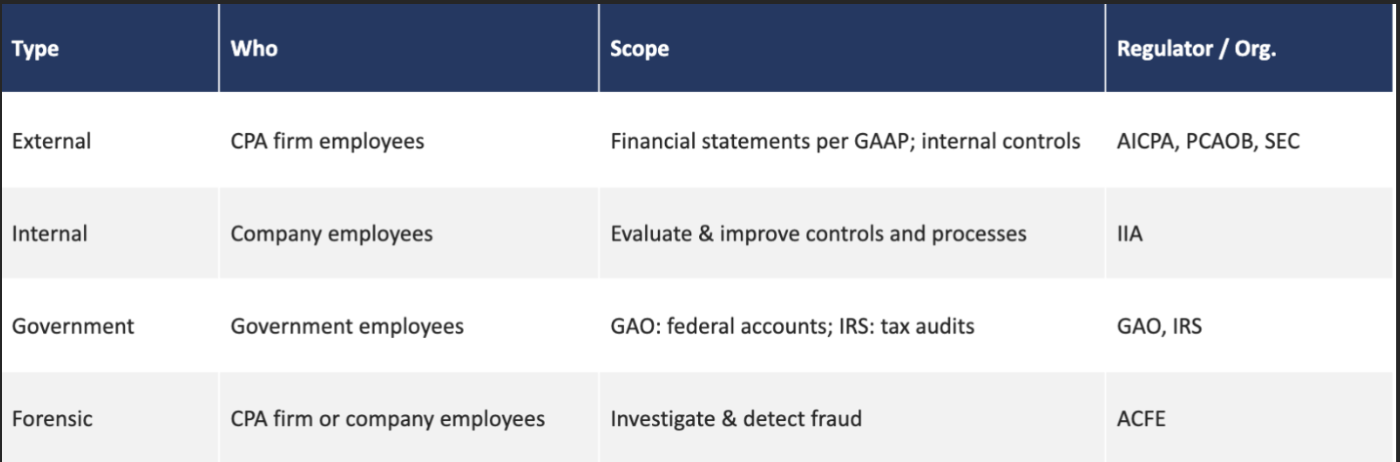
Inside a CPA firm: The Team
STAFF (you, soon!) - Performs procedures: inventory counts, confirmations
SENIOR – Supervises staff and fieldwork
MANAGER – Helps supervise & plan; key audit judgements
PARTNER – Supervises audit; signs the opinion
2001-2022: The Profession’s Reckoning
What went wrong?
The question Congress asked:
Can you objectively audit a system you designed – for a client paying you millions in consulting fees?
Massive accounting scandals – Enron, WorldCom (remember Chapter 1!)
Auditors were selling non-audit services to audit clients:
IT System design
Tax services and bookkeeping
Outsourced internal audit
Question: Can you objectively audit a system you designed – for a client paying you millions in consulting fees?
Congress Responds: Sarbanes-Oxley (SOX)
SOX Changes:
SOX Changes:
Created the PCAOB -> Independent board: inspects firms, set standards, funds scholarships
Internal controls focus -> Public companies get a controls audit, not just an FS audit
CEO & CFO certification -> Executives personally certify the financial statements
SOX: Protecting Auditor Independence
What SOX requires:
Bans most non-audit services for audit clients
Mandatory PARTNER rotation: 5 years on, then 5 years off (lead and EQR partners)
What SOX does NOT require:
Audit FIRM rotation is NOT mandated – the firm can stay indefinitely; only the partners rotate.
The Auditor’s Mindset: Professional Skepticism
Questioning mind: Don’t assume management is honest OR dishonest - verify
Critical assessment of evidence: Ask: is this evidence sufficient? Reliable? Consistent?
Alert on contradictions: Follow up when documents or explanations don’t add up
Know Your Client Before You Audit
Corporate governance: who oversees management?
Board of directors – elected by shareholders
Audit committee – independent contractors who hire, pay, and oversee the external auditors
Why industry matters
Different companies = different risks and different accounting (banking vs. Retail vs. Software)
The auditor must understand the business to know where misstatements are likely
Who Sets the Rules?
Standard setters
PCAOB
.Applies to: Audits of U.S PUBLIC companies
Standards: Auditing Standards (AS)
AICPA (ASB)
Applies to: Audits of U.S PRIVATE companies
Standards: Statements on Auditing Standards (SAS)
IAASB
Applies to: International audits
Standards: International Standards on Auditing (ISA)
Premise and Purpose of an Audit
Auditor provides and opinion on whether the financial statements are presented fairly in all material respects
Management Responsibilities (PIE)
Prepare the financial statements
Internal Controls
Evidence – provide relevant information to the auditor
GAAS: Three Categories of Principles
RESPONSIBILITIES:
Competence & capabilities
Ethics & independence
Professional skepticism & judgement
PERFORMANCE
Plan the work
Assess risk & materiality
Gather sufficient, appropriate evidence
REPORTING
Express an opinion
State whether statements follow the framework (GAAP)
Ethics:
A system of moral principles governing what is right and wrong conduct.
Professionalism:
The conduct, aims, and qualities expected of a professional – holding yourself to standards beyond personal interest.
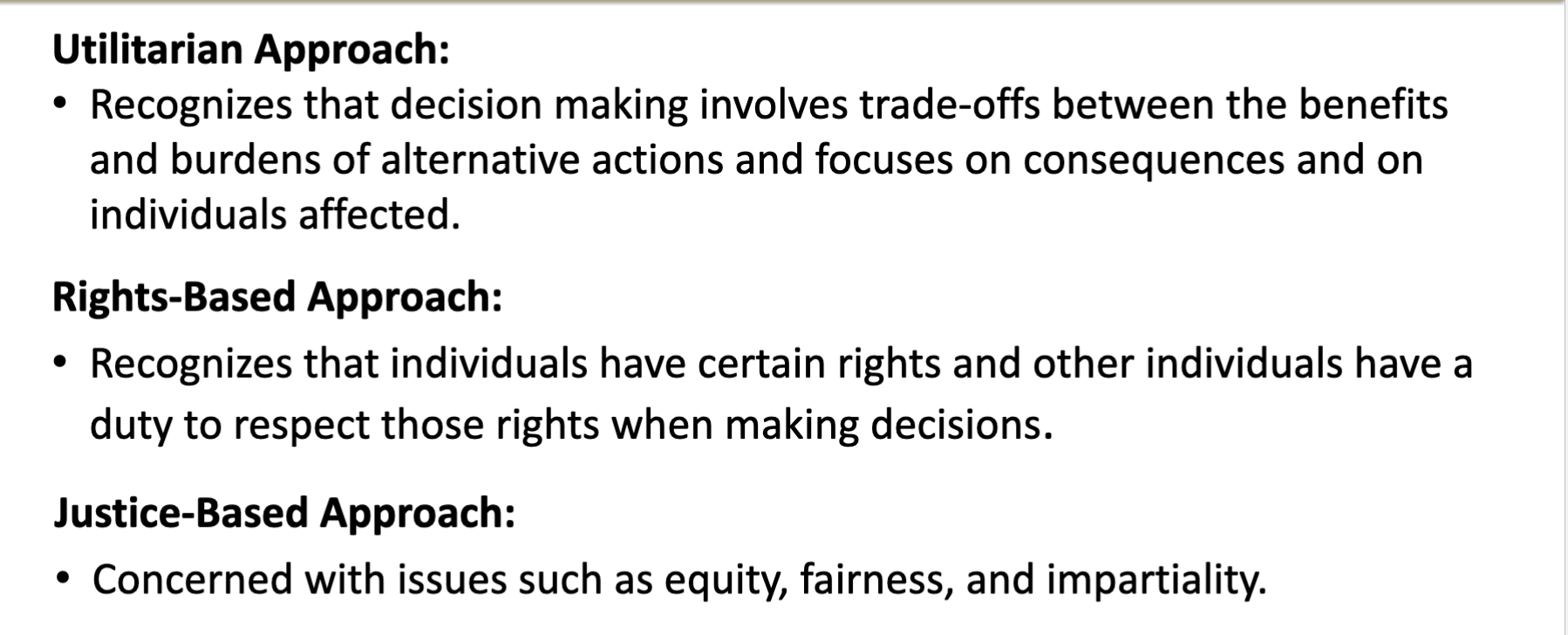
Theories of Ethical Behavior:
AICPA

PCAOB

SEC

The AICPA Code: Ideals vs. Rules
Six principles:
Nature: Framework and ideals – What CPAs aspire to
Enforceable? No
Rules of Conduct:
Nature: Minimum standards of behavior
Enforceable? Yes
Our focus: Part 1 Rules – those applying to members in public practice (sections 1.100, 1.200, etc.)
Only the rules are enforceable.
Who Must Be Independent? The ‘Covered Member’
You are a COVERED Member if you are:
On the attest engagement team
In a position to influence the attest engagement team
A partner/manager providing 10+ hours of nonattest services to the attest client
A partner in the office associated with the attest engagement
The CPA firm itself – including its employee benefit plan
An entity controlled by any of the above
Your Family Can Impair YOUR Independence
Immediate Family:
Who Counts: Spouse, spousal equivalent, dependents
The Rule: Subject to the SAME Independent Rule as you
Close Relatives
Who Counts: Parents, siblings, nondependent children
The Rule: Impair independence only if they have a MATERIAL investment (to the relative) in, or CONTROL over, the client
Lawsuits and Job Offers
Litigation by the CLIENT against the auditor impairs independence if:
Litigation has been filed, OR
Litigation is threatened AND reasonably probable to be filed
Litigation by the AUDITOR against the client:
Always impairs independence
A job offer on the table from the client:
Impairs independence – you cannot objectively audit your possible future employer
Why All This Fuss? Fact vs. Appearance
Independence in FACT: The auditor’s actual state of mind – truly unbiased. It cannot be proven – It’s invisible
Independence in APPEARANCE: Whether a reasonable outsider would BELIEVE the auditor is unbiased. It can be proven – judged by observable relationships.
Case in point: K-Mart vs Arthur Andersen – when auditor objectivity is questioned, the damage is done regardless of the facts
Tan auditor can disclose confidential client information with Two Notable Exceptions
Client confidentiality has limits
Confidential info CAN be disclosed for: a valid subpoena/summons, a peer/quality review, an ethics investigation, or with client consent.
Some loans FROM the client are permitted
Certain loans from client institutions are allowed – e.g., car loans (collateralized), fully collateralized loans, credit cards with balance within limits, obtained under normal lending terms.
The Nine Prohibited Non-Audit Services
Bookkeeping & accounting records
Financial info systems/implementation
Appraisal & valuation services
Actuarial services
Internal audit outsourcing
Management or HR functions
Broker-dealer / investment adviser / investment banking services
Legal services & expert services unrelated to the audit
Any other service the PCAOB decides is permissible
What Happens When Rules Are Broken?
Who enforces:
AICPA / state societies – Admonish, suspend, or expel members; require remedial CPE
State board of accountancy – Suspend or REVOKE the CPA license, the only body that can take your license
SEC & PCAOB – Fines, censure, bar individuals/firms from public company audits, refer that criminal prosecution.
Acts Discredible
