Metabolism and Energetics
 Call Kai
 Learn
Learn Practice Test
 Spaced Repetition
 Match
Match Flashcards
 Knowt Play
1/29

There's no tags or description
Looks like no tags are added yet.
Name | Mastery | Learn | Test | Matching | Spaced | Call with Kai | Chat |
|---|
No analytics yet
Send a link to your students to track their progress
30 Terms
Energy Metabolism
sum of the processes by which animals acquire energy, channel energy into useful functions, and dissipate energy from their bodies in ways that sustain life
catabolic processes: breaking down
anabolic processes: constructing molecules
Second Law of Thermodynamics
in an isolated system, internal changes are always towards greater disorder (entropy)
order can only be maintained or increased if a system is not isolated (will require energy to be added from outside)

Order in an Animal System
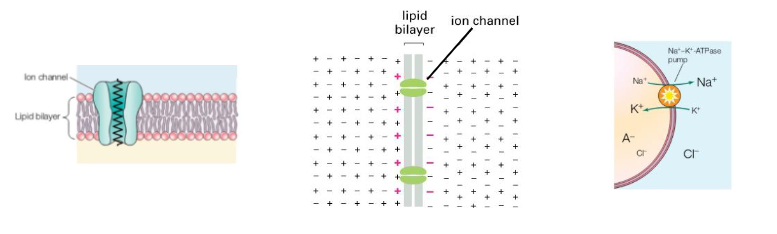
animals require energy from the outside because energy is necessary to create and maintain their essential internal organization
protein channels, action potential gradients in neurons, sodium potassium ATPase
Many Animals Must Feed Regularly
jamaican fruit-eating bats - glycogen stores are exhausted very quickly
study done on their livers to see how long the stores last
bats were held for different periods → stores were depleted after 24h
common vampire bats die if they go more than 2 nights without a meal → food sharing and regurgitation
Some animals go long periods without feeding
some animals are adapted for long periods without feeding (weeks - months)
common in ectotherms and heterotherms - some insects don’t eat at all in the adult stage; many examples exist in homeotherms
NOTE: long term fasting ≠ starvation
burmese python might feed once a year, where the meal could be up to 70% of their body mass - digest meal over 10-14 days (ectotherm with low metabolic rate so doesn’t need a constant energy source to maintain body T)
photosynthetic sea slugs eat photosynthetic algae as larvae and incorporate their chloroplast genes into their own cells → don’t need to eat for up to 10 months provided access to sunlight
Forms of Energy
chemical
electrical
mechanical
heat (molecular kinetic)
Physiological Work
a process carried out by an animal that increases order
synthesizing molecules
ocntracting muscles
etc.
What kind of work can be done?
chemical energy can do all forms of physiological work “totipotent”
electrical and mechanical energy can only perform some physiological work (e.g. move ions but not synthesize protein)
heat energy cannot perform any physiological work BUT is still important
Efficiency
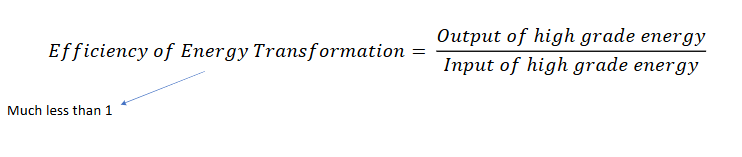
ability to do work = high grade energy (chemical, electrical, mechanical)
energy that can’t do work = low grade energy (heat)
glucose → ATP loses 30-40% as heat; ATP → muscle contraction loses 70-75% as heat = 15021% efficient total
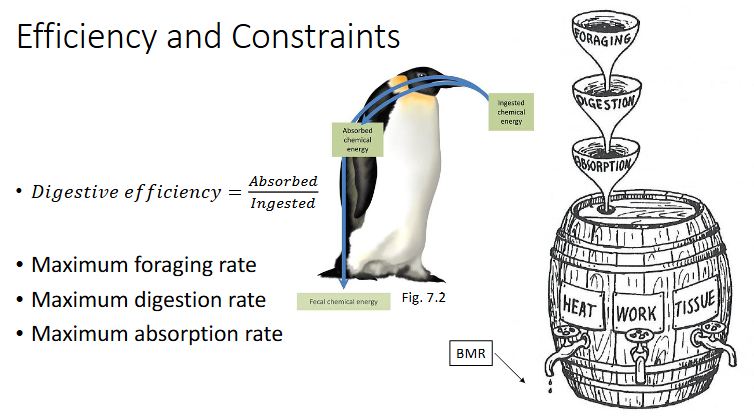
Constraints on Efficency
max foraging rate
max digestion rate
max absorption rate
even if the animal was sitting amongst its main food source, there is an upper limit of how much it can forage, how much it can digest, and absorb
energy is constant being lost as heat = basal metabolic rate
Pathway of Energy Through the Body
energy enters an animal’s body as chemical energy
absorbed chemical energy is used to perform 3 major types of physiological work in the body
energy leaves the body as heat, chemical energy, or external work

3 Major Functions
biosynthesis:
energy reminds in chemical form
accumulate chemical energy in body
exported organic matter (gametes, secretions, mucous, skin, hair, exoskeleton)
maintenance: circulation, respiration, nervous system, gut motility, tissue repair
external work: chemical energy largely degraded to heat inside the body, some work externalized (mostly degraded)
Examples of Biosynthesis
caterpillar to butterfly
arctic ground squirrel getting ready to hibernate by building up fat in the summer (biosynthesis of fat)
cicada shedding exoskeleton
christmas island crab going to edge of water during high tide to deposit eggs into the ocean, but if they get washed away they drown
What is internal work?
energy fully degraded to heat
Heat
produced by each major function
conversion of chemical energy to this is irreversible
all animals produce heat, some more than others (endotherm/ectotherm)
Is the conversion of chemical energy to heat reversible?
no; once it is degraded to heat it remains that way
Energy Consumption
energy converted to heat and external work (external work is generally internal work that degrades to heat)
Metabolic Rate
rate at which an animal consumes energy
heat is always the dominant component of metabolic rate
metabolic rate = rate of heat production
Units of Metabolism
is measured as energy
Watts (joules/second); mW in small animals with low metabolic rate
kcal/hr
1 calorie = 4.186 J
mL O2/hr
mL Co2/min/g
V CO2, V H2O (rate of consumption)
Mo2
Significance of Metabolic Rate
one of the most important determinants of how much food an animal needs
human MR is usually ~23 cal/s
nutritional calories are actually kcal (1 nutritional calorie = 1000 calories)
represents the intensity of living (metabolic pace of life)
every E-using process makes heat → MR is the total rate of heat production
a quantitative measure of the total activity of all physiological mechanisms
ecological relevance of transforming energy in an ecosystem
Ways to Assess Metabolic Rate
respirometry (earliest public records)
allometry
heart rate
isotopes
accelerometry
direct calorimetry
body mass loss
infrared thermography
History of Respirometry
discovered that mouse and candle both consume oxygen and release carbon dioxide (makes heat, takes oxygen, gets rid of CO2)
both release heat as part of the process
therefore O2/CO2 = heat
Direct Calorimetry
measure heat production directly
simple concept but technically challenging
commonly used in early MR measurements but not used much now

Indirect Calorimetry
material balance: (E in) - (E out) = E consumed
done in captivity, not in the wild
get animal, feed them, hold them until they defecate, calculate difference between excretion and initial food to see how much was used
NOTE: assumes that the animal is neither increasing nor decreasing biomass
measure over long time intervals represents the average metabolic rate

Energy Budget
(P + R)/I = assimilation
p = production
r = heat lost from respiration
i = intake
Calorimetry
measuring energy/heat
calor (heat) + metrion (measure) = calorimetry
Lavoisier Calorimetry
to measure an animal’s heat production, he surrounded the animal with an ice-filled jacket
enclosed the entire apparatus in an outer ice-filled jacket that intercepted environmental heat
ice melted by animal heat yielded liquid water, which dripped out of the apparatus for collection and measurement (faster melting and dripping indicated higher MR)

Indirect Calorimetry Based on Respiratory Gas Exchange
2820 kJ per 6 mol O2
holds true even with multiple intermediate products (doesn’t matter what the animal does with the glucose)
measuring either O2 or CO2 can indirectly measure MR

Respirometry
find a big or cooperative animal and put a mask on them to measure how much oxygen is being consumed and CO2 being made
measured by a precision O2 meter

Types of Metabolic Rates
Basal metabolic rate
Standard metabolic rate
Maximum metabolic rate
Resting metabolic rate
Flight metabolic rate
Field metabolic rate
Torpid metabolic rate