Chapter 4.2: Passive and Active Transport Are Used by Small Molecules to Cross Membranes
 Call Kai
 Learn
Learn Practice Test
 Spaced Repetition
 Match
Match Flashcards
 Knowt Play
1/17

Name | Mastery | Learn | Test | Matching | Spaced | Call with Kai | Chat |
|---|
No analytics yet
Send a link to your students to track their progress
18 Terms
Selective permeability
A membrane characteristic that allows only some substances to pass through
Passive transport
Transport that does not require an input of energy down the concentration gradient
Can use channel or carrier proteins as well for polar molecules
Active transport
Transport that requires an input of energy up the concentration gradient
Applied to larger, hydrophilic molecules; this requires proteins in most cases
Unidirectional, only moving according to specific protein function
Equilibrium
A state of solution concentration across a membrane where the distributions of solute are relatively uniform and equal, moving randomly
Cells combat this with their membrane
Diffusion
The process of random movement of particles towards equilibrium
Affected by surface area, temperature, and gradient severity
Simple diffusion
Diffusion without the need for a protein in a cell; this generally applies to small, non-polar molecules

Osmosis
The diffusion of water to places of higher solute concentration to disperse energy; this generally occurs in cell channels called aquaporins
Specifically changes as a result of nonpermeable solutes that cannot diffuse across a membrane
Osmotic pressure
The pressure needed to prevent the flow of water across a membrane
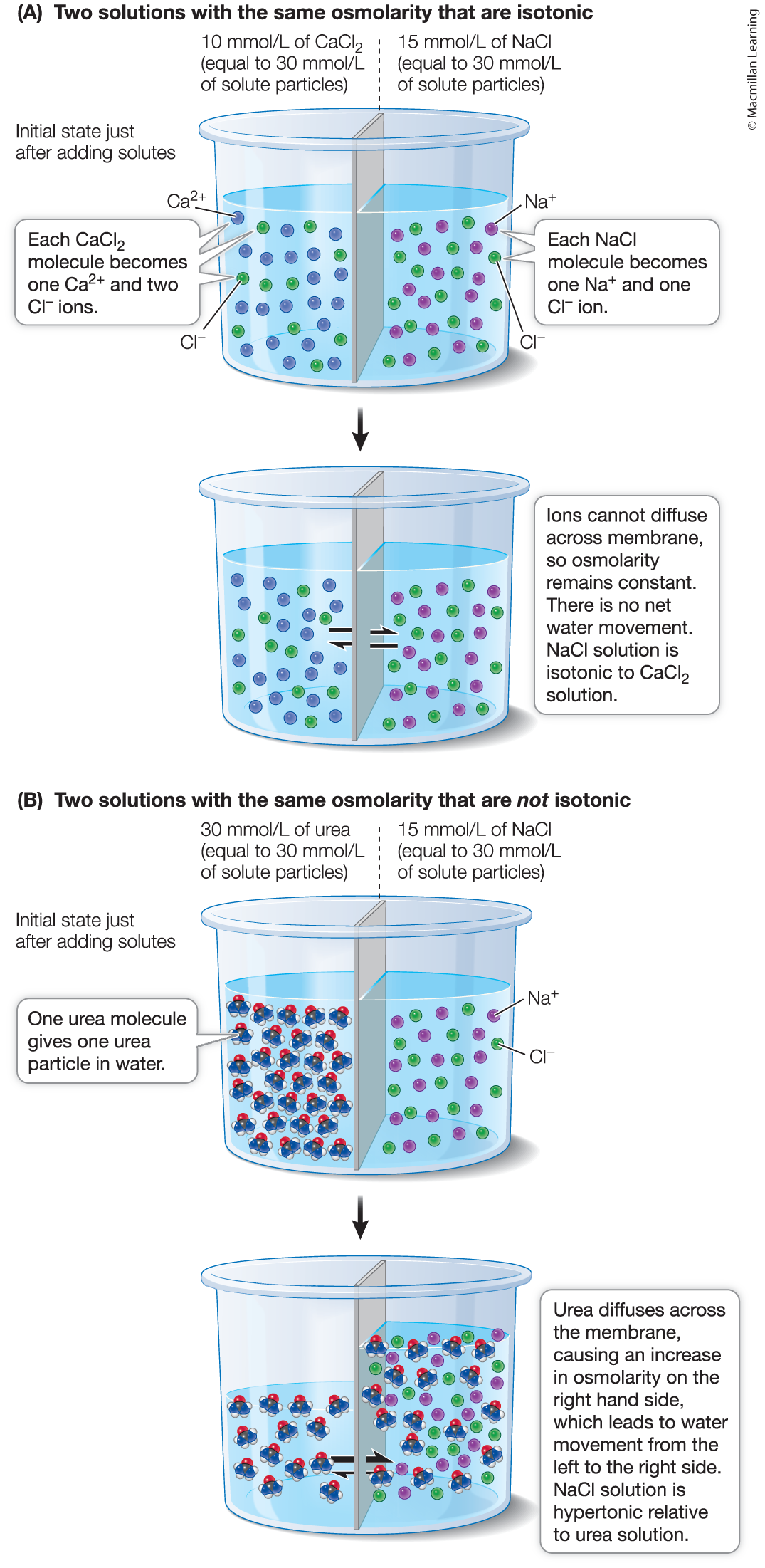
Osmolarity
The concentration of all solute particles; this is proportional to osmotic pressure
Affected by solutes that can cross the membrane that diffuse and thus attract more water

Tonicity
A measure of the relative concentration of solutes on either side of a membrane; can be higher (hyper-), lower (hypo-), or the same (iso-) to determine where water will flow
Important in some cells to avoid bursting or shriveling
Affected solely by solutes that cannot cross the membrane
Turgor pressure
Pressure against the cell wall that prevents water from entering, seen mostly in plant growth
Facilitated diffusion
Passive transport done with the help of a channel or carrier protein, seen with polar molecules
Relies on hydrophilic interiors for passage

Ion channels
Protein channels created for the passage of certain ions like Na+
Can aid in the transport of water alongside aquaporins
Gated channel
An ion channel that requires a stimulus, like a chemical signal, electrical difference, or ligand, to operate

Carrier protein
A protein that transports polar molecules by binding with them for passage through to the other side
Seen with glucose and its transporters to create an energetically favorable passage
Transport saturation
Occurs when all available transporters are in use; this sets a maximum transfer rate compared to simple diffusion

Primary active transport
A type of active transport that requires the use of energy to move substances against their concentration gradient
Seen with the sodium-potassium pump allowing sodium to be pumped out with ATP and potassium to use dephosphorylation to enter

Secondary active transport
A type of active transport that uses a concentration gradient created by primary active transport to move substances to higher concentrations with the aid of another substance
Seen with the sodium-glucose co-transporter using the energy of sodium diffusion to move glucose inside