Y10 SEM1: SCI EXAM
 Call Kai
 Learn
Learn Practice Test
 Spaced Repetition
 Match
Match Flashcards
 Knowt Play
1/63

Earn XP
Description and Tags
physics, biology
64 Terms
Time
s, scalar
Distance
m, scalar
Displacement
m, vector
Speed
m/s, scalar
Velocity
m/s, vector
Acceleration
m/s², vector
Force
N, vector
Volume
L, scalar
km/h → m/s
divide by 3.6
m/s → km/h
multiply by 3.6
Newton’s First Law
Object stays at rest or constant motion unless acted on by an external force (inertia)
Inertia
Resistance to change in motion (more mass = more inertia)
Balanced forces
Equal forces → no change in motion
Unbalanced forces
Unequal forces → causes acceleration (speed up, slow down, change direction)
Newton’s Second Law
F = ma (greater force = more acceleration, less mass = more acceleration)
Newton’s Third Law
For every action force there is an equal and opposite reaction force (on different objects)
Kinetic energy examples
motion
light
heat
sound
Potential energy examples
elastic
gravitational
chemical
static
Law of Conservation of Energy
energy can’t be created or destroyed; only transformed or transferred
Wasted energy
(mainly) friction
air resistance
Efficiency formula
efficiency = (useful output energy / total input energy) x 100
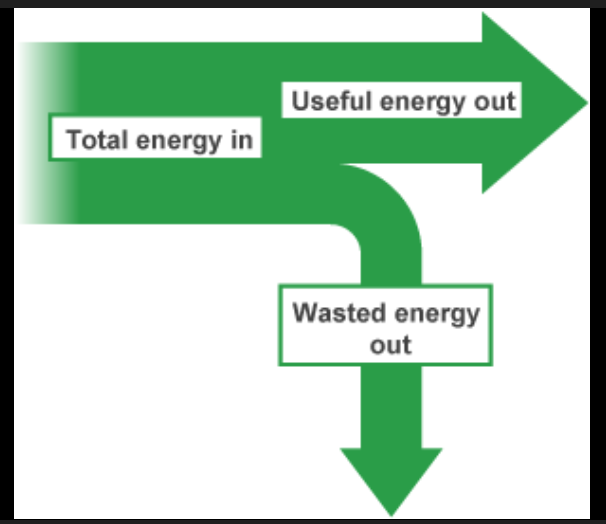
Sankey diagram
What is DNA and its two functions?
Deoxyribonucleic acid that:
carries genetic information for inheritance
codes for amino acids to produce protein
What are nucleotides, and what three things is it made of?
the basic building blocks of DNA
deoxyribose sugar
phosphate
nitrogenous base
What are the two complementary base pairs?
Adenine (A) + Thymine (T)
Cytosine (C) + Guanine (G)
What is a gene and its function?
a section of DNA that:
codes for a particular trait
Describe the structure of a chromosome and what it contains.
consists of tightly-coiled DNA (chromatin) that:
forms a rod-like structure
contains many genes
What is DNA replication, and when/why does it occur?
the process by which:
a DNA molecule forms an exact copy of itself (before cell division)
so cells have identical genetic information
What is a protein, and what does it control?
🧪
an organic compound that is made of amino acids and:
controls chemical reactions
What is the helicase enzyme responsible for?
enzyme responsible for:
separating/unzipping the two sides of the DNA molecule
What is the DNA polymerase enzyme responsible for?
enzyme responsible for:
attaching loose nucleotides to the exposed DNA strand
What is the DNA ligase enzyme responsible for?
enzyme responsible for:
repairing bonds of nucleotides to form DNA
What is an allele?
different versions (variations) of the same gene
inherit one allele from each parent
What is the difference between dominant and recessive alleles?
dominant alleles → always ignores the recessive allele if at least one is present (uppercase)
recessive alleles → only expressed if both alleles are recessive (lowercase)
What is the difference between genotypes and phenotypes?
genotypes → allele combinations for a gene (e.g. RR, Rr, rr)
phenotypes → an individual’s trait determined by its genotype (e.g. red/white flower)
What is the difference between homozygous and heterozygous?
homozygous (Ho) → two identical alleles for a given gene
heterozygous (He) → two different alleles for a given gene
What is the difference between autosomal and s*x-linked inheritance?
autosomal → genes found on non-s*x chromosomes
s*x-linked → genes found on s*x chromosomes (usually X chromosome)
What is a sex-linked trait?
a trait controlled by a gene located on a sex chromosome
What is an X chromosome?
a sex chromosome that carries many genes and traits
females have XX, males have XY
How to determine if a pedigree is dominant or recessive?
dominant: trait appears every generation (affected offspring have 1+ affected parents)
recessive: trait skips a generation (affected offspring dont have affected parents)
How to determine if a pedigree is autosomal or x-linked?
autosomal: affected males to female ratio is roughly equal
x-linked: mostly males affected, no father → son inheritance, trait often inherited from mother → son
interphase
the stage before mitosis where the cell undergoes:
growth
DNA replication
regular cell functions
cytokinesis
the cell splits into two identical daughter cells
daughter cells
the two new cells formed after mitosis (genetically identical)
sister chromatids
the two identical copies of a chromosome joined in the middle
centromere
the point where sister chromatids are attached
spindle fibres
thin structures that pull chromatids apart during mitosis
mitosis
a type of cell division that:
produces two identical cells
keeps the chromosome number the same as the parent cell (2n → 2n)
stages of mitosis (PMAT)
Prophase
Chromosomes become visible and the nucleus starts to break down.
Metaphase
Chromosomes line up in the middle of the cell.
Anaphase
Sister chromatids are pulled apart to opposite sides of the cell.
Telophase
New nuclei form around each set of chromosomes.
gametes
sex cells (sperm and egg)
what is different between haploid and diploid?
haploid (n) → cell with half the number of chromosomes
diploid (2n) → cell with full set of chromosomes
homologous chromosomes
pairs of chromosomes (one from each parent) that carry the same genes
meiosis
a type of cell division that:
produces four non-identical gametes
halves chromosome number (2n → n)
first stage of meiosis ( PMAT[I] )
Meiosis I
Prophase I
Homologous chromosomes pair up and crossing over occurs.
Metaphase I
Chromosome pairs line up in the middle.
Anaphase I
Homologous chromosomes are pulled apart.
Telophase I
Two cells form, each with half the chromosomes.
second stage of meiosis ( PMAT[II] )
Meiosis II
Prophase II
Chromosomes become visible again.
Metaphase II
Chromosomes line up in the middle.
Anaphase II
Sister chromatids are pulled apart.
Telophase II
Four haploid cells are formed.
evolution
the gradual change in a species’ characteristics over time
natural selection
the process by which a species becomes better adapted to its environment
variation
the differences that exist between individuals or populations
selection pressure
the pressure exerted by environmental factors in causing the death of organisms with characteristics not suited to the environment
favourable trait
traits that are suited to the environment and favour the reproductive success of an individual
Four (4) concepts in natural selection
Variation: the differences that exist between individuals/populations
Selection pressures: exerted by the environment in killing unfit organisms
Survival of the fittest: species with favourable traits will survive
Future generations: favourable traits are passed onto the next generation
Three key steps of speciation
Variation → differences exist within a species
Isolation → groups become separated and cannot breed
Selection → different environments favour different traits over time
allopatric speciation
Formation of new species due to geographic isolation.
sympatric speciation
Formation of new species within the same location.