biology anelli 1
 Call Kai
 Learn
Learn Practice Test
 Spaced Repetition
 Match
Match Flashcards
 Knowt Play
1/19

There's no tags or description
Looks like no tags are added yet.
Name | Mastery | Learn | Test | Matching | Spaced | Call with Kai | Chat |
|---|
No analytics yet
Send a link to your students to track their progress
20 Terms
what is the advantage of compartmentalisation
each organelle has its own function and the environmental conditions are the optimal for the specific chemical reaction the occur
smooth ER and rough ER functions
sER eliminates waste products from the organism rER produces and secretes proteins
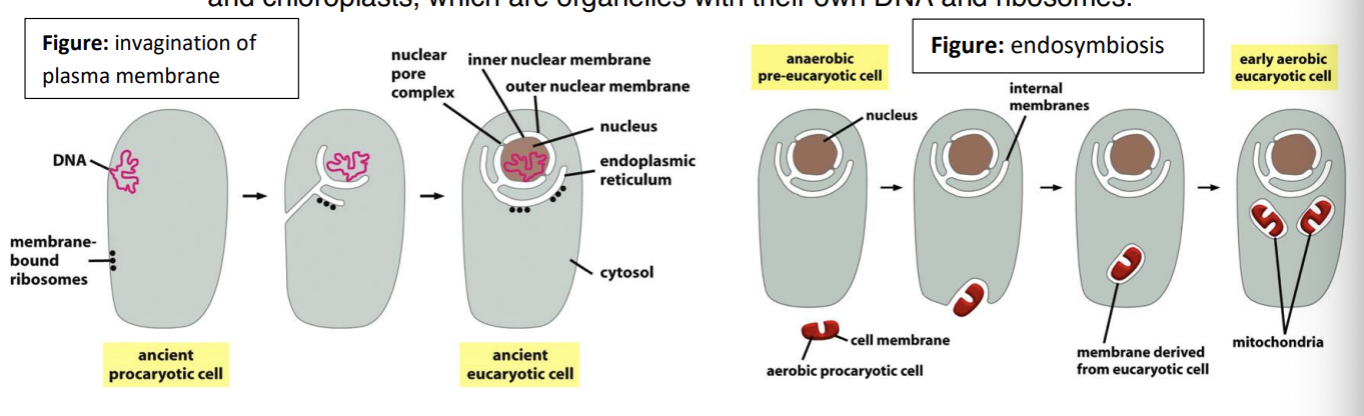
hypotheses for the origin of organelles in cells
1- The invagination of the plasma membrane: an ancient prokaryotic cell with DNA and membrane bound ribosomes formed intracellular membranes through inavgination of the external membrane
2- Endosymbiosis: an anaerobic eukaryotic cell comes in contact with an aerobic prokaryotic cell. thus through the invagination the aerobic prokaryotic cell is incorporated into the eukaryotic cell. this may have been the origin of mitochondria and chloroplasts which are organelles with their own DNA and ribosomes.
what is the cytosol
first component of the cytoplasm that contains gel-like fluid because it contains a high amount of protein (fibres from cytoskeleton/ enzymes/ inclusion of bodies which are granules without membranes/ droplets of triacylglycerols in adipocytes)
function of the cytosol
synthesise most proteins but not all of them. others are synthesised in mitochondria
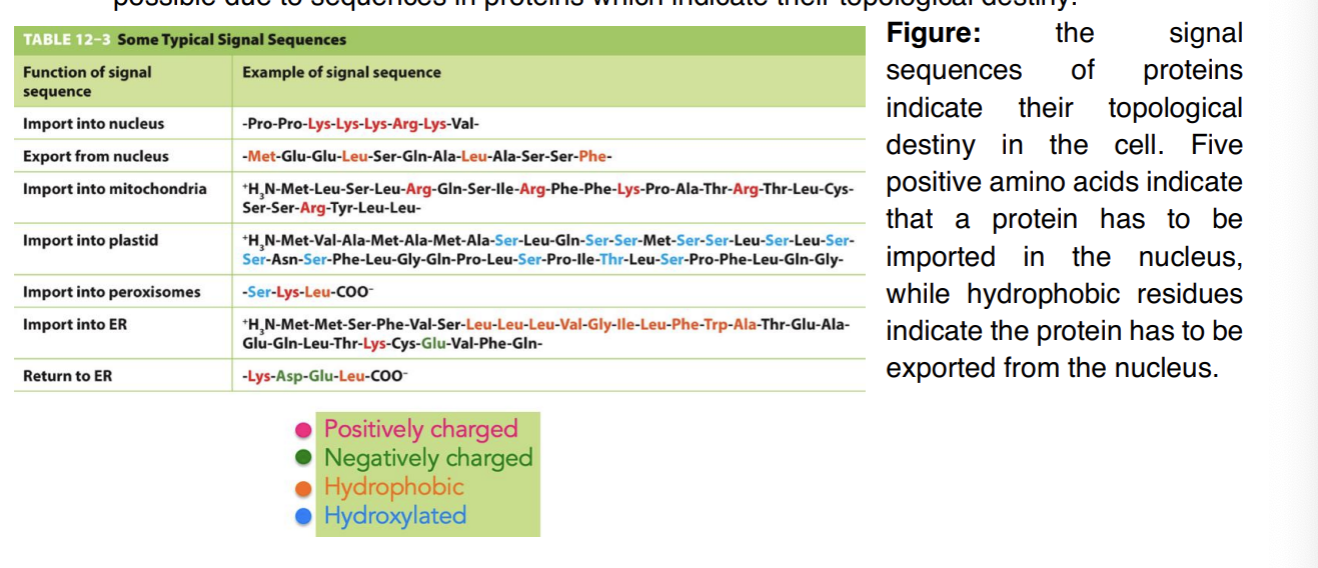
these cystolic proteins is distributed to the organelles via sequences in proteins which indicate their topological destiny
secretory pathway
route followed by proteins which are either secreted by the cell or that will be exposed on the membrane of the cell.
ER —> Golgi Apparutus —> secretory vesicles —> lysosomes
endoplasmic reticulum composition
it is similar to a net that covers a large part of the cytoplasm and is composed of 3D tubules called cisternae
endoplasmic reticulum functions
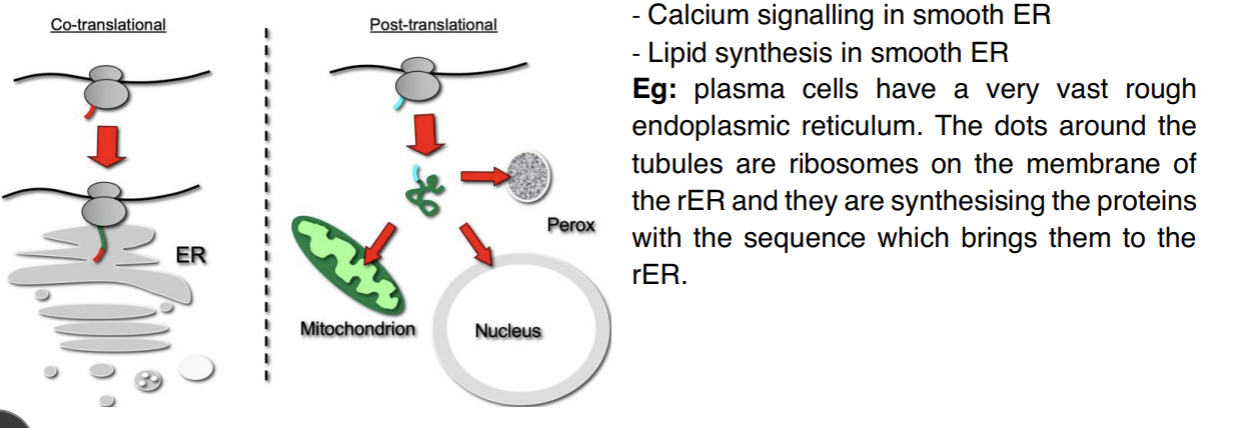
synthesis and folding of proteins in the rough ER. proteins that have to enter the ER are synthesised on ribosomes which sit on the ER. there is a con translational translocation of proteins from ribosomes to the rough ER, thus it occurs when the proteins are still being synthesised on the ribosome. also post-translational modifications occur in the ER, which occur after protein synthesis and are needed for the correct folding of the protein.
Golgi apparatus is the second step in the secretory pathway and its structure:
consists of organised flattened cisternae. it contains two faces: the cis face receives proteins from vesicles from the ER and the trans face include vesicles which depart the Golgi apparatus to go to plasma membrane
Golgi apparatus functions
N-glycan remodelling: binds a sugar (containing N-acetylglucosamine) to tge aa asparagine
O-glycan addition: occurs only inside the Golgi compartment in which another sugar different from the one attached in the ER attaches to threonine as a lateral residue of OH.
why is protein glycosylation so important
it has an effect on protein folding because glycans hydrophilic. by adding glycans to a protein the hydrophilicity of the protein itself is increased. glycans prevent aggregation on folding and are essential in protein quality control
glycans increase specificity. there are receptors that recognise, on the surface of the cell, some sugars present on the proteins.
it is important to protect the cells from proteases or other modifying chemical agents
important for protein protein and cell cell interactions
essential for sorting
what is ERGIC
a compartment in between the ER and the Golgi. it is made of vesicles which move between er ang Golgi
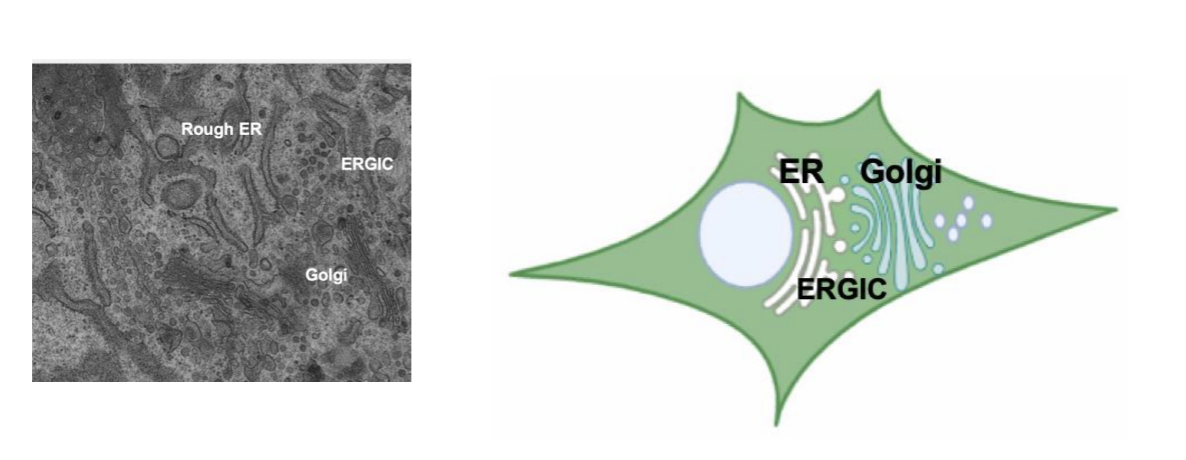
function of the ERGIC - ERGIC53
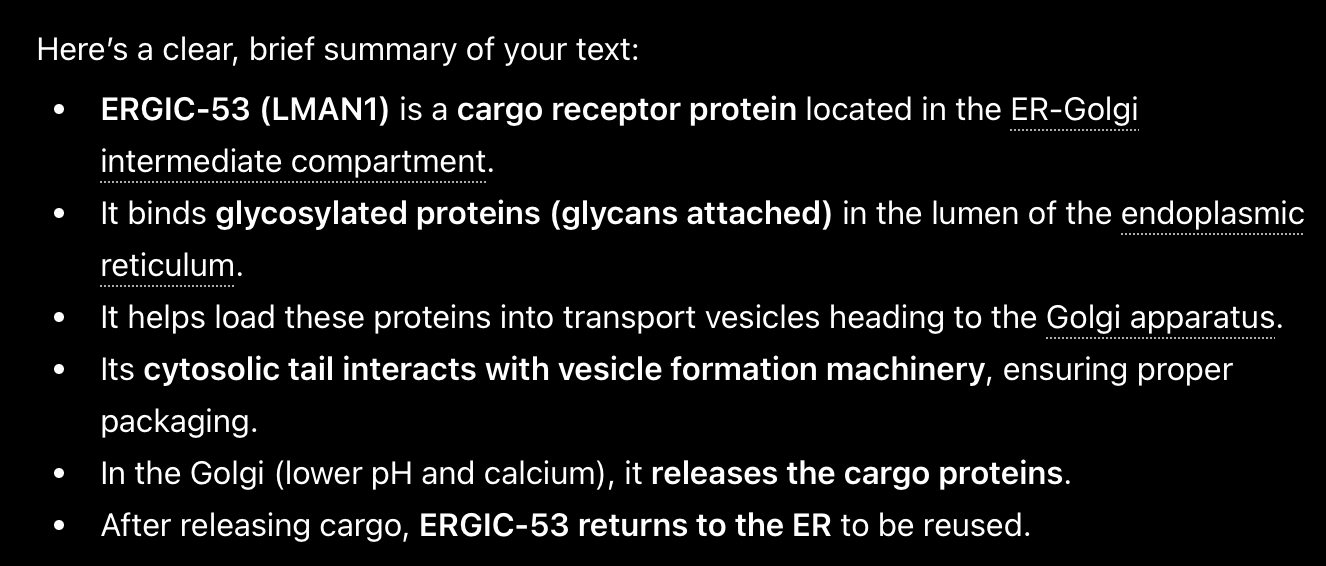
ERGIC-53 selects and transports specific proteins from the ER to the Golgi, then recycles back
what is bulk flow
as vesicles form from the ER they randomly capture nearby proteins in their lumen withoutt needing specific receptors. because of this some proteins (like factors 5 and 8) can still be transported and secreted even without help from cargo receptors like ERGIC 53
how can the cell still keep the enzymes of the ER in the ER despite bulk flow
1. Supramolecular complex hypothesis
ER enzymes form large complexes while assisting protein folding. Because of their size and organization, they are not easily captured into vesicles, so they remain in the ER.
2. Cargo receptor exclusion hypothesis
Cargo receptors selectively load proteins meant for export. ER-resident enzymes are not recognized and therefore excluded from vesicles. If cargo receptor function is blocked, some ER enzymes can accidentally be secreted.
Explain the mechanism of retrieval of ER resident enzymes via the KDEL receptor.
ER enzymes that escape to the Golgi are recognized by the KDEL receptor via their C-terminal KDEL. in the acidic Golgi environment the receptor binds them and transports them back to the ER and releases them in the neutral pH. the receptor then recycles back to the Golgi.
Compare the function of the KDEL receptor with cargo receptors like ERGIC-53.
KDEL receptor works in retrieval (Golgi → ER), while cargo receptors (e.g. ERGIC-53) function in forward transport (ER → Golgi). KDEL receptor releases cargo in the ER, whereas ERGIC-53 releases cargo in the Golgi
describe how pH differences between ER and Golgi regulate protein transport
Golgi has more acidic pH which allows receptors like KDEL to bind their cargo. the ER has neutral pH, causing cargo release
What is immunofluorescence and what is its main limitation?
mmunofluorescence is a method that uses antibodies and fluorescent tags to detect and visualize proteins in cells. Its main limitation is that cells must be fixed and permeabilized, which kills them.
How does GFP allow the study of proteins in living cells?
GFP is genetically fused to a protein of interest, creating a fluorescent fusion protein. When expressed in cells, it emits light under excitation, allowing the protein’s location and movement to be observed in living cells.