Evidence Lecture Review
 Call Kai
 Learn
Learn Practice Test
 Spaced Repetition
 Match
Match Flashcards
 Knowt Play
1/141

Earn XP
Description and Tags
Exactly 250 vocabulary-style flashcards covering the entire lecture on Evidence, including Rule 103 to 804 and Constitutional intersections.
Name | Mastery | Learn | Test | Matching | Spaced | Call with Kai | Chat |
|---|
No analytics yet
Send a link to your students to track their progress
142 Terms
FRE: Where It’s Used and Not Used
Federal Rules of Evidence; the rules used for civil and criminal trials in federal courts
Not Used:
Grand jury proceedings
Extradition hearings
Preliminary hearings/Determinations of preliminary questions going to admissibility — judges can consider whatever evidence they want when making their admissibility decisions
Makes sense: judges can be trusted to know the law and be neutral, unlike like the jury!! Judges don’t need rules!!
Judge Determines What, Jury Determines What
Judge decides whether something is admissible, jury decides weight and credibility of evidence
PreliminaryHearings: When do they need to be held outside jury’s presence (if ever)
Hearings held to determine the admissibility of evidence — generally held without jury
But MUST be held without jury when:
1) Issue is admissibility of a confession in a criminal trial
2) ∆ in a criminal case is a witness and requests it
Right to not testify in front of a jury needs to be preserved
3) Interests of justice otherwise require
Evidentiary appeal: when can an evidentiary ruling be reversed on appeal? (Two Methods)
Method #1 — more “normal” errors:
1) A substantial right of a party was affected AND
Substantial: error likely affected the outcome of the trial)
2) Error was preserved in timely manner
Evidence was wrongly admitted —> defense objected/motion to strike w/ specific grounds stated
Evidence was wrongly excluded —> defense made offer of proof
Offer of proof: explanation of the relevance and admissibility of the evidence (but not necessary if substance of evidence is clear or questioner could not know what it would show)
I.e. could not know what it would show → you get barred from asking a witness a question → you’re not going to know what they would have said
Method #2 — Plain Error Rule: evidence ruling can be reversed on appeal, even if not preserved via objection or offer of proof made during trial, if the error is obvious to reviewing court and affecting substantial right
Offer of Proof
Usually required as part of notifying judge of error that evidence was wrongly excluded
Offer of proof: explanation of the relevance and admissibility of the evidence
Not necessary if substance of evidence is clear or questioner could not know what it would show
I.e. could not know what it would show → you get barred from asking a witness a question → you’re not going to know what they would have said
Rule105: Limited Admissibility
The limited admissibility rule requiring the court to restrict evidence to its proper scope and instruct the jury accordingly upon request
Judge can also give instruction sua sponte if they want (obligation only arises after request)
Rule106: Remainder of Related Writings/Recorded Statements/Rule of Completeness
Allows relevant portions of documents or recordings to be admitted immediately to complete other evidence if necessary to fairly understand/misleading when taken out of context EVEN IF these portions were originally inadmissible
Can be introduced immediately (instead of having to wait your turn to present evidence)
π offers letter that says “in response to the assertions in your original letter.” ∆ tried to admit that letter a couple of weeks ago, but judge declined. What now?
Rule of completeness/106 means ∆ can now immediately admit OG letter (even though it was originally found inadmissible!!)
JudicialNotice (Define, when must judge take judicial notice, when can judge NEVER take judicial notice, what instructions sound like in practice)
When the court accepts a fact as true without requiring formal proof
Judge must take judicial notice if party requests and provides necessary information
But court MAY also take it without being asked
Court will take only if the fact in question is not subject to reasonable dispute because it’s:
1) Generally known within the territorial jx of the court OR
2) It can be accurately and readily determined by sources whose accuracy cannot reasonably be questioned
Instructions — Civil vs. Criminal:
Civil case: “jury, I am instructing you to find, May 1, 1990 was a Wednesday”
Criminal case: “jury, you may find that May 1, 1990 was a Wednesday.”
Rule201
The rule governing judicial notice of adjudicative facts.
Can judges call witnesses?
YES, but then parties can cross-examine them and/or object to judge calling witness
Mandatoryjudicialnotice
Requirement that the court must take notice if a party requests it and provides necessary information.
LeadingQuestion (Define, when is it allowed, exception)
A question that suggests the answer within the question itself
Not allowed on direct, only on cross
Exception — May Be Allowed on Direct When:
Preliminary background info
Witness has trouble communicating (kid or elderly — may allow as necessary)
Hostile witnesses (witness who is unwilling/against party who called them)
Cross-Exam (Define, Scope)
When you’re questioning the other side’s witness — all questions will generally be leading. Scope generally limited to what was talked about on direct exam and credibility issues with this witness
Court has discretion to broaden scope/allow inquiry into other stuff
Refreshingrecollection
The legal process of helping a witness remember facts using documents, recordings, or images.
Presentrecollectionrefreshed
When a witness views a document, remembers the facts, and then continues testifying from memory.
Versus past recollection recorded: witness looks at doc, but doesn’t remember —> allows witness to read document into evidence under hearsay exception
BUT will not be received as exhibit (unless offered by adverse party — the one who didn’t bring the document up on questioning)
Pastrecollectionrecorded
When a witness still cannot remember after a refresh attempt, allowing the document to be read into evidence.
Improper Question: compound, fact not in evidence, argumentative, calls for conclusion, repetitive
1) Compound question: asks witness to answer multiple questions combined into one
2) Question that assumes facts not in evidence
3) Argumentative: intended to bother or harass the witness – not actually a genuine question
I.e. “You don’t really expect the jury to believe that do you”
4) Calls for conclusion: a question that calls for a conclusion the witness is not qualified to make
I.e. “In your expert opinion, XYZ?” → but witness is a fact witness… they’re not qualified to answer that
5) Repetitive: when a question repeats “asked and answered” questions
Exclusionofwitnesses (from courtroom) (define, when is it a MUST, exceptions)
When the court removes witnesses from courtroom upon request of either party OR to prevent them from hearing others' testimony
If party requests exclusion and court deems it necessary —> must exclude witness
Exceptions:
1) Party in case (who is also testifying) can’t be excluded
2) Witness who is essential to presentation of the case (i.e. expert witness — they need to hear about the facts they will be testifying about)
3) Person who is permitted by state law to remain in courtroom (i.e. crime victim)
Burden of production (define, compare to burden of persuasion)
Party must present legally sufficient evidence for each element of their claim/defense to the judge to the point where judge thinks a reasonable trier of fact could find the fact has been proven
TLDR: gotta come up with sufficient evidence for judge to send it to a jury/fact-finding stage – enough evidence to survive
Don’t meet this? Judge will decide against you as a matter of law
Think of this as a gatekeeper
Burdenofpersuasion (define, standard of proof for civil vs. criminal)
Party must convince fact-finder that claim/defense/issue is true by given standard of proof
Civil case: preponderance of the evidence
Criminal case: beyond a reasonable doubt
TLDR: enough to win
Presumption
A legal mechanism that shifts the burden of production to the other party on a particular issue
If that other party produces evidence, presumption is dead, now the other party has burden shifted back
I.e. “presumption of discrimination” → means that now the other side would have to produce evidence that they did NOT discriminate (if they don’t produce that evidence, case/issue will be decided against them as a matter of law!!)
Mailed−letterpresumption
If you prove that you put the right address on it, right postage on it and mailed it (via enough evidence) → there will be a presumption that it was received (other side would need to offer evidence it was not received)
Destructionofevidencepresumption
If a party destroys/doesn’t preserve evidence (with the intent to deprive other party of use in litigation), there is a presumption it would have been adverse to that party
Party would need to offer evidence that it wasn’t adverse if they want jury to avoid being told by judge “hi jury, I want you to find that the evidence that was destroyed was adverse to this party”
DirectEvidence
Evidence that, if believed, proves a factual proposition exactly as it is offered, such as eyewitness testimony.
CircumstantialEvidence
Evidence that indirectly suggests a fact and requires an inference or linking step to actually prove
Rule 401: Relevant Evidence
Relevant evidence is admissible unless otherwise excluded; sets standard
Relevant: anything that would make any fact of consequence more or less probable than it would be without the evidence
Material and some level of probativeness
TLDR: all relevant evidence is admissible unless excluded by rule, statute or constitutional provision
Other side can object, but as long as you can find a way to get over objection hurdle → it’s gonna get admitted
Rule403 (what might the court do if evidence is found to be prejudicial)
The rule allowing the exclusion of relevant evidence if its probative value is substantially outweighed by unfair prejudice
Tiled in favor of admissibility; hail mary for getting evidence thrown out
Prejudice: unfair prejudice, confusing jury away from main legal issue, misleading jury, delay
If going to be excluded for being deemed prejudicial: judge might look for less prejudicial alternative —> limit evidence instead of throwing it out completely
Question: If someone is on trial for stealing miniature ziploc bags from a convenience store, would evidence that the defendant has 10 previous drug sale convictions (where they would put the drugs in this exact type of ziploc bag) be admissible evidence? Please analyze this under relevance, 403, and admissibility of prior criminal convictions.
Relevance – this is relevant under 401. The drug sales make it more likely that Defendant stole these particular ziploc bags because he had a use for them – this is a fact of consequence made more probable by this evidence. Relevant and at least minimally probative – good to go.
Admissibility of prior convictions: we have to ask, is this conviction (or here, the 10 drug convictions) being offered for a proper purpose? Prosecution would not be offering these to say “look, the defendant is a drug dealer – so that means he’s more likely to steal (propensity argument). Prosecution has a permissible purpose here (MIMIC: motive). Prosecution would say these past criminal drug convictions show a motive for this crime: steal these particular ziploc baggies so that defendant can use them to package up his drugs. Good to go.
BUT, 403 BALANCING – NOT ADMISSIBLE. The evidence is relevant and here for a proper purpose but its probative value is substantially outweighed by the risk of prejudice here. Jury is at high risk of concluding from this evidence “well this guy is a career criminal low life, of course he would steal these ziploc bags.” This is the exact propensity argument the court is desperate to protect against.
Judge will try to find less prejudicial alternative: maybe admit 1 of the convictions instead of 10 OR allow testimony that “defendant previously possessed or used these types of miniature bags in connection with narcotics packaging”
BUT NOTE: if defendant had said “I accidentally walked out with the bags,” intent would become disputed… now, evidence would be much more likely to be admitted
Prior bad acts are more likely to be admissible when they prove a genuinely disputed issue other than propensity
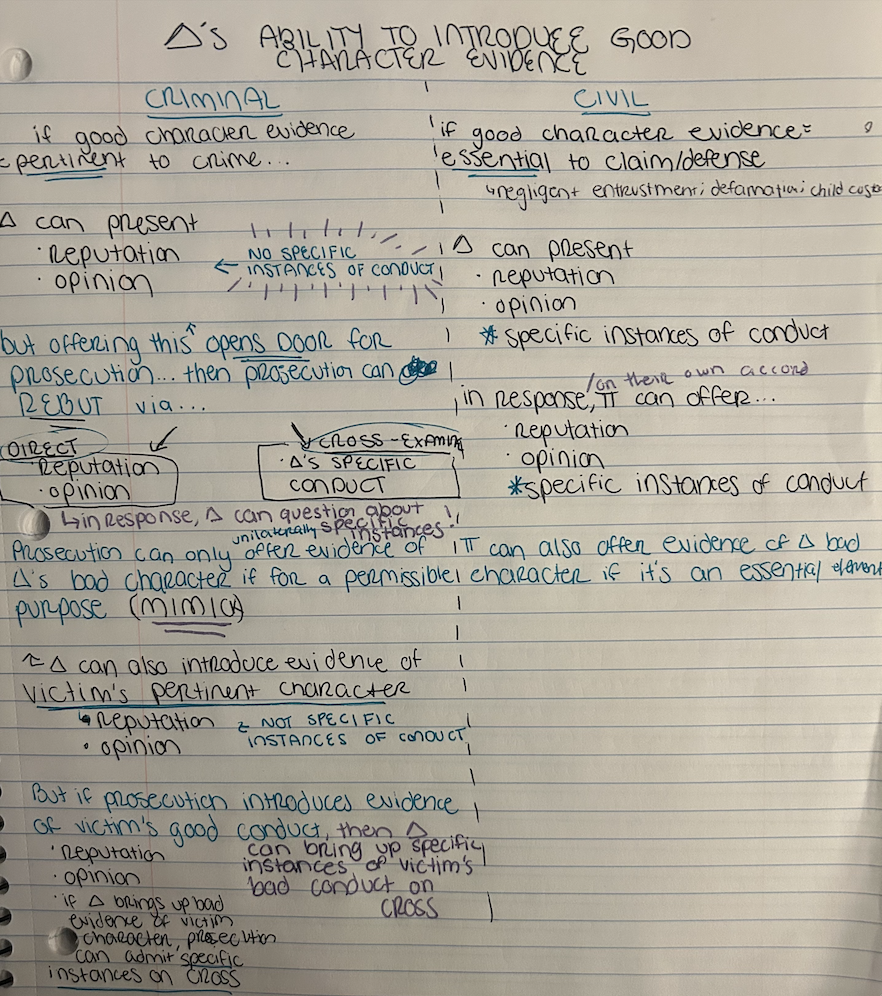
CharacterEvidence (Define, when it’s allowed to be used, when it’s allowed to be used to prove propensity)
Evidence of a person's general disposition or propensity (i.e., their usual character traits) offered to prove that the person acted in accordance with that character trait on a particular occasion — generally not allowed
When character evidence is admissible — must generally be introduced through opinion/reputation testimony
When is Character Evidence Admissible: when you’re offering it to not prove propensity
MIMICK, 404(b) — specific bad acts when NOT being offered for propensity
Witness credibility/impeachment: when cross-examining adverse party’s witness —> allowed to suggest witness is dishonest
Character is an essential element in the case (i.e. defamation; negligent hiring; child custody case)
When is Character Evidence Admissible to Prove Propensity:
Criminal ∆’s good character if pertinent to crime charged (6th Amendment)
But door opening: can now be asked about specific past incidents —> “you say he’s known for being non-violent and respectful to women, but were you aware that the defendant was fired from his previous job for sexually assaulting a coworker”)
Victim’s pertinent character in criminal cases offered by ∆
Usually self-defense
This also opens door: now prosecution can admit evidence about victim’s good opposite trait
Rape Shield: CANNOT introduce evidence of victim’s alleged promiscuity in sexual assault case
*Homicide exception — Prosecution: if defendant claims victim was first aggressor, prosecution can introduce evidence of victim’s peaceful character, EVEN IF ∆ doesn’t introduce ANY character evidence about victim at all
Propensityargument
An argument that someone acted in conformity with their character, which is usually inadmissible.
RapeShieldLaws
Statutes preventing defendants in sexual assault cases from introducing evidence of a victim's promiscuity.
Rule404(b)
The rule prohibiting prior acts to show propensity but allowing them for other purposes like motive or intent.
Character Evidence Use Break-Down
MIMICK (acronym, cheat sheet)
You are allowed to introduce evidence of defendant’s specific prior acts when it’s NOT being offered for propensity (“he did it once, so he probably did it this time too!”) → MIMICK: Motive, Intent, Mistake, Identity, Common Plan, Knowledge
I.e. offering evidence of defendant’s prior bad act as motive for the act ∆ is on trial for (i.e. offering evidence of ∆ raping someone when they are on trial for killing that person – motive being to silence them)
Cheat sheet:
∆ says “I didn’t know” → knowledge
∆ says “it was an accident” → absence of mistake
∆ says “that wasn’t me” → identity
∆ says “I didn’t intend to steal” → intent
∆ says nothing about mental state, but prosecutor trying to use ∆’s old prior acts to explain why ∆ did something → motive
Knowledge, mistake, and intent often move together
∆ charged with possessing cocaine with intent to distribute. ∆ says, “I didn’t know it was cocaine.” Prosecution offers evidence that ∆ sold cocaine 6 months earlier. Admissible?
Purpose is not “he’s a drug dealer” purpose is to show that ∆ knew what cocaine was and intended to distribute it
Dan (∆) enters a jewelry store, places diamonds in his backpack and walks out. Dan claims “I accidentally forgot they were in my backpack.” Prosecutor offers evidence that Dan previously stole jewelry from another store by placing it in his backpack and pretending he forgot. Admissible?
Not offering to prove “Dan stole this time because he stole before – look he’s a thief!” offering to prove “the way the prior theft went down shows that Dan intended to steal this time and didn’t do it accidentally!”
Dan cashes what he claims is a counterfeit cashier’s check – says he honestly believed the check was genuine.” Prosecutor introduces evidence that Dan previously cashed 3 counterfeit cashier’s checks using the exact same counterfeit template. Admissible?
Not offering to prove Dan cashed a counterfeit cashier check one time, he obviously did it again. Being offered to prove ‘this wasn’t a mistake – it’s happened 3 times with the same template.”
Bank robber wears a clown mask, leaves a red rose, writes “see you next Tuesday” on the vault wall, second robbery occurs with the exact same bizarre pattern. Admissible?
Evidence of the first robbery may be admissible — purpose in offering this is to identify the robber, not say “he did this once, so he did it again”
∆ marries wealthy people and then murders them for life insurance. Evidence of earlier marriages and deaths admissible?
Maybe to show common plan/scheme
Dan is charged with robbing Jewelry Store #3. Evidence shows that on Monday, he robbed Store #1. On Wednesday, he robbed Store #2, and on Friday, he robbed Store #3. All 3 robberies were part of a single plan to steal enough diamonds to pay off one particular debt. Admissible?
Admissible because not being offered to prove “he robbed one jewelry store, so he obviously robbed this one.” Being offered to prove “he robbed this jewelry store as part of a larger coordinated scheme”
Common Scheme: stealing uniforms to commit bank robbery, prior acts so closely connected that they help explain the charged offense
Intent
The 'I' in MIMICK; used to show the defendant's mental state during the act (i.e. purposefully vs accidentally)
AbsenceofMistake
Used under 404(b) when a defendant claims the act was an accident.
CommonPlanorScheme
The 'C' in MIMICK; used to show a pattern of related criminal activity.
Knowledge
The 'K' in MIMICK; used when a defendant claims they were unaware of a fact.
HabitEvidence (define, character as adjective habit as BLANK, organization?)
Evidence of a person’s regular response to a specific repeated situation, admissible to prove conduct in conformity
Think of character evidence as an adjective (“Dan is a careful person”) and habit as a specific repeating action (“every day before backing out of his driveway, Dan walks completely around his car.”)
Can include the habit of an organization
Organizationhabit
The admissible regular practice of a business or group.
Competence of a witness
Every person is generally presumed to be competent
Incompotent Witness: doesn’t grasp importance of telling the truth or cannot differentiate between true and false (or state law limitation) — otherwise competent
Whether a witness is too young or incapacitated goes to the WEIGHT of the evidence, NOT admissibility
State Rules: federal courts sitting in diversity will apply state competence rules (i.e. minimum age to testify)
2 Requirements to Give Testimony (one just for lay witnesses)
1) Non-expert witnesses must have personal knowledge
Examining attorney must ask witness how he knows what he’s about to testify/establish that witness has personal knowledge
I.e. “where were you on that day?” “were you able to see what happened?”
2) Oath or Affirmation: witnesses must declare by oath or affirmation that they will testify truthfully and must appreciate that obligation
Can judges or jurors be witnesses in trial where they’re currently sitting/presiding?
Judge cannot be a witness in a trial over which she is presiding
Jurors cannot be a witness in a trial where they’re sitting as a juror
What about jurors as witnesses about a trial after the fact? (606(b)) — note Exceptions
During inquiry of the validity of a verdict, a juror cannot testify about any statement made or any incident that occurred during the jury’s deliberations, effect of anything on jury vote, or any juror’s mental processes concerning the verdict or indictment
Nothing about what jurors thought, how they evaluated evidence, if they understood the evidence
Exceptions:
1) Improper extraneous, prejudicial information brought to attention of jury
I.e. newspaper article after jury told not to read news about trial, internet research conducted by jurors, scene visit after being told not to go there → previous juror can testify to these
2) Outside influence
I.e. juror threatened or bribed, baliff told jury ∆ had confessed; judge tells juror “this case should be easy” —> can testify
3) Technical mistake made on the verdict form
4) Reliance on racial stereotypes to convict a criminal defendant → can be called to testify as matter of defendant’s due process rights
Juror tells you “oh, we convicted him because of this specific evidence, even though the judge told us not to consider it.” Permitted?
NO, under 606(b) — this is a statement about statements made during jury deliberations — how they evaluated evidence, mental proccesses, and upon what grounds they decided their verdict. Not admissible.
Juroraswitness
The prohibition against a juror testifying in the trial where they are sitting, or about deliberations after the fact.
Rule606(b)
The rule prohibiting jurors from testifying about statements made or incidents occurring during deliberations.
DeadManStatutes
State rules (not FRE) that limit certain kinds of testimony about conversations and transactions with people who have since died
I.e. “The decedent promised to sell me his prized rare painting for $12.” → in a state with a dead man’s statute… inadmissible (transaction)
Impeachment (define, who can you do it to, list 4 basic ways, attack a rehabilitator?, no subterfuge)
Calling into question the witness’s credibility (or testimony)/showing the jury why a witness may be lying/mistaken/biased/unreliable
Can impeach any witness (even your own)
4 Basic Ways to Impeach: can admit extrinsic evidence to show all of these if witness denies (not really if they admit — cumulative), except specific bad acts showing untruthfulness (you’re stuck with whatever answer witness gives you)
1) Bias: when witness has some reason to lie or not reveal whole truth
I.e. witness has relationship to party; has some interest in testifying (was paid/getting reduced sentence); some interest in outcome (stands to get an inheritance); romantic relationship with party
2) Mistake/sensory incompetence/capacity: witness didn’t see clearly/forgot/is confused
I.e. “Isn’t it true that you had a few drinks that night,” weren’t wearing glasses, how far away were you, dark outside, it was a long time ago, etc.
3) Demonstrate dishonesty – FRE 608: this witness can’t be trusted… can show by
a) reputation
b) opinion
c) specific bad acts probative of dishonesty on cross
“Isn’t it true you lied on a job application last year.”
d) witness past criminal convictions — FRE 609, lots of exceptions
4) Prior Inconsistent Statements: if a witness has previously made a statement to someone that contradicts what they’re saying while testifying → you can use that statement to impeach
Can ask them about the statement directly OR can bring in extrinsic evidence
But if you’re giving extrinsic evidence need to give witness chance to explain or deny statement at some point
Can use this shit to impeach a character witness called in to rehabilitate ANOTHER character witness’s impeachment
Witness A testifies — on cross, suggested that he’s dishonest. Witness B is called to rehabilitate Witness A's credibility. Witness B can also be impeached on any of these grounds ^
BUT Limit On All of This — Improper Impeachment by Subterfuge: party calling the witness may not use impeachment as a mere subterfuge to get otherwise inadmissible evidence before the jury
π knows Witness will deny seeing the light red. π calls Witness anyway solely so π can introduce Witness's prior statement saying the light was red —> NO
FRE 609: past criminal convictions
What crimes are dishonesty crimes?
Rule for felonies involving dishonesty
Normal witness
∆ as witness
Rule for felonies not involving dishonesty
Normal witness (civil vs. criminal)
∆ as witness
Rule for felony conviction/release from confinement being over 10 years
Rule for if witness’s pardoned convictions
Dishonesty Crimes: perjury, fraud, embezzlement, false pretenses, forgery, counterfeiting, identify theft
Felony Conviction Involving Dishonesty: admissible for all witnesses (doesn’t matter whether witness is normal or criminal ∆)
Felony NOT Involving Dishonesty:
Witness is Civil ∆/Normie Witness in Civil/Normie Witness in Criminal: 403 balancing
Witness is Criminal ∆: modified balancing — admitted unless probative value is outweighed by prejudicial effect
Felony Conviction/Release = Older Than 10 Years: admissible only if…
1) Reverse 403 balancing: probative value (supported by specific facts) substantially outweighs prejudicial effect AND
2) Other party given reasonable advance notice
Witness has Been Pardoned: inadmissible if…
Pardon based on a finding of innocence OR
Pardon based on rehabilitation and no felony since
Rule608
The rule governing evidence of a witness's character for truthfulness or untruthfulness.
LayWitness (define, can they give opinions, limits)
A non-expert witness whose testimony must be based on perception/personal knowledge and helpful to the factfinder
Discouraged from offering opinions, should offer facts — but opinions allowed if based on witness’s persoonal knowledge and helpful to understanding of testimony
Limit: cannot give testimony that purports to be grounded in scientific, technical, or specialized knowledge
ExpertWitness (define, standard, limit)
Witness qualified by knowledge, skill, experience, training, or education who may offer opinions if court determines that…
1) Subject matter is scientific, technical, or other specialized knowledge AND
Basically looking at reliability
2) Their opinion will help the trier of fact
Basically looking at relevance
Limit: expert witnesses cannot be called to use their expertise to speak about the credibility of other witness’s → invades province of the jury
I.e. can’t call a psychologist as an expert witness to offer testimony about whether another witness was lying
DaubertStandard (what party offering testimony needs to show, what about underlying data?)
Party offering testimony must show that expert witness…
1) Based the testimony on sufficient facts or data (about this case)
2) Based the testimony on reliable principles and methods
3) Expert applied those principles and methods reliably to the facts of the case
I.e. DNA testing is reliable BUT if sample contaminated → failed
Underlying data: experts can rely on inadmissible evidence to form their opinions
BUT cannot go on the stand and start describing that inadmissible evidence UNLESS the probative value in helping the jury evaluate the expert’s opinion substantially outweighs its prejudicial effect (and need to be very limited about it)
I.e. “I relied on weather reports, burn patterns, and firefighters notes” — even if one of these is inadmissible, this is fine. Its probative value (of helping jury determine credibility) substantially outweighs any prejudicial effect
I.e. “I also relied on the anonymous tip we received that the defendant confessed.” — super prejudicial and not much probative value
So if other party objects to adverse witness testimony because the underlying data is inadmissible → their objection will be overruled if other experts in the field would reasonably rely on that information and satisfies reverse 403 balancing
Daubert: how does court assess whether principles and methods are reliable?
Whether these methods can/have been tested
Reviewed by other experts
Published
Known error rate
Standards and controls governing use
Whether they’re generally accepted in scientific community
Murder case – psychiatrist diagnoses defendant with Intermittent Explosive Disorder. Testifies as expert witness, “my diagnosis was based partly on interviews with family members.” In the interviews with family members the family members said this guy previously tried to beat 3 members of the family to death. Can expert rely on this information when testifying?
What if counsel asks, “doctor, why did you diagnose Intermittent Explosive Disorder?” What should he say?
Yes, psychiatrist can rely on that inadmissible information when testifying
Psychiatrist CANNOT say “well the guy previously tried to beat 3 members of the family to death” (inadmissible hearsay) → huge risk for prejudice via propensity argument
BUT psychiatrist can definitely get away with “my diagnosis was based on interviews, medical history, and collateral information from family members” —> underlying information inadmissible, but giving insight into credibility behind expert witness’s claim
Probative value in helping the jury evaluate the expert’s opinion substantially outweighs the prejudicial effect here… didn’t give any specific details
Psychiatrist might even be able to say “because multiple family members independently described repeated episodes of sudden, uncontrolled violent outbursts.” —> more borderline, but might be admitted
UltimateIssue
The final legal decision to be made in a case; experts can generally testify to this except for legal conclusions AND/OR criminal mental states (questions of ethical responsibility —> need to go to the jury)
Legal Conclusions: “In my opinion, the defendant committed the crime,” “in my opinion, this doctor acted negligently” —> expert witness cannot spoon-feed the jury what conclusion to reach
But can get pretty close: “based on the blood spatter evidence, the defendant was the only possible shooter”
Criminal Mental States:
Can say: “he could not distinguish fantasy from reality,” “∆ experienced auditory hallucinations”
CANNOT say: “in my opinion, ∆ was legally insane,” “∆ lacked the capacity to form intent”
On trial for murder – defense of “extreme emotional disturbance.” Can expert say “in my expert opinion, that defendant did have extreme emotional disturbance.”
What about a blood spatter analyst — can he say, “in my expert opinion, the defendant committed this crime.”
NO expert cannot give his opinion on the ultimate issue of whether a criminal defendant had the requisite mental state
STILL NO — he’s giving his opinion on a legal conclusion/telling the jury how to find… needs to be a little more removed
“With the blood-spatter evidence I have, he’s the only potential culprit”
What can be the basis of expert opinion?
Personal observation
Facts made known to expert at trial (i.e. by listening to other testimony)
I.e. “based on the account that you heard, did the procedure meet the medical standard?”
Information from outside the courtroom (hearsay) if it’s a type reasonably relied on by experts in that particular field
Can experts be cross-examined? On/with what?
YES
Experts can be cross-examined about their qualifications, the basis/credibility of their opinions (critiquing methodology), or bias/sensory competence
Will allow extrinsic evidence for all of these (and VERY liberally for bias
Can cross-examine experts by asking them about publications that are established as reliable authority
I.e. “You said the standard dosing could be 2mg-5mg but isn’t it right that the Physician’s Desk Reference says that the maximum standard dosing is 3.5mg?”
Court−appointedexpert (can courts do this? If so, what needs to happen?)
Courts may appoint their own expert witnesses, BUT
Must give parties notice
Give parties opportunity to object/heard about whether expert should be called
Must allow expert to testify at trial (and be cross-examined or deposed by parties)
Must let each party know what the witness found
TangibleEvidence (+real evidence)
Physical items, documents, and real evidence used in court — must be authenticated before they can be shown to jury
Real evidence: just means physical evidence
Authentication
The threshold requirement you gotta meet for the court to let you show your evidence to the jury (so JURY can decide if THEY think it’s authentic)
Court just asks: is there enough evidence upon which the jury could find this piece of evidence to be authentic?
Basically burden of production but for evidence
Ways to Authenticate Real Evidence: 3 main ways
1) Authentication by personal knowledge (most common): witness testimony that recognizes and identifies the item
2) Distinctive features or markings: if the thing looks like many other things (i.e. guns all look alike) police may mark an item when they remove it as evidence
“How do you know this is the gun that you took from the ∆’s house?” “because we put this marking into it.”
3) Chain of custody: technique showing the location of the evidence for different periods leading up to a trial
More common with fungible items (i.e. white powder) that you can’t really mark
“How do we know that that’s really the drugs you took from the defendant and not some random drugs you brought here today” → “because I bagged it and then put it in this locker that only I have the combination to, etc.”
Chainofcustody
A technique showing the location of evidence from seizure to trial, commonly used for fungible items (interchangeable or indistinguishable items).
Ways to Authenticate Telephone Conversation
1) Voice identification
2) Speaker said details only the speaker would know
3) Caller dialed the number believed to be the speaker’s and speaker identified himself upon answering
4) Caller dialed a business and spoke with person about business conducted regularly over the phone
BestEvidenceRule (+duplicates, list exceptions)
When contents are at issue, witness cannot testify about the contents of a writing/recording or photograph instead of showing original document
CAN admit duplicates to satisfy, UNLESS…
a) Genuine question as to authenticity/claim of alteration OR
I.e. photocopy might hide white-out, erasures, discussing whether document is a forgery (need to examine original — pen pressure, ink, etc.)
b) Unfair under the circumstances to admit the duplicate
I.e. Original contract features important handwritten notes in red/blue/green ink, plaintiff orders black and white copy (can’t tell who wrote wrote); blown up copy cuts off margins (had handwritten modifications)
Exceptions:
1) document/photograph/recording lost/destroyed NOT in bad faith
2) document/photo/recording was in opposing party’s control, they knew it was going to be in issue but didn’t bring it
3) public records
4) voluminous
5) admissions
“I received a letter from the Defendant.” Do you need to produce it at that moment?
“I received a letter from the Defendant that said he murdered his brother.”
“I received a letter from the Defendant.” — NO NEED TO PRODUCE UNDER BER — not testifying to contents of letter, just testifying to the fact that you got a letter
“I received a letter from the Defendant that said he murdered his brother.” — YES, NEED TO PRODUCE UNDER Best Evidence Rule, you’re testifying to the precise content of a document without producing the document
Exceptions to Best Evidence Rule
Exception: document/photograph/recording lost/destroyed NOT in bad faith —> can testify without producing document
I.e. witness talking about letter. “Do you still have the letter.” “No, it was destroyed in a horrible accidental fire.” “Okay, do you remember what the letter said?”
Exception: document/photograph/recording was in opposing party’s control and opposing party knew it was going to be in issue but didn’t bring it → other party prevented from objecting
Exception – Public Records: when dealing with a public record, content may be proved by…
1) Certified copy, OR
2) Regular copy plus testimony that the copy was compared to the original
Testimony: “I personally compared this copy to the original deed and it’s accurate.”
Why: we don’t want parties running around and removing original government records from public offices every time there’s a lawsuit
Exception – Voluminous Writings: if there’s a ton of writings, contents can be proved by summary or chart if contents can’t conveniently be examined in court
But originals/duplicates must be made available for inspection by other party
Exception – Admission: if party the evidence is being offered against admits the contents of the document in testimony, deposition, or written statement – OG doesn’t need to be produced
But if you take advantage of this and try to mischaracterize/cherry-pick the winners, it’s not going to work — other side will just draw upon Rule of Completeness
Attorney−ClientPrivilege
Confidential communications between a client and an attorney for purposes of obtaining or providing legal advice are privileged
Confidential: if communicator makes no reasonable effort to keep confidential → no privilege
I.e. telling you this tea in front of a ton of other people
But unknown eavesdropper, presence of necessary/useful people ⇒ still privileged
Communication: the communication with your lawyer is privileged BUT the underlying thing/documents you talked about may still be discoverable
Client holds the privilege – they’re the only ones who can waive it
Attorney must assert privilege on behalf of the client, unless client waives it
Ways Client May Waive Attorney-Client Privilege
Failure to assert privilege in timely manner, voluntary disclosure of information, contractual waiver
But wrongful disclosure without client’s consent → NOT waiver
Exceptions to Attorney-Client Privilege (when you, as a lawyer, don’t have to not disclose/protect info anymore)
1) Future crime or fraud exception: communication is related to future commission of what client knew/should have known was a crime or fraud → not privileged
2) Dispute between lawyer or client (i.e. malpractice, fees): communications that would normally privileged, aren’t going to be privileged any more for the purposes of resolving the dispute between them
Attorney-Client Privilege but your client is a corporation? (federal vs. state standards for what might be privileged)
Federal courts: nature of communication
If a communication is made 1) within an employee’s duties and 2) for the purpose of securing legal advice
Some states: control group test
Only the communications of certain leaders of the corporation for purposes of legal advice will be privileged
WorkProductDoctrine (define, exception)
Protects materials prepared by a party/party’s representative in anticipation of litigation or for trial from discovery unless opposing party shows…
1) A substantial need for the materials AND
2) Cannot obtain that information elsewhere without undue hardship
CoreWorkProduct (what would court do about statement: “witness stated light was red, but I think she is unreliable and will likely crumble under cross-examination.”
Attorney’s mental impressions, conclusions, opinions, legal theories, and litigation strategy developed in anticipation of litigation have absolute protection from discovery
If attorney writes “witness stated light was red, but I think she is unreliable and will likely crumble under cross-examination.” → if 1) substantial need and 2) undue hardship… court will redact the core work product portion
Physician−PatientPrivilege (define, who holds, what jx, when might this not apply)
A state-recognized protection for statements made to doctors for medical treatment; not recognized in federal court
Patient holds privilege, physician should assert privilege on patient’s behalf
No privilege if: advice for reasons other than medical treatment, advice as part of illegal purpose, dispute between physician and patient, paitent has waived, case in federal court
PsychotherapistPrivilege (define, who holds, what jx, when might this not apply)
A federal and state protection for mental health communications, excluding communications as result of court-ordered exams or commitment proceedings
Patient holds privilege, psychotherapist/psychiatrist/social worker should assert on patient’s behalf
5thAmendmentPrivilege (define, who/where can assert, past statements, physical characteristics, if you have full immunity?)
Allows person to refuse to give testimony that may incriminate them
Only individuals can assert this (NOT corporations)
Can be asserted anywhere
Protects only current statements – can’t assert Fifth Amendment from protecting prior statements (i.e. diary entries)
Doesn’t apply to physical characteristics, mannerisms, voice samples, blood type, breathalyzers
These can all be compelled → i.e. you can’t refuse to give a voice sample/stand in a line-up on the grounds of privilege against self-incrimination
If you have no risk of incrimination → no privilege
If prosecutor gives you full immunity… cannot assert this as a privilege at all (you’re not at risk of incriminating yourself!)
ConfidentialMaritalCommunications (define, who holds, divorce, marital exceptions)
Protects confidential communications made between the spouses during the time they were married
Held by both spouses – either spouse can refuse to reveal AND/OR prevent other spouse from revealing confidential communications
Survives and protects statements made while married, even after you guys get divorced
Exceptions – Two Situations Where Doesn’t Apply:
1) One spouse is suing the other
2) One spouse is charged with a crime against the other spouse or the children of either of them (or both of their kids)
SpousalImmunity (define, who holds, divorce, marital exceptions)
Spouse of a criminal defendant can refuse to testify against her defendant-spouse while they’re married
But if you guys get divorced, you can’t assert this anymore → get ready to testify
Don’t have this if it’s a civil case… BUT can try to object on confidential marital communication privilege (if the thing they’re asking about is a communication)
Exceptions – Two Situations Where Doesn’t Apply:
1) One spouse is suing the other
2) One spouse is charged with a crime against the other spouse or the children of either of them (or both of their kids)
LiabilityInsurance
Evidence that a person was/was not insured against liability is not admissible to prove negligence or wrongdoing
I.e. “they acted carelessly because they had liability insurance – it’s not on their dime if they kill or injure someone” → INADMISSIBLE
But can admit to prove ownership, control, bias (someone testifying a certain way to secure a large insurance pay-out)
SubsequentRemedialMeasures
Evidence of repairs/safety enhancing changes to products after injury to plaintiff is not admissible to prove negligence, culpable conduct, defective product design, or inadequate warning
Admissible when relevant for some other purpose (ownership, control, feasibility)
Admissible if made before plaintiff’s injury
SettlementOffers
Not admissible to prove liability for, validity of, or amount of disputed claim
Statements made during settlement discussions are not admissible (“maybe part of this was my fault”)
BUT STILL ADMISSIBLE to prove bias (i.e. if a witness is testifying, you can bring up the fact they received a huge settlement from the defendant before)
I.e. Bus accident with huge injuries. One of the injured settles with bus company for $100k and says he’ll testify at the other trials → admissible
Not bringing it to prove liability, bringing it to discredit witness/show bias
OfferstoPayMedicalExpenses
Inadmissible to prove liability, though other statements of fact made during that conversation may be severable and admitted depending on the context.
I'.e. “I’m so sorry I ran the red light. I’ll pay all of your medical bills.” —> the offer will be inadmissible, but “I’m so sorry I ran the red light” can be admitted as an admission by a party opponent
Compare to Statements Made During Plea Negotiations: the whole convo will be protected/inadmissible
Admissibility of Statements Made During Plea Negotiations
Cannot offer withdrawn guilty pleas, nolo contendere pleas, offers to plead guilty, OR statements made while negotiating plea
Rape Shield (+exceptions)
Evidence of victim’s past sexual conduct/reputation is not admissible in a proceeding involving sexual abuse
Rape Shield Exceptions: Criminal Context
Criminal – Exceptions: evidence of past sexual conduct is admissible to show…
∆ was or was not source of physical evidence (i.e. bruises or semen)
Victim’s past sexual conduct to argue consent
When ∆’s constitutional rights so require… unclear but basically if aspects of victim’s previous sexual conduct show motive to lie (i.e. she has a boyfriend)
Rape Shield Exceptions: Civil Context
Civil: evidence of victim’s past sexual conduct admissible only if probative value substantially outweighs danger of harm to victim AND unfair prejudice to any party
Evidence of reputation admissible ONLY if victim brings it up
I.e. Plaintiff alleges “∆ infected me with herpes during assault.” ∆ wants to introduce medical evidence that π had herpes years earlier from another partner —> very probative for damages, not going to harm victim, no unfair prejudice
Rape Shield — Admissibility of ∆’s Past Sexual Conduct/Misconduct
If defendant is being accused of sexual assault, child molestation (in civil OR criminal context) can bring up prior convictions/testimony of prior bad acts relating to sexual offenses
Define sexual assault and child molestation broadly (groping, indecedent exposure in front of a child, etc.)
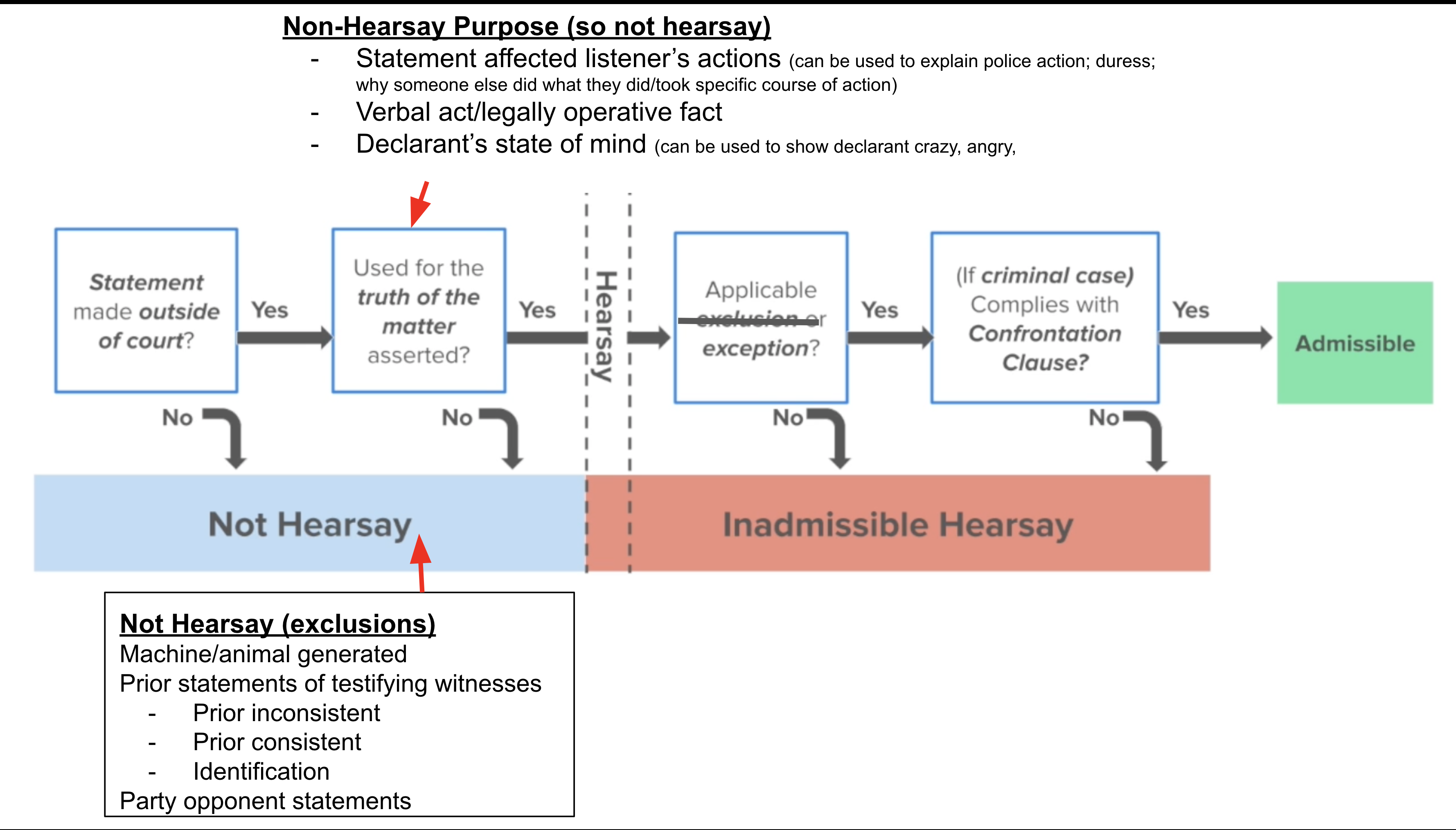
Hearsay (+ quick list of what is NOT hearsay — Hearsay Exclusions)
An out-of-court statement offered to prove the truth of the matter asserted
NOT HEARSAY
1) Evidence generated by dog/animal/machine…only people can make “out of court statements”)
2) Certain prior statements of testifying witnesses: prior inconsistent; prior consistent; prior statements of identification
3) Opposing Party Statements
Out of Court Statement
Any statement (i.e. verbal, text message, etc.) made by any person out of court/not under oath, EVEN if it’s made by the witness themself
BUT needs to be intended as an assertion:
Pointing or nodding outside of court → intended as an assertion → subject to hearsay rule
Witness talking about seeing people do something → those people probably weren’t intended anything as an assertion, they were just going about their day → NOT subject to hearsay rule
I.e. “I knew it was raining because I saw people walking in with umbrellas” → not intended as an assertion… not subject to hearsay rule
Declarant
Whoever made the statement that we’re hearing about/seeing/reading
(So the person testifying about this might not be the declarant, might just be someone else who heard what the declarant said)