Bio 210 Exam1 prep
 Call Kai
 Learn
Learn Practice Test
 Spaced Repetition
 Match
Match Flashcards
 Knowt Play
1/68

Earn XP
Description and Tags
CSUMB Prof. Greg Tyson
Name | Mastery | Learn | Test | Matching | Spaced | Call with Kai | Chat |
|---|
No analytics yet
Send a link to your students to track their progress
69 Terms
Inductive reasoning
IN- specific observations to a broad general rule
ex. all three apples in your bag are sour so you conclude that they are all sour in your bag
Deductive Reasoning
general rule to specific conclusion
ex. all dogs are mammal, buster is a dog so buster is a mammal
Scientific method
ask a question → do background research → form hypothesis (testable) → conduct experiment → analyze data → draw conclusion
this is not a simple process
Biological Organization
Atom- Hydrogen, Oxygen
small molecule- water, carbon dioxide
Large molecule (aka Macromolecule)- DNA/RNA proteins, complex carbs, lipids
Cells- red blood cells, nervous cells, bacteria
Organisms- human, dog, tree
Features of life (with examples)
common set of chemical compounds
made up of cells
extract energy from the enviroment adn use it to do work
regulate internal enviroments
genetic info
exist in populations that evolve over time
Life
Composed of cells, has DNA, involvesenergy transfer and transformation, that life interacts as part of ecosystem, and that evolution is the central idea fundemental to biology
Three domains of life
eukaria
bacteria
archaea
Natural selection
organisms with traits best suited for their envirormoent are more likely to survive and reproduce more over time
How do you group things together on a phylogenetic tree
shared characteristics and DNA sequences
Why do we use model systems
similarities between organisms from common desent → make predictions about pheno0menoms that can be applicable to other organisms
studying biological processes in organisms are easier to work with (ex. DNA model for students)
experimental to see if animal learns or reacs differently
Mean
add all numbers then divide by amount of numbers in the set
Median
Number in middle/ the two numbers averaged
Mode
number that is there most frequently
Quantitative data
measured and documentable
qualitative
descriptive, up to the persons observations, differ from people to people
negative/positive controls
the control group where you expect no response or positive where it produces the desired effect
major elements in the human body
nitrogen, hydrogen, oxygen, carbon
proton
positive charge,and has mass, inside nucleus
electrons
negative charge, neglegible mass, outside nucleus
neutrons
neutral charge, have mass, in the nucleus
atomic mass
protons+ neutrons
atomic number
number of protons and “normal” number of electrons

isotope
forms of an element with different numbers of neutrons
what happens if we change the number of subatomic particles of an atom of a particular element?
for protons: it would change the element and therefore mass (rare)
for nutrons: becomes isotope and changes mass
for electrons: changes the charge
orbital
region where an electron is found at least 90% of the time
→ they are filled in a specific sequence, in a series of electron shells, or energy level
first shell (inner most)
1orbital, holds 2 electrons
second shell
4 orbitals, each shell holds 8 elecrons
valence shell (outer most)
determines how an atom behaves
full? atom is stable
unpaired? atom is reactive
is the energy level higher closer to the nucleus in the orbitals or farther away?
farther away
molecular weight
sum of an atomic weight of all atoms inthe molecule
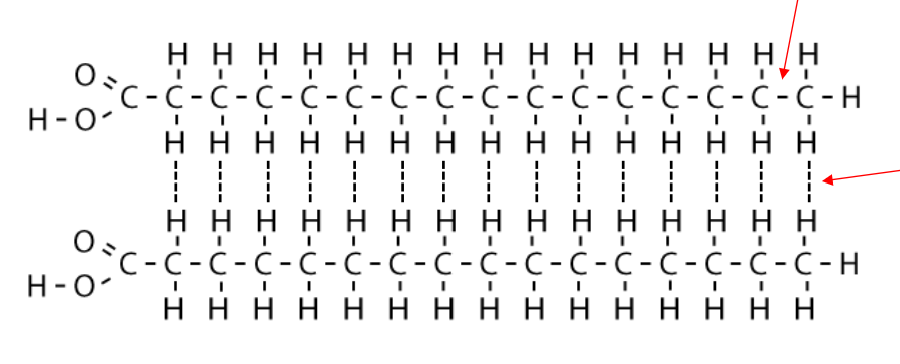
what bonds are shown in this image
top: nonpolar covalent (bonds within the hydrocarbon) shared equally
bottom: van der waals (interactions between nonpolar molecules) weak bond
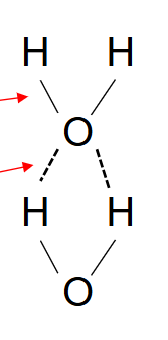
what bonds are shown in this image
top: polar covalent (bonds within a water molecule ) VERY strong, one atom has a greater electronegativity
bottom: hydrogen bond (interactions between polar molecules)
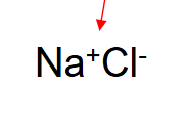
What bond is shown
Ionic (interactions between atoms with full charges) atom is much mroe electronegative than the other +/-
intramolecular bond
polar, non-polar, covalent, ionic
intermolecular
hydrogen bonds, van der waals forces/bonds
what molecules are hydrophobic
nonpolar (repels water)
what molecules are hydrophilic
polar (attract water)
solute
substance (that goes in liquid)
solvent
liquid (where solute goes in)
whats so special about water
high specific heat
high heat of vaporization
cohesion (held together with H-bonds)
acid/ acidic
releases hydrogen ions in water
→ pH under 7
base
accept H+ ions
buffer
solution that resists significant changes in PH when small amounts of an acid or base are added to it. (usually a weak acid and a conjugate base)
name macromolecules and think about what shape they are

polymerization
combining small molecules into a large chain
→ involves dehydration
depolyrization
breaks downa large chain into individual units
→ involves hydrolysis
-OH
hydroxyl group
-COOH
carboxyl group
-NH2
Amino groups
-PO 2-/4
Phosphate group
-CH3
Methol Group
Isomer
molecule s w/ the same chemical formula, but the atoms are arranged differently
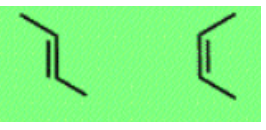
What kind of isomer is this?
CIs-trans: Different orientation around a double bond

What kind of isomer is this?
Optical: mirror images

What kind of isomer is this?
structural: differ in how atoms are joined
proteins and their functions
storage proteins, transport proteins, motor proteins
→ store amino acids for later use
→ bind and cary substances within the organism
→ cause movement of structures in the cell

what are the parts of an amino acid?

disulfide bridge/bond
(-S-S-)strong covalent bond betweent the sulfur atoms in two cysteine amino acids within a protein
→ important in protein folding but most cysteine in a protein are not involved in disulfide bridges
peptide bond
covalent amide linkage that forms between the carboxyl group of one amino acid and the amino group of another
→ -C(=O)-NH-
primary protein structure
sequence of amino acids

secondary loevel for protein structure
H bond interactions between amino andcarboxyl groups of amino acids
→ can form alpha helixs or beta pleated sheets

tertiary protein structure
polypeptide fold, forming specific shapes
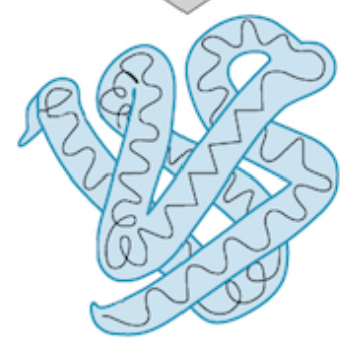
quaternary protein structure
2 or more polypeptides assemble to form larger protein molecules

how can proteins unfold?
being heated (considered denatured)
pH changes, high concentrations of polar molecules, non polar substances, via hydrophobic interactions