Cell Biology Ch. 1
 Call Kai
 Learn
Learn Practice Test
 Spaced Repetition
 Match
Match Flashcards
 Knowt Play
1/22

There's no tags or description
Looks like no tags are added yet.
Name | Mastery | Learn | Test | Matching | Spaced | Call with Kai | Chat |
|---|
No analytics yet
Send a link to your students to track their progress
23 Terms
Cells
Small, membrane-enclosed units filled with a concentrated aqueous solution of chemicals
True or False: All known living organisms are a cell or made up of cells.
True
what are the three tenets of the cell theory
All organisms consist of one or more cells. 2. The cell is the basic living unit of structure for all organisms. 3. All cells arise from preexisting cells.
E.B. Wilson statement.
The key to every biological problem must finally be sought in the cell, for every living organism is, or at least at some time has been, a cell.
Who was E.B wilson? And what year?
Cell biologist (1925)
Ancient atmosphere
H20+N2+Nh3+CO2+CO+CH4+H2+H2S
What does Leeuwenhoek build? and in what year
Microscope in 1674
How do cells differ?
Size 2.Shape 3. Function and specialization 4. Unicellular or multicellular 5. Energy-transducing strategy
How do cells acquire reduced carbon?
either autotrophs or heterotrophs
Autotrophs vs. Heterotrophs
Autotrophs: fix their own energy from inorganic sources.
Heterotrophs: depend on energy and carbon fixed by other organisms.
True or false: All cells have the same basic chemistry.
True
True or false: All cells look different from the outside and inside.
False. Only outside.
Layout the central dogma.
DNA -> RNA -> Protein
Similarities of all cells.
surrounded by a phospholipid bilayer membrane. 2. genetic code written in the same language-DNA is the genetic material. 3. same basic chemical machinery required for replicating and reading DNA (gene expression). 4. Use ATP as a primary carrier of chemical energy.
Essential Cell Processes:
Obtain nutrients/eliminate waste. 2. respond to stimuli (cell signaling) 3. Carry out chemical reactions (synthesize cellular materials) 4. Grow (cellular reproduction/grow in cell size)

Explain the Green arrows of the Autocatalytic process.
DNA and RNA provide the sequence information that is used to produce proteins and to copy themselves.
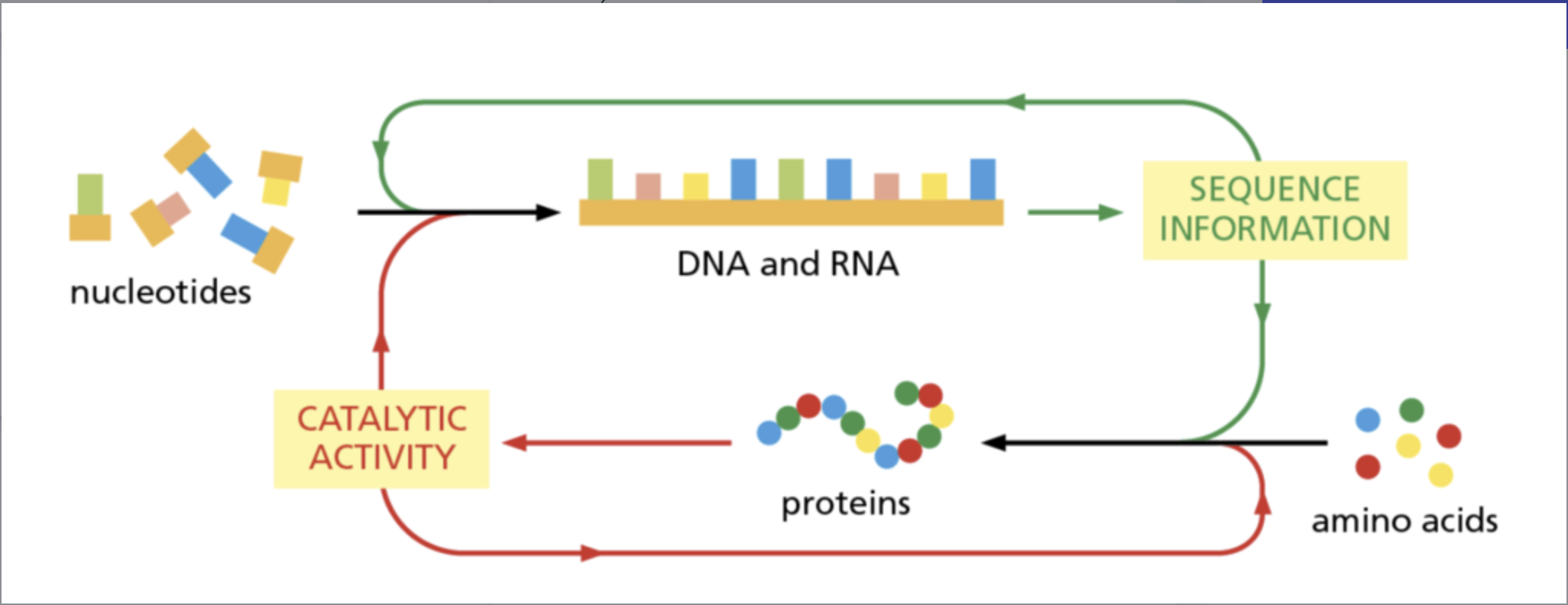
Explain the Red arrows of the autocatalytic process.
Proteins provide the catalytic activity needed to synthesize DNA, RNA, and themselves.
Genome
The entire library of genetic information in its DNA providing a genetic program that instructs the cell how to function and to grow into an organism with different cell types.
What did Eduard Strassburger draw in 1880?
A living plant cell (a hair cell from a Tradescantia flower).
What did Eduardo Strassburger observe?
A cell dividing into two daughter cells over a period of 2.5 hours.
Cytology
Microscopic observation of cellular structure, specific staining for cell components, and even staining for enzymatic or other biochemical reactions.
Biochemistry
Investigation of cellular chemical reactions and the structure-function of biological molecules.
Genetics
Study of how genes function in cells and how they are transmitted to offspring cells (heredity).