Mitochondria part - I Reading: Chapter 14
 Call Kai
 Learn
Learn Practice Test
 Spaced Repetition
 Match
Match Flashcards
 Knowt Play
1/11

There's no tags or description
Looks like no tags are added yet.
Name | Mastery | Learn | Test | Matching | Spaced | Call with Kai |
|---|
No analytics yet
Send a link to your students to track their progress
12 Terms
Mitochondria (inheritance and genome)
maternally inherited
contains own genome
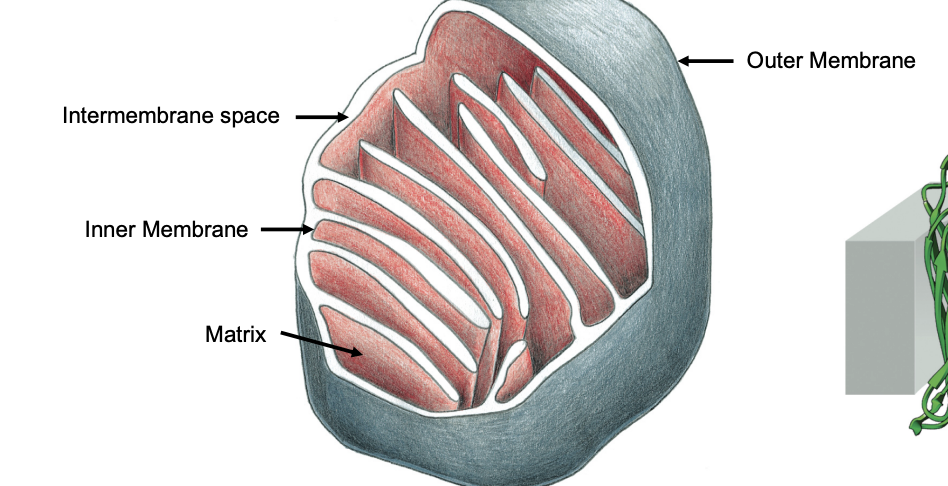
Mitochondria membrane
inner membrane
lots of folding
Cristae
inner membrane folds that increase surfaces area
allow for more ATP to be produced from ETC
Mitochondria adapt to meet energy demand (where in teh cell is it found; how does it vary)
mitochondria found in cytosol
size is relative to the need of the cell ; skeletal muscels have more mitochondria
mitochondria located in the cytosol
Mitochondria can divide like bacteria by mitochondria fission
inter-membrane space
inner membrane
outer membrane
matrix
Porins
Outer Membrane allow passage of water, pyruvate and other small
molecules into the Intermembrane Space.
Inner Membrane lacks porins
instead has proteins of Electron Transport
Chains, ATP synthase and Pumps to move solutes in and out of Matrix.
it is impermeable because of its lipid composition
matrix contains
contains DNA and ribosomes.
Lipids of mitochondria (where do they come from; hows the mitochondria membrane similar)
Mitochondria import their lipids from the ER.
• Outer Membrane lipid composition is similar to that of plasma membrane.
• Some imported lipids are converted to cardiolipin in the mitochondria.
• Cardiolipin is a phospholipid with 4 hydrophobic tails which helps in making
the Inner Membrane impermeable.
• Cardiolipin forms approx 20% of the lipid in the Inner Membrane; there is no
cardiolipin in the Outer Membrane
Cardiolipin
phospholipid with 4 hydrophobic tails which helps in making
the Inner Membrane impermeable.
Cardiolipin forms approx 20% of the lipid in the Inner Membrane; there is no
cardiolipin in the Outer Membrane

