HE L4 : CONCEPTS OF LEARNING
0.0(0)
Studied by 0 people Call Kai
 Learn
Learn Practice Test
 Spaced Repetition
 Match
Match Flashcards
 Knowt Play
Card Sorting
1/46

Earn XP
Last updated 8:46 AM on 2/18/23
Name | Mastery | Learn | Test | Matching | Spaced | Call with Kai |
|---|
No analytics yet
Send a link to your students to track their progress
47 Terms
1
New cards
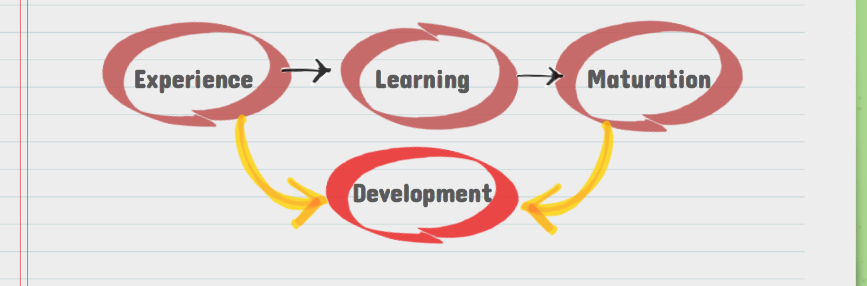
GROWTH
is increase in learning, an acquisition of knowledge that may result to maturity
2
New cards
DEVELOPMENT
is the orderly, dynamic changes in a learner from a combination of learning, experience, and maturation (Eggen,1994)
3
New cards
MATURATION
Biological changes that affect the individual
4
New cards
EXPERIENCE
Interactions with the environment that form ideas
5
New cards
LEARNING
Acquiring knowledge, skills, and values
6
New cards
Factors Influencing Intellectual Development
7
New cards
STAGES
are qualitative changes like that of the transformation of a caterpillar to a butterfly
8
New cards
Infancy (0-1)
The sensorimotor stage.
\
Most learning are responses to stimuli
\
Most learning are responses to stimuli
9
New cards
Toddler (1-3)
The pre operation stage.
\
Learning is mostly by perceptions
\
Learning is mostly by perceptions
10
New cards
Preschool (3-7)
Perceptual Intuitive Thought.
\
Learning is accommodation of ideas to fit reality than reasons
\
Learning is accommodation of ideas to fit reality than reasons
11
New cards
School Age (7-11)
Concrete & Operations stage.
\
Learning is thinking and reasoning logically about concrete objects not just by perception
\
Learning is thinking and reasoning logically about concrete objects not just by perception
12
New cards
Adolescent (12-18)
Formal Operational Thought.
\
Learning is logical, providing scientific reasons even with the abstract
\
Learning is logical, providing scientific reasons even with the abstract
13
New cards
Every individual
is unique and thus a student is entirely different from another student regardless of the student’s personal profile.
14
New cards
Teacher’s considerations
* Multiple Intelligences
* Emotional Intelligence
* Socioeconomic Status
* Culture
* Gender Differences
* Emotional Intelligence
* Socioeconomic Status
* Culture
* Gender Differences
15
New cards
Multiple Intelligences
A person can be any of the 8 or more smarts
16
New cards
Emotional Intelligence
A person who has capability to manage and monitor his or her own emotions
17
New cards
Socio economic Status
affects a learner’s well being
18
New cards
Culture
refers to attitudes, values, customs and behavior patterns that characterize a social group
19
New cards
Gender Differences
Different treatment and stereotyping boys and girls
20
New cards
LEARNING
is acquisition of knowledge, skills, and attitudes by experience or practice that changes a person’s behavior.
21
New cards
PHYSIOLOGICAL NEEDS
Impoverished students tend to have diminished motivation to learn
22
New cards
SAFETY NEEDS
Students who have a low sense of security tend to achieve less
23
New cards
ESTEEM
\
LOVE AND BELONGING
\
LOVE AND BELONGING
Growth needs tend to energize and direct student learning
24
New cards
SELF- ACTUALIZATION
True motivation for learning develops when students see the relationship between what they are learning and what they want to become
25
New cards
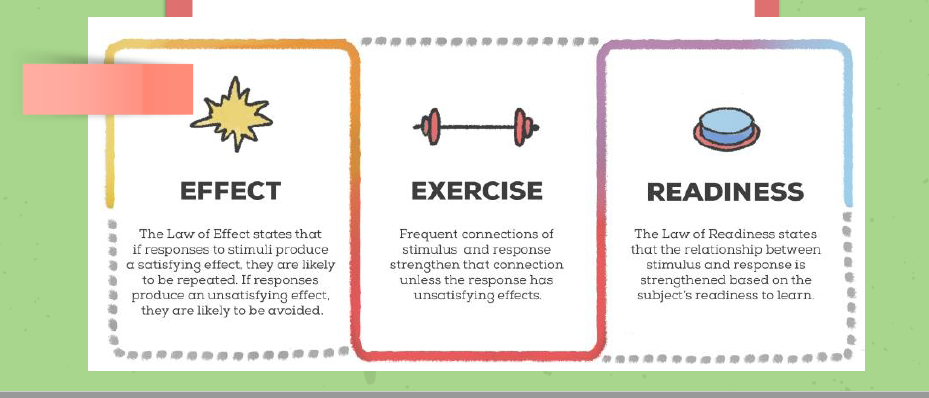
Simple responses to the presence of stimuli
26
New cards
EFFECT
27
New cards
EXCERCISE
28
New cards
READINESS
29
New cards
TRUE
Habits. Highly coordinated skills and sequences of behavior are learned over time. When applied to muscles, this is known as motor skills
30
New cards
TRUE
Perceptual responses involving past experiences. Interpretation and understanding is based on what is already stored in the brain
31
New cards
TRUE
Attitudes. These are responses to selected aspects of the environment and the present situation that brings benefits like love, cooperation and honesty
32
New cards
TRUE
Emotional responses. We learn to fear high places or enclosed places, blush in certain situations, and smile happily to friends
33
New cards
TRUE
To solve problems and develop problem solving skills. We apply the skills to specific situations we face
34
New cards
TRUE
Language. We learn words, communication through words, and even mathematical symbols
35
New cards
TRUE
To develop our personality. We learn how we are able to combine emotions, attitudes, behaviors and response patterns
36
New cards
TRUE
Motives. We learn what prompts us to act in a certain way. We develop an inclination for specific behavior
37
New cards
Retention
Best for students who read, hear, see, say, and do. The percentage is about 90
38
New cards
Involvement
Not only do we learn more by using more senses BUT to be actively involved in the learning process
39
New cards
Environment
Must be conducive to learning. This refers both to the physical and psychological atmosphere
40
New cards
Readiness
Only the ready learns. Assess readiness and create motivation
41
New cards
Relevance
Lesson must be deemed relevant to the learners to affect lasting learning
42
New cards
Repetition
Constant correct practice makes perfect. The learner must hear, see, say, and do correctly to affect learning
43
New cards
Synthesize & Generalize
Learning must be a means to put together the small parts learned. The small parts learned must create a big picture of the lesson
44
New cards
Pleasant experience
Students tend to learn and keep on learning as they accumulate pleasant learning experiences
45
New cards
From Known to Unknown
Learning must be an association of what was previously learned to what must be learned. Lost connection means no learning
46
New cards
Pacing
Students must have the right pace to learn. Pauses are necessary to absorb content and process skills
47
New cards