sports performance test
 Call Kai
 Learn
Learn Practice Test
 Spaced Repetition
 Match
Match Flashcards
 Knowt Play
1/36

There's no tags or description
Looks like no tags are added yet.
Name | Mastery | Learn | Test | Matching | Spaced | Call with Kai | Chat |
|---|
No analytics yet
Send a link to your students to track their progress
37 Terms
how many bones are in the human body
206
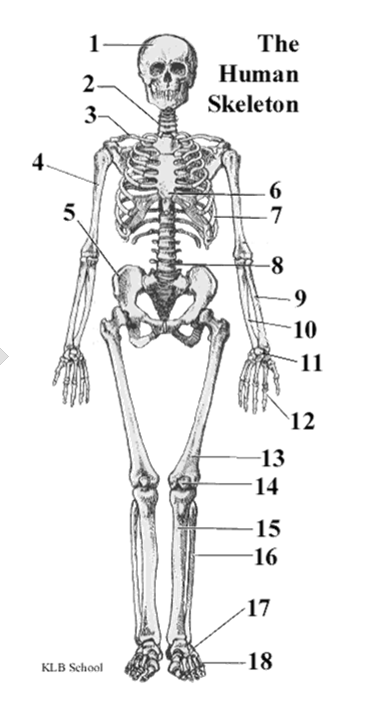
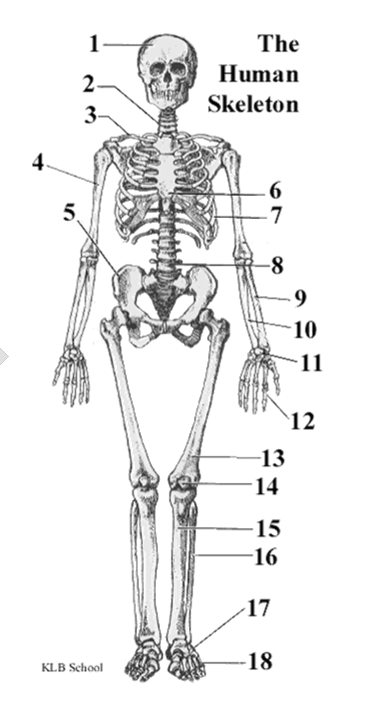
what are the numbers
1: Skull (Cranium)
2: Cervical vertebrae (Neck bones)
3: Clavicle (collarbone) scapula (sholder blade)
4: Humerus (Upper arm bone)
5: Pelvis (Hip bone / Ilium)
6: Sternum (Breastbone)
7: Rib
8: Lumbar vertebrae (Lower back bones)
9: Radius (Forearm bone on thumb side)
10: Ulna (Forearm bone on pinky side)
11: Carpals (Wrist bones)
12: Metacarpals (after wrist bones) and phalanges (Finger bones)
13: Femur (Thigh bone)
14: Patella (Kneecap)
15: Tibia (Shin bone)
16: Fibula (Calf bone)
17: Tarsals (Ankle bones)
18: Phalanges (Toe bones)
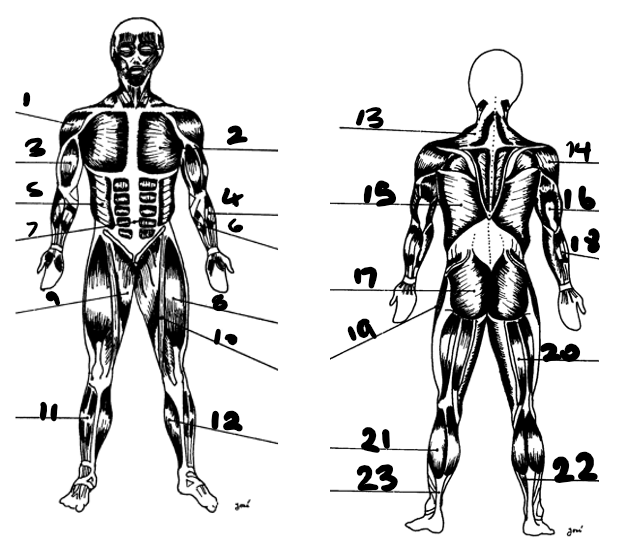
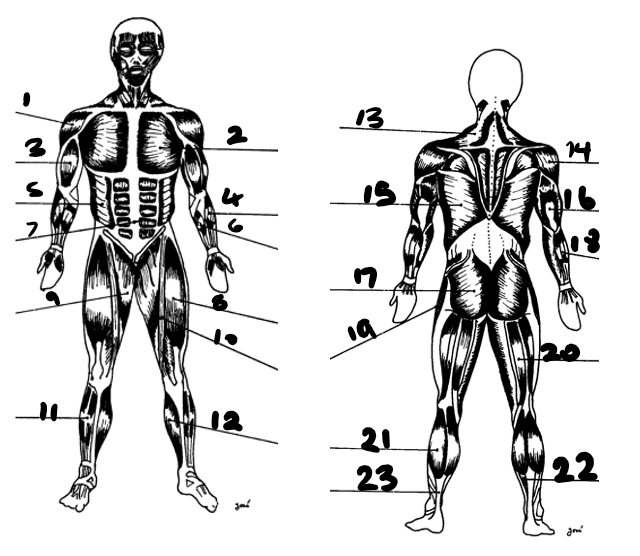
what are the numbers
deltoid
pectorals
biceps brachii
brachioradialis
abdominal external oblique
flexor capi radialis
rectus abdominis
rectus femoris
gracilis
sartorius
tibialis anterior
fibularis longus
levator scapulae
deltoid
latissimus dorsi
triceps brachii
gluteus maximus
extensor carpi ulnaris
vastus lateralis
semitendinosus
gastrocnemius
peroneus brevis
achilles tendon
function of skeletons
to provide support
to allow movement
to protect vital organs
to produce red blood cells
to store essential minerals
joint
where two bones meet and joined together
ligaments
how joints are connected together with a strong tissue
tendons
strong tissue that connects muscles to a bone
muscles
a soft body tissue made of cells or fibers that tighten and relax to create movement
origin bone
the one that dosent moved is called the origin
insertion
the one that moves is called the insertion, moves towards origin during muscluar contraction
fibours
fixed joints
cartilaginous
slightly moveable joints
synovial
freely moveable joints
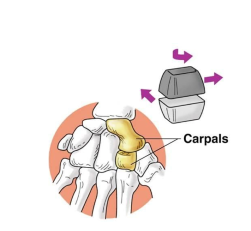
gliding joints
bone surfaces are flat and allow a slight sliding movement, examples are between the carpal bones in the wrist and between the tarsal bones in the ankle
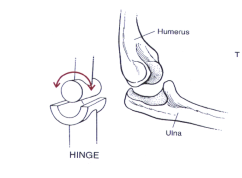
hinge joints
acts like a hinge on a door examples are the knee ( femur and tibia) and the elbow (humerus and ulna)
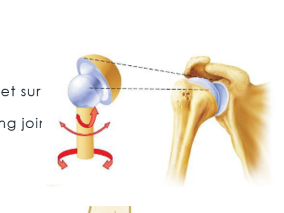
ball and socket joint
one bone is a ball shape that fits into a socket surface of another bone. This is the most freely moving joint in the body examples are the hip joint (pelvis and femur) and the sholder joint (humerus and scapular)
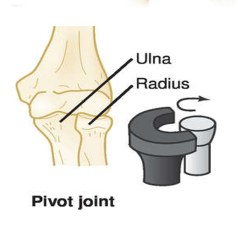
pivot joints
a ring shaped bone surrounds another bone examples are the neck (first and second vetebrae) and the elbow ( radius and ulna bones)
skeletal muscles
they are the muscles that we are most interested in. they have some unique characteristics that allow them to create movement of the skeleton.
three characteristics of skeletal muscles
elasticity
extendibility
contractibility
elasticity
the ability of a muscle to return to its original resting length after it has been stretched, like an elastic band
extendibility
the ability of a muscle to stretch beyond its normal resting point.
contractibility
the ability of a muscle to contract or shorten, with force.
sprain
damage to ligaments around a joint
strain
stretching or tearing of a muscle or tendon
prevention
the act of stopping something from happening or arising
management
the process of dealing with or controlling things
minor injury
does not impare performance and can continue playing, bumps and brusies
moderate injures
not life threatining impacts performace, ligament sprains
severe injures
involes vital organs requires an ambulance, major bleeding
what if athlete is unconsious
do doctors abcd and call an ambulance
STOP
during a game
S- Stop
T-Talk
O-Observe
P-Prevent further injury
TOTAPS
for soft tissue injuries during a game or before a game
T- talk to athlete
O-Observe
T-Touch
A-Active movement
P-Passive movement
S-Skills test
RICER
injury management
R- Rest
I-Ice
C-Compression
E-Elevation
R-Referral
no HARM
do no harm for the first 24-48 hours
H-heat
A-achohal
R-Running
M-message
immediate care
0-48 hours do RICER control bleeding and swelling
extendend care
48+ hours do no HARM
after 5 days, regain flexability, gentle passive and active stretching
after, restoration of strength, endurace and coordination to muscles and a gradual increase of work load.
aim of strapping
limits movement and prevents action
provide support to injured ligaments
provide enhanced proprioception ( send messages to brain and muscles prevent movement)