Lecture 10: Extractions I
 Call Kai
 Learn
Learn Practice Test
 Spaced Repetition
 Match
Match Flashcards
 Knowt Play
1/28

There's no tags or description
Looks like no tags are added yet.
Name | Mastery | Learn | Test | Matching | Spaced | Call with Kai | Chat |
|---|
No analytics yet
Send a link to your students to track their progress
29 Terms
What is the difference between a simple and surgical extraction?
Simple extraction: An extraction not requiring a gingival incision (other than within the sulcus) or sectioning of the tooth. Also called a closed, uncomplicated, or nonsurgical extraction.
Surgical extraction: An extraction that requires a gingival incision, bone removal, and/or sectioning of the tooth. Also referred to as an open or complicated extraction.
What is the difference between elevation and luxation?
Elevation: The process by which the periodontal ligament is fatigued or torn and alveolar bone is expanded to facilitate removal of the tooth from the alveolus. Using an elevator as a lever, the tooth is lifted (elevated) from its alveolus.
Luxation: The process by which the periodontal ligament is cut or severed to loosen teeth from the surrounding alveolar bone.
What are the indications for extraction?
Severe periodontitis
Pulp necrosis
Tooth resorption
Stomatitis
Fractured teeth: Adult, Deciduous
Traumatic malocclusion
Crowding
Unerupted teeth
Unhealthy teeth in jaw fracture line: keep healthy teeth for better stabilization
Failed endodontic treatment
What are the contraindications for extraction?
Ethics: Disarming procedures (i.e. canine extraction on aggressive dogs)
Severe systemic dz: Congestive Heart Failure, Uremia, Uncontrolled endocrine disease, Severe coagulopathies, Untreated leukemia/lymphoma
Previous radiation therapy - Leads to osteonecrosis, poor wound healing
What are the 3 fundamental steps for successful extraction?
adequate visualization of the tooth to be extracted
an unimpeded pathway for the removal of the tooth
use of controlled force to luxate or elevate and remove the tooth.
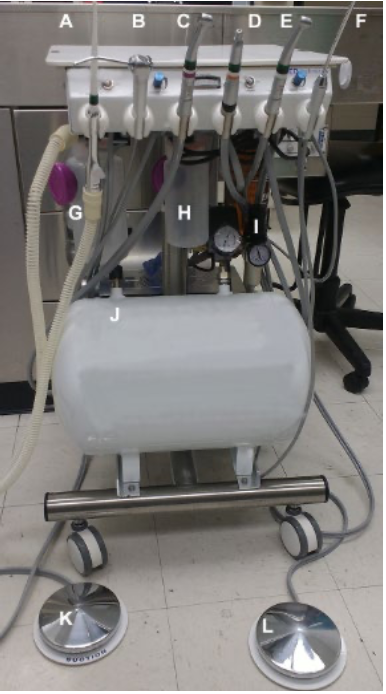
(A) Suction tip.
(B) Air–water syringe.
(C) High-speed handpiece.
(D) Low-speed handpiece.
(E) Optional second high-speed handpiece.
(F) Fiber-optic light.
(G) Suction bottle.
(H) Exhaust air bottle/filter.
(I) Pressure regulator.
(J) Compressor tank.
(K) Suction rheostat (foot pedal).
(L) Rheostat (foot pedal).
Why do you need to remove and get a new bur if you get the bur stuck in gauze or other soft tissue?
turbine can only rotate in one direction → can damage turbine if do not get new bur
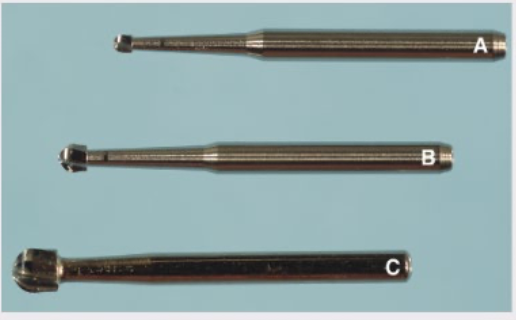
What type of burs are these?
round burs

What type of bur is this?
cross-cutting
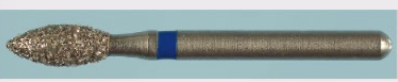
What type of bur is this?
diamond bur
How do you design a gingival flap?
Good exposure = Sufficient size
Preserve Blood supply = Wide base compared to free margin
Prevent dehiscence/delayed healing = edges of the flap must lie over intact bone
Non-tension closure = make vertical releasing incisions at line angles of adjacent teeth vs. parallel to allow for large non-tension flap
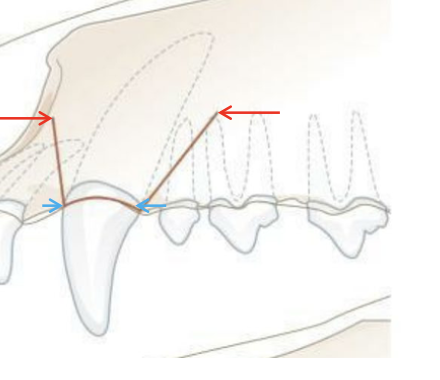
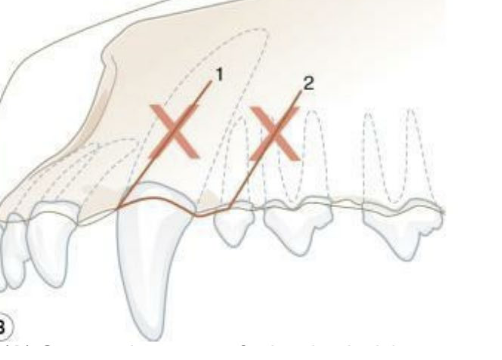
Why is the top picture correct?
incisions need to be oblique to allow a wide-based flap and does not cross the area of bone removal
bottom picture crosses the attached gingiva directly over the buccal aspect of the adjacent tooth, which will. likely result in gingival defect
What is the difference between elevators and luxators?
ELEVATORS = LEVERS
• Rotation of elevator in PDL space utilizes the surrounding alveolar bone as a fulcrum
• Tear the periodontal ligament
LUXATORS = WEDGES
• Wedged into PDL space and pressure is directed apically
• Luxators are made of softer metal and cannot be used as a lever
• CUT the periodontal ligament

Why is maintaining this proper hand position important when using a luxator?
index finger functions as a stop to prevent penetrating too deeply with the sharp instrument
What is the recommended use of extraction forceps?
leverage: twist once and pull down and out in a continuous movement
What is the principle of suturing oral mucosa?
insert at 90 degree angle and rotate to easily pass through tissue
What patient prep is necessary before extractions?
minimum database and intraoral dental rads
post-extraction rads
plan for water control
0.05% chlorhexidine rinse in oral cavity to reduce aerosolized bacteria
remove calculus prior to extractions
What post-op care is recommended for extractions?
multimodal pain control: nerve blocks, NSAIDs, gaba, ± opioid
homecare: soft food 5-7 days, avoid chew toys and treats for 7-10, avoid brushing for a few days
ice packs may be beneficial
oral rinses twice daily after meals may help speed healing in patients with compromised oral hygiene
antibiotics typically NOT needed
What is a closed extraction technique?
Defined as extraction of teeth without flap creation, with or without tooth sectioning
Applies to any single rooted tooth or tooth with fused roots
Does NOT apply to canine teeth (104/204/304/404)
True or false: in a closed extraction technique, you should always close the gingiva.
true because there is a socket left behind to close
What preparation is necessary before a closed extraction?
remove calculus
(+/-) rinse mouth with 0.05%-0.12% chlorhexidine gluconate.
Perform pre-extraction dental radiographs (either before or after removing calculus based on amount of accumulation present)
What is an open extraction?
An extraction that requires a gingival incision, bone removal, and/or sectioning of the tooth - AKA Surgical Extraction
What teeth commonly require surgical extraction (open extraction)?
Maxillary PM4
Mandibular M1
Canine teeth
Maxillary or mandibular pre-molars not affected by advanced stage periodontal disease
Maxillary third incisor not affected by advanced stage periodontal disease
What are the indications for open extraction of 2-rooted teeth?
fracture, periodontal disease, non-vital tooth
What are the indications for open extraction of maxillary teeth?
fracture, periodontal disease, oronasal fistula, non-vital tooth
What do you need to be careful of when removing a maxillary canine?
penetration into the nasal cavity
What is used to remove alveolar bone across the root surface of the maxillary canine to expose the root and periodontal ligament?
diamond bur (coarse grit)
What needs to be done in order to close the defect made by removing the maxillary canine?
perform a periosteal release using LaGrange scissors
What should you be cautious of when removing the mandibular canine?
Watch out for mandibular canal, potential risk for jaw fracture
NEVER remove bone on the lingual aspect of the tooth → will cause jaw fracture