[L18] Geothermal energy
 Call Kai
 Learn
Learn Practice Test
 Spaced Repetition
 Match
Match Flashcards
 Knowt Play
1/28

There's no tags or description
Looks like no tags are added yet.
Name | Mastery | Learn | Test | Matching | Spaced | Call with Kai | Chat |
|---|
No analytics yet
Send a link to your students to track their progress
29 Terms
Geothermal energy forms
geothermal energy systems assume a wide variety of forms, generally classified according to the operating temperatures
High temperature geothermal energy functioning
water flows into an area closer to a heat source (hot rocks or magma) → increase water temperature → creates steam or water reservoirs
wells are drilled to bring steam to the surface
water as vapour is injected into turbines → generates electricity
Why do we need to drill to access the vapour
Crystalline rock covered by low conductivity sediments
Closed-loop system Cornwall
Extraction → power production → lithium extraction → reinjection
Advantages / disadvantages for geothermal energy
24/7 electricity generation (deep energy)
renewable (for shallow energy if managed properly but needs electricity for heat pump)
low emissions
but
limited high-temp locations
complex design (thermal + hydraulic + mechanical)
risk of thermal depletion
Shallow ground heat sources
heating only
most heat extracted is recharged through solar → considered renewable & sustainable
heat can be stored in ground during summer (sink) and used in winter
uses heat pumps
Conventional geothermal system
Natural hot water / steam resevoirs, volcanic areas
EGS
Enhanced geothermal systems
Inject water at high pressure → creates fractures → circulate → extract
Closed loop system
fluid circulates in pipes and warms up
vertical loops (borehole heat exchangers)
horizontal loops (slinky system)
Heat pump
heat absorbed from water → refrigerant in pump evaporates
goes through compressor → increases pressure and temperature
circulates through heat exchanger
condenses back to a liquid and passes through expansion valve lowering its pressure and temperature
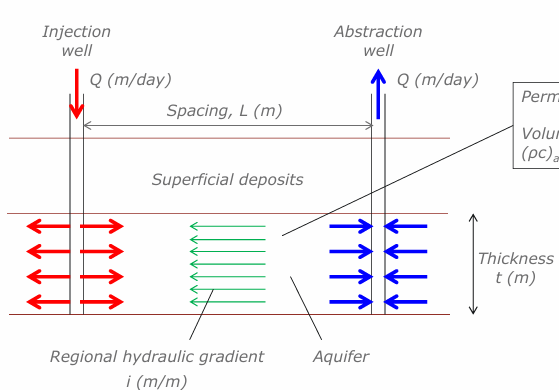
Open-loop
extract groundwater directly from aquifer
heat exchanged → water reinjected
depends on groundwater flow (convection)
Injection well (hot water in)
Abstraction well (cold water out)
Thermo-active structures
infrastructure with built in heat exchangers
piles, tunnels, retaining walls
provides heating + cooling + structural function
Geothermal energy applications
District heating (e.g. Paris)
Building heating/cooling
Underground heat exchangers (e.g. metro systems)
Ice rinks (heat recovery)
Road de-icing
Energy storage
“Geothermal city” concept → thermo-active foundations
Thermo-active foundations
Thermo active tunnel
pipes in tunnel lining
normal heat exchanger, cooler in summer and heater in winter
cheap → no added infrastructure
Ice rink
pipes under ice absorb heat to keep it frozen → heat pump → ground loop
Change in heat content
= diffusion (conduction) + advection (convection)
Fourier’s law
q = rate of heat transfer
in W/(mK)
lambda = thermal conductivity J/S

Conduction
heat transfer through solids
Convection
heat transfer via moving fluids
controlled by permeability
Specific heat capacity
J/kg/K
energy required by 1kg of material to increase t by 1K
Volumetric heat capacity
J/m3/K
energy required by 1m3 of material to increase its temperature by 1K
Thermal conductivity
rate at which heat is transfer by conduction
Permeability
controls the amount of heat transferred through convection
Field vs lab techniques to measure thermal conductivity & heat capacity
Field
needle probes
thermal reponse test TRT
Lab
sensors
Main goal of design principles
Avoid thermal depletion
→ predict temp in ground (numerical or expressions)
Closed loop systems design procedures
determine ground thermal conductivity
determine extraction rate as a function of thermal conductivity and ground temperature
calculate required borehole length
Open loop design
reinjected water may return too quickly → reduces efficiency
Must consider:
well spacing (larger = better = longer use)
Calculate distance for minimal risk of thermal breakthrough
flow rate
permeability
Time for breakthrough w or w/out regional hydraulic gradient
volumetric heat capacity
Thermo-active structures design
Concerns:
structural safety
adjacent soil strength & stiffness
thermal stresses
Heating → expansion → increased stresses
Cooling → contraction
Must estimate temperature field
Take into account foundation displacements and ground movements
Numerical analysis needed
Thermo active pile
expand when heated → soil restrains deformation → increase in axial force
opposite for cooling