Review of Embryology (Oral Bio)
 Call Kai
 Learn
Learn Practice Test
 Spaced Repetition
 Match
Match Flashcards
 Knowt Play
1/118

There's no tags or description
Looks like no tags are added yet.
Name | Mastery | Learn | Test | Matching | Spaced | Call with Kai | Chat |
|---|
No analytics yet
Send a link to your students to track their progress
119 Terms
Growth — definition
Physical increase in size or number; differential process in which some parts grow more rapidly than others.
Development — definition
Increase in degree of organization and/or functional complexity; a physiologic and behavioral process.
Craniofacial morphogenesis — critical period
Weeks 4-14 of intrauterine life are the critical period for formation of the face and oral cavity. (MKE 414)
Proliferative period
Weeks 0-2: fertilization, implantation, and embryonic disk formation.
Embryonic period
Weeks 2-8: tissues and organ systems develop; weeks 3-8 are most susceptible to serious malformations.
Fetal period
Week 8-birth: tissues enlarge, differentiate, and function; susceptibility to major malformations declines.
Week 1 — what happens to embryonic disc
Bilaminar disc forms from cells of the zygote: differentiation of ectoderm + endoderm.
Ectoderm — key idea
Outer structures; skin/hair and nervous-system development.
Endoderm — key idea
Forms GI tract epithelial linings and associated glands.
Week 2 — gastrulation
Gastrulation (process of forming 3rd layer) forms mesoderm and produces a trilaminar disc: ectoderm, mesoderm, endoderm.
What important system does the ectoderm develop into?
Nervous system
What sensory epithelium does the ectoderm include?
Sensory epithelium of eye, ear, and nose
What type of skin structures does the ectoderm give rise to?
Epidermis, hair, and nails
What glands are derived from the ectoderm?
Mammary, intraoral and cutaneous (skin) glands
What cavities are formed from the ectoderm?
Oral and nasal cavities, epithelium of the sinuses
What dental structure is developed from the ectoderm?
Tooth enamel
What are the 3 M's when it comes to mesoderm?
Muscles, middle, mesoderm
What are the connective tissue derivatives of the mesoderm?
Bone, cartilage, blood, dentin, pulp, cementum, periodontal ligaments
After week 2, the trilaminar disc becomes the...
embryo
Weeks 0-2 (proliferative period) — environmental susceptibility
Least susceptible to environmental factors and acquired defect formation.
"p"roliferative = "p"rotected
Weeks 3-8 (embryonic period) — environmental susceptibility
Most critical for serious malformations because structures are developing and highly susceptible.
What happens during week 3?
neural folds appear, neural tube closes, primary brain vesicles (brain, spinal cord) form
Week 8-birth — susceptibility
Declining susceptibility to malformations; defects tend to be minor.
By week 4
Heart begins to beat.
heart 4 you
Weeks 4-7
Formation of the face and oral structures.
Weeks 8-14
Face takes on a more human appearance. Fetal period begins at week 8.
What happens during neurulation?
Week 3. Neural folds appear and form the neural tube; this initiates CNS formation.
Neural groove development
Deepens between rising neural crests. Where CNS forms
What are NCC (neural crest cells)?
Differential cells around neural grooves that migrate laterally/ventrally to form diverse structures in the future face. Contribute to sensory nerves and teeth.
What structures does the newly formed CNS make in week 3?
Primary brain vesicles; forebrain, midbrain, and hindbrain; cerebral hemispheres also form.
What makes up the forebrain?
frontal, temporal, and occipital lobes, other brain matter
Weeks 4-5 — cranial nerves
Cranial nerves begin development and grow into the tissues they innervate.
What stage does Fetal alcohol syndrome affect?
Affects Stage 1 which is the initial organization of germ layers.
Fetal alcohol syndrome — brain impact
First three ventricles of the brain fail to separate.
Fetal alcohol syndrome — face deformations (7 key features)
Saddle nose (low nasal bridge), minor ear abnormalities, epicanthal folds (folds within eye lids), indistinct philtrum (no two lines from nose to mouth), micrognathia (less developed jaw), flat midface and short nose, thin upper lip
Gut tube — foregut becomes:
Upper digestive tube from throat to duodenum.
Gut tube — midgut derivatives:
Small intestine, cecum, ascending colon, and most of the transverse colon.
Gut tube — hindgut derivatives
Sigmoid colon and rectum.
Buccopharyngeal membrane
Between cardiac bulge and forehead, opening to oral cavity
Week 4 — facial development
Pharyngeal arches appear and facial development begins.
Orange Box in image (develops in to)
Front Nasal Passage

Purple Box in Image (develops in to)
Nostrils

Teal box in image (develops in to)
Mandible
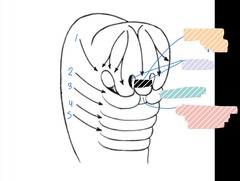
Pink box in image develops in to
Buccopharyngeal membrane

Black box develops in to
Nose

Frontal prominence (week 4)
Becomes the forehead area.
Stomodeum (week 4)
The oral pit; becomes the oral cavity.
Maxillary process (week 4)
A facial prominence that grows toward the oral cavity and contributes to facial structures/cheeks.
Mandibular process (contributes to? what week do they form?)
Contributes to the developing mandible/lower face.
week 4
What are Nasal pits and what week do they start to form
Beginning of the nasal cavity.
week 4
Ncc contribute to tooth and periodontium formation by..
and why is this an exception
Migrating to oral ectoderm
ectoderm is usually for outer parts of the body but it also refers to the front of the oral cavity.
What are some complex processes of NCC's
NCC's migrate to epithelial areas with specific homeobox genes in high concentrations
also help with cell signaling
What can happen when NCC's don't work properly
Missing teeth, or supernumerary teeth
What is the orange box (middle black gray area)
Stomodeum (oral pit) and rupturing buccopharyngeal membrane

What does the lighter gray area (purple box) develop
Maxillary process (first arch)
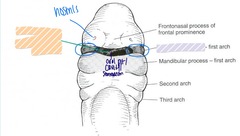
Blue box
medial nasal process
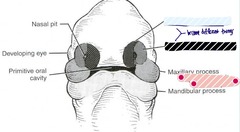
Black box
lateral nasal process
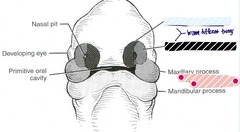
Pink box, what does the maxillary process develop
shelves that are sent out to form palate
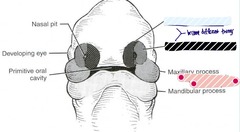
When does the oral pit first appear and what is it
Week 4
Develops between brain and heart buldge, becomes oral cavity, or stomodeum
What day does a heart start beating
day 21
Light blue box
where does it emerge
Maxillary process
emerges from arch
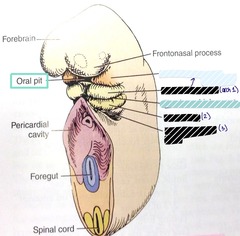
Teal (bottom) box
first branchial groove

three black boxes (in parenthesis is arch it orignates from)
1. Mandibular arch
2. Hyoid arch
3. Third branchial arch

Week 5 — oropharyngeal membrane
Ruptures, opening the oral cavity to the tubular foregut and establishing the oropharynx.
In week 5, ____ grows ___(direction)__ to oral pit and will develop in to the _____ which forms the cheeks.
a. mandibular arch
b. laterally
c. maxillary process
What direction do maxillary processes grow
Ventromedially (towards the surface and towards the middle)
What face parts develop during week 5-6?
nose and nostrils develop, eyes and external ears become for evident
What is ossification of the mandible and when does it happen?
Mandible begins ossification (boney calcification next to cartilage) during the late sixth week
During weeks 5-6, the maxillary processes grow _____ toward the oral cavity and meet the _____ and lower extent of the _____.
ventromedially
lateral nasal prominences
medial nasal processes
What happens to the mandible during late week 6
Mandible begins ossification.
What nose and nostril feature develops from the nasal placodes
Develop into nasal pits, with medial and lateral nasal prominences forming around them.
What is the nasolacrimal groove
this region runs between eye and maxillary prominence
Weeks 6-9 — facial development updates?
Facial processes continue fusion and maturation; facial contours become increasingly recognizable.
Weeks 10-14 — facial development updates? What region becomes more recognizable
The face continues to take on a more human appearance; the intermaxillary/philtrum region becomes recognizable
What are the 3 components of the pharyngeal apparatus from outside the inside
Groove -> arch -> Pouch
What is the importance of pharyngeal arches
Also called branchial arches; contribute greatly to formation of the head and neck.
Pharyngeal arches - when do malformations happen
Many major craniofacial malformations originate during transformation of the branchial apparatus into adult derivatives.
Each pharyngeal arch contains...
Cartilage, an artery, a cranial nerve, and mesodermal tissue.
What are pharyngeal grooves/clefts?
Develop around week 5
vertical indentations between the arches outside (groovy outside) (cleft= went outside)
they develop around week 5
Pharyngeal pouches
Internal structures that separate the arches within the pharynx and correspond with external grooves.
(pouch is inside something)
Arch 1 — name and cartilage
Mandibular arch
meckels cartilage (bilateral)
Arch 1- development time
develop in week 4 and disappear in week 5
Arch 1 — cranial nerve
CN V (Trigeminal)
Arch 1 — muscles (name and when they develop)
Muscles of mastication; also anterior belly of digastric, mylohyoid, tensor veli palatini, and tensor tympani.
Develop in week 5 and spread into muscle origin in weeks 6/7
Arch 1 — skeletal/bone derivatives
Melleus and incus
Arch 1 lined by
ectoderm (both internally and externally)
Arch 2 — name and cartilage
Hyoid arch
Reicherts cartilage (rod shaped)
Arch 2-5 development time and lining (AND EXCEPTION)
weeks 4-7
ectoderm externally and endoderm internally
EXCEPT anterior area behind arch 2
Arch 2 — cranial nerve
CN VII (Facial).
Arch 2 — muscles (5 answers)
Muscles of facial expression, posterior belly of digastric, stylohyoid, and stapedius.
Arch 2 — skeletal/bone derivatives (5 answers)
stapes, styloid process, stylohyoid ligament, upper body of hyoid and lesser cornu.
Arch 3 — cranial nerve
CN IX (Glossopharyngeal).
Arch 3 — muscles (1)
Stylopharyngeus; (from styloid process to pharynx)
Arch 4 muscles
inferior pharyngeal constrictor muscles
Arch 3 vessels become prominent, becoming the ____ and suply the ____p
common carotid arteries
supply neck face and brain
During week 7, 3rd arch vessels switch from the ____ to the ___ to face and neck. ___[first blank]___ supplies the brain
1. internal carotid
2. external carotid
3. internal carotid
Arch 3 — skeletal derivatives
Greater cornu and lower body of the hyoid
Arch 4/5 — cranial nerve
CN X (Vagus).
Arch 4 becomes the ...
Dorsal aorta (descending aorta)
Week 7 — carotid supply
External carotids supply the face/neck; internal carotid supplies the brain.