Antigen Recognition & Presentation
 Call Kai
 Learn
Learn Practice Test
 Spaced Repetition
 Match
Match Flashcards
 Knowt Play
1/8

There's no tags or description
Looks like no tags are added yet.
Name | Mastery | Learn | Test | Matching | Spaced | Call with Kai |
|---|
No analytics yet
Send a link to your students to track their progress
9 Terms
Describe MHC
Two Types?
Differentiate between the two classes:
location
Antigen presentation
Presentation to which cells?
Structure
Describe the MHC genetics
Dominance pattern?
Inherited as?
Describe the genes for the different chains in Class 1 and 2
Describe MHC I genes
What are the two types?
describe its morphism
Function?
Describe MHC II genes
What are the two types?
describe its morphism
Function?
Describe Allelic Variation
Location
Mech
Function
Define:
polymorphism
polygeny
Describe the relationship between Natural Selection and MHC diversity:
MHC
two types:
autologous (Self)
allogeneic (Non-self)
1-10% of circulatory T cells in most individuals are alloreactive
Two Classes: MHC Class I; MHC Class II:
Location:
Class I: almost all nucleated cells
Class II: on professional APCs only
Antigen Presentaiton:
Class I: from inside the presenting cell
Class II: from outside (engulfed)
Presenting to which Cells:
Class I: CD8 T Cells (killer)
Class II: CD4 T Cells (Helper)
Structure:
Class I: 3 Alpha Chains + 1 β₂‑microglobulin ; “Cup”
Class II: 2 alpha + 2 beta; “hotdog”
MHC Genetics:
Co-dominant
(Genes from both parental chromosomes are expressed at the same time in the same cell)
Inherited as HAPLOTYPES
definition: cluster of alleles on one chromosome that are inherited together.
Class II region, Class I region, Class III region (no MHC genes here)
alpha vs beta chain genes:
Class I:
α-chain: six genes
β2-macroglobulin: one gene that pairs w/ all α-chain genes
Class II:
α-chain: five genes
β-chain: multiple genes that pair with a specific α-chain gene
MHC I genes
HLA-A, HLA-B, HLA-C
highly polymorphic (many alleles)
interact w/ CD8+ T cells
HLA-E, HLA-F, HLA-G
oligomorphic (a few alleles)
have roles associated with NK cells
These codes for alpha-chains; pairs up w/ B2 microglubulin
MHC II genes in humans
HLA-DP, HLA-DQ, HLA-DR
highly polymorphic
interact w/ CD4+ T cells
HLA-DR = Diverse in Gene
Everyone has DRB1; Some people also have DRB3 OR DRB4 OR DRB5
HLA-DM, HLA-DO:
oligomorphic,
control how peptides are loaded into the other MHC II molecules
These represent a few α-chain genes and many β-chain genes
Allelic Variation
Occurs w/in Peptide Binding Grooves
a1 and a2 domains of MHCI
b1 domain of the MHCII
Mech:
substitutions of 1-50 amino acids.
Function:
influences the types of peptides each isoform will bind.
Definition:
Polymorphism:
multiple alternative forms of a gene (allele) within the population.
Polygeny:
multiple similar genes encoding the same thing
Natural Selection and MHC diversity:
Balancing selection:
tends to maintain a given polymorphism
Directional selection:
tends to introduce new haplotypes
Describe Interferon-gamma
Produced by?
Function? Mechanism?
IFN-γ
Production:
by NK cells during innate immune responses
by T cells during adaptive immune responses
Function:
induces the expression of MHCI
IFN-γ → Jak-Stat → act. NLRC5 (MHC Class I Transactivator) → controls expression of MHC I genes
induces the expression of MHCII
IFN-γ → signaling → act. CIITA (MHC Class II Transactivator) → controls expression of MHC II genes
What is the difference between Antigen Processing versus Presentation
What determines which peptides gets presented?
Antigen Processing versus Presentation
Processing:
Internal pathways in cells that prepare and load antigens into MHC molecules
Presentation:
MHC molecules loaded with peptide delivered to the surface and presented to T cells
Which peptides gets presented?
Dependent on Affinity to MHC and Abundance (higher = more likely)
Describe the Mechanism for processing for MHC ClassI/II
MHC Class I:
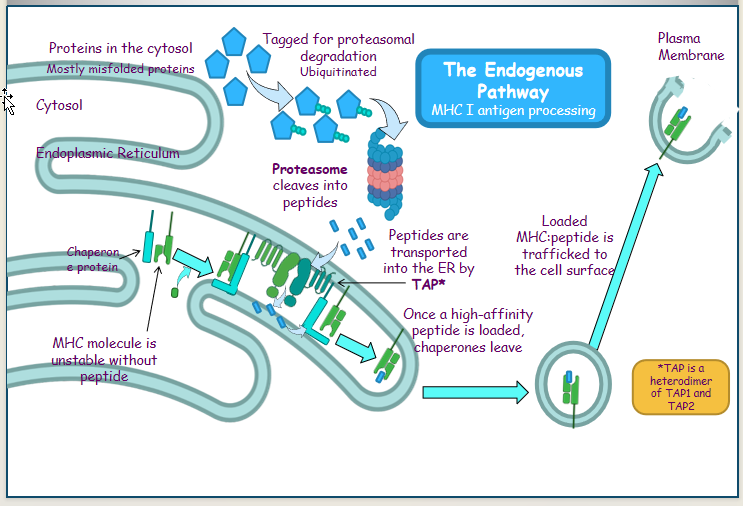
Endogenous Pathway
Misfolded proteins in cytosol → tagged by ubiquinate → proteosome cleaves → remnants peptides transported to ER via TAP → Joins w/ MHC molecules → trafficked to cell surface
Prior, MHC is unstable and helped by chaperon proteins; once peptide binds, chaperon leaves
MHC Class II:
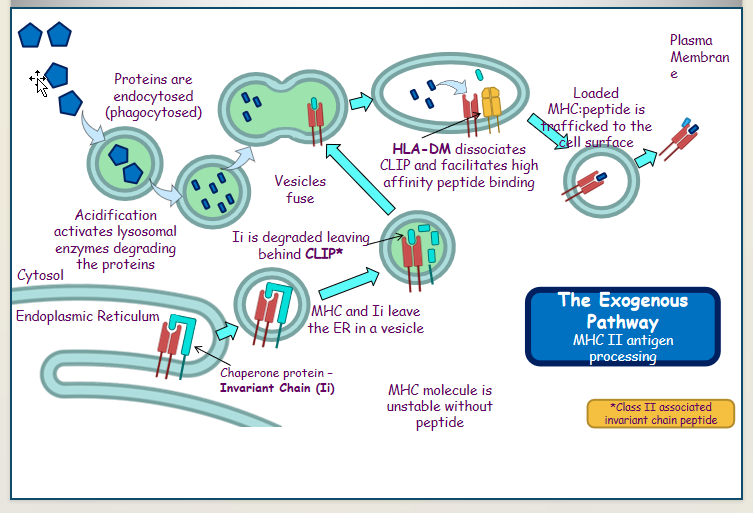
Exogenous Pathway:
Proteins are phagocytosed → Acidification → act. lysosomal enzymes degrading proteins
MHC + Ii (invariant chain; chaperon) → leaves ER in vesicle → Ii degraded, turns into CLIP ↗ vesicle fuses
HLA-DM dissociates CLIP + facilitates high affinity peptide binding → sent to PM
Describe what happens to MHC Class I @ homesostasis:
@ homeostasis, self-peptides are presented.
Cells are always presenting antigen via MHC molecules
constitutive process.
When there are no pathogens around, the peptides in the MHC grooves are from self-antigens that are processed in either the endogenous or exogenous pathway.
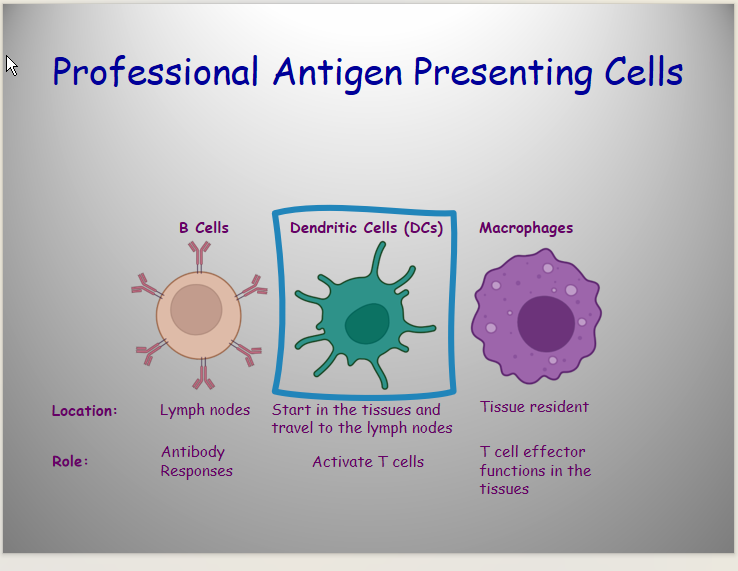
List the Professional Antigen Presenting Cells:
Location
Roles?
Differentiate between Conventional Dendritic Cells (cDCs) and Plasmacytoid Dendritic Cells (pDCs)
Location
Function
cDCs vs pDCs:
Location:
cDCs:
Cycle between the tissues and the lymph nodes
pDCs:
Tissue resident
Functions:
cDCs:
antigen uptake and presentation
generate cytokines → act. T Cells
pDCs:
produces type 1 interferons
can present antigen but not efficienctly
Differentiate between immature and mature DCs
Phagocytosis ability
presentation ability
Cytokine secretion
what happens when it travels to T cell zone
How does Immature → mature
Immature vs mature:
Phagocytosis:
Immature: Great @
Mature: Poor @
Presentation:
Immature: Poor @
Mature: Great @
Cytokine Secretion:
Immature: Little to no
Mature: Massive secretions
Co-stimulatory molecules
Immature: no expression
mature: high expression
Travels to T cell zone
Immature: no act.
mature: Activates T cells
Immature → mature:
via danger signals
PAMPs
Inflammatory cytokines
DAMPs