Ch. 30 Flowering Plants
 Call Kai
 Learn
Learn Practice Test
 Spaced Repetition
 Match
Match Flashcards
 Knowt Play
1/83

There's no tags or description
Looks like no tags are added yet.
Name | Mastery | Learn | Test | Matching | Spaced | Call with Kai |
|---|
No analytics yet
Send a link to your students to track their progress
84 Terms
Seed
Consists of an embryo and nutrients surrounded by a protective coat
wind
Seeds can disperse over long distances by ____ or other means
ultraviolet radiation
All seed plants have reduced gametophytes, heterospory, ovules, and pollen which are adaptations that help plants cope with drought and exposure to ____ ____
False
True or false: water is not required for fertilization of seed plants
sporophyte, gametophytes
Seed plant life cycles are ____-dominated, and ____ are microscopic and dependent
spores
Gametophytes develop from ____ retained within the sporangia of the sporophyte
Homosporous plants
Plants that produce one kind of spore and generally have bisexual gametophytes
Heterosporous plants
Plants that produce two types of spores, which form either male or female gametophytes
Ovule
Consists of a megaspore within a megasporangium, surrounded by integuments
Integuments
One or more protective coats that surround the ovule
Pollen grain
Pollen wall that encloses a male gametophyte developed from a microspore
Pollination
Transfer of pollen to the part of a seed plant containing the ovules
germinate
Pollen grains ____ when they reach the female reproductive structure
sporophyte
If a sperm fertilizes the egg of a seed plant, the zygote grows into a ____ embryo
ovule, sperm
The pollen tube produced by germinated pollen grain will grow into the ____ and discharge ____ into the female gametophyte
seeds, spores
Both ____ and ____ provide protection from harsh conditions and facilitate dispersal
multicellular, unicellular
Seeds are ____ and spores are ____
Spores
Are seeds or spores shorter-lived?
No
Do spores provide nourishment to gametophytes?
Conifers
Most gymnosperms are cone-bearing plants called what? (ex. pines, firs, redwoods)
Pollen
Airborne agent bringing gametes together
Scales
Part of each ovulate cone that separate at maturity and seeds are dispersed by wind
seedling
At germination, the sporophyte embryo emerges as ____
Devonian
Characteristics found in living seed plants date back to the late ____ period
305
The oldest gymnosperm fossils are about ____ million years old
drought
Seeds, pollen, and adaptations for ____ tolerance helped gymnosperms thrive into the Permian period
Mesozoic
Gymnosperms dominated terrestrial environments during the ____ era
Mesozoic
Angiosperms began to replace gymnosperms near the end of the ____ era
Cycadophyta, ginkgophyta, gnetophyta, coniferophyta
Name the four phyla of gymnosperms
Phylum Cycadophyta
Phylum of gymnosperms with flagellated sperm, large cones, and palmlike leaves; many species toay are endangered
Phylum Ginkgophyta
Phylum of gymnosperms with fleshy seeds produced by female trees (smell rancid as they decay); popular in cities because they tolerate air pollution
Phylum Gnetophyta
Phylum of gymnosperms in which some are tropical while others live in deserts
Gnetum, Ephedra, Welwitschia
Name the three genera of Phylum Gnetophyta
Welwitschia
Genus of Phylum Gnetophyta that occurs only in desserts of Southwestern Africa and has large straplike leaves; produces ovulate cones on stalks
Ephedra
Genus of Phylum Gnetophyta that produces ephedrine
Ephedrine
Compound used medicinally as a decongestant
Gnetum
Genus of Phylum Gnetophyta that includes species of tropical trees, shrubs, and vines; leaves look similar to flowering plants, and seeds look similar to fruits
Phylum Coniferphyta
Largest phylum of gymnosperms (~600 species); most have woody cones; some have fleshy cones, needlelike leaves, or scaly leaves; most are evergreens
Flowers and fruits
Angiosperms are seed plants with reproductive structures called what?
Flower
Angiosperm structure specialized for sexual reproduction
pollen
In many species, insects or other animals transfer ____ from one flower to the sex organs of another
Sepals
Usually green and enclose the flower bud
Petals
Often brightly colored to attract pollinators; wind-pollinated flowers aren’t usually brightly colored
Stamens
Microsporophylls, male reproductive organs
Carpels
Megasporophylls, female reproductive organs
Filament
Stalk that’s part of stamen
Anther
Terminal sac of stamen
Microspores
____ are produced within the anthers and develop into pollen grains which contain the male gametophytes
ovary, style, stigma
Name the three parts of the carpel
anther, filament
Name the two parts of the stamen
Ovary
Contains the female gametophyte(s) within the ovule(s); fertilized ovules develop into seeds
Pistil
A single carpel or two or more fused carpels
Radial symmetry
Any imaginary line through the central axis divides the flower into two equal parts
Bilateral symmetry
A flower can only be divided into two equal parts by a single imaginary line
Fruit
As seeds develop, the ovary wall thickens and the ovary matures into a what?
seeds
Fruits protect ____ and aid in their dispersal
seeds
Some dry fruits split open and release mature ____, others remain closed
wind
Some fruits (ex. dandelions) function like parachutes for ____ dispersal
water
Some fruits (ex. coconuts) are adapted to float by dispersal by ____
fur
Some fruits modified as burrs cling to animal ____
feces
Sweet tasting, vividly colored fruits are eaten by animals and dispersed in their ____
embryo sac
Female gametophyte contained in each ovule
Egg
Contained within the embryo sac
Cross-pollination
Transfer of pollen from a different individual
pollen
Male gametophytes are contained within ____ grains produced by the micsporangia or anthers
Double fertilization
Process in which one sperm fertilizes the egg to form a diploid zygote and the other sperm fuses with two nuclei in the embryo sac to form a triploid cell (3n)
Cotylendons
Seed leaves of sporophyte embryo
sporophyte
The zygote forms a ____ embryo with a simple root and one or two cotylendons
Endosperm
Tissue rich in starch and other food for the developing embryo; formed by triploid cell
Cretaceous
Angiosperms originated in the early ____ period, and they dominated terrestrial environments midway through this period
woody, aquatic
Fossils of seed plants closely related to angiosperms indicate the ancestor was probably ____ and not ____
Extant
Opposite of extinct
Bennettitales
Angiosperms may be more closely related to ____, extinct seed plants with flowerlike structures
Parasitism
What is the most successful type of symbiosis?
Eudicots
“True” dicots; form a clade that includes most of the species once categorized as dicots
one, two
Monocots have ____ tylendon(s) and dicots have ____ tylendon(s)
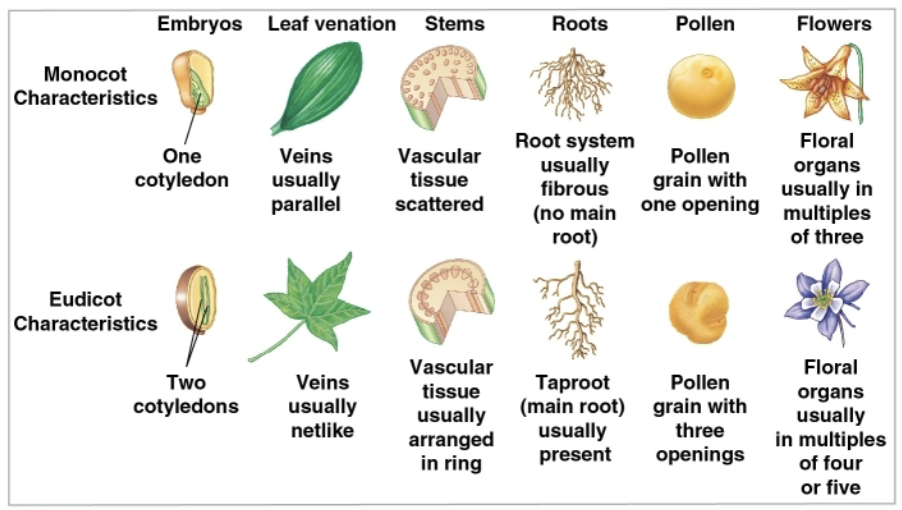
Basal angiosperms
Flowering plants belonging to the oldest lineages, Amborella, water lillies, star anise and relatives (~100 species)
Magnoliids
Share some traits with basal angiosperms (ex. spirally arranged floral organs) but evolved later; genetically more closely related to monocots and eudicots than basal angiosperms
one quarter
About ____ of angiosperms are monocots
two-thirds
More than ____ of angiosperms are eudicots
Seed
____ plants are key sources of food, fuel, wood products, and medicine
angiosperms
Most of our food comes from ____
175
At this rate of habitat destruction, the remaining tropical forests will be eliminated in ____ years
carbon dioxide, global warming
Loss of forests reduces the absorption of ____ ____ by photosynthesis, contributing to ____ ____