Tile Principles and Installation
 Call Kai
 Learn
Learn Practice Test
 Spaced Repetition
 Match
Match Flashcards
 Knowt Play
1/78

Earn XP
Description and Tags
Comprehensive vocabulary flashcards covering the history, definitions, materials, and installation methods of tiles based on lecture notes.
Name | Mastery | Learn | Test | Matching | Spaced | Call with Kai |
|---|
No analytics yet
Send a link to your students to track their progress
79 Terms
tegula
The Latin word from which 'tile' is derived, meaning 'to cover.'
Mesopotamia and Egypt
Ancient civilizations where tile use dates back to around 4000 BCE for flooring and drainage systems.
Greek Pottery
featured detailed hand-painted designs, reflected scenes from mythology, life, and nature
Mosaics
A Roman tilework technique using small colored pieces to create intricate patterns and pictures.
Islamic Artistry
Tilework featuring intricate geometric patterns, Arabesque motifs, and calligraphy, reaching new heights during the Islamic Golden Age.
Islamic Artistry
This form of art emphasizes symmetry and repetition, often showcasing vibrant colors and complex designs.
The Moors
Occupied Spain and Portugal
Vibrant Islamic tilework
Renaissance Elegance
Broader range of colors and intricate details
Symbol of elegance and sophistication
Tile originated from ceramic clay pottery
Renaissance
Ceramic clay was left to bake and harden in the hot sun to create tiles
Ceramic clay pottery
After its creation was the invention of kiln-firing pottery
Florence
The Italian city that became the hub for tile production during the Renaissance, known for hand-painted tiles.
Chinese Artisans
Focused on ceramic vase work, decorative table wear art, and ceramic sculptures of mythical animals and deities
Encaustic tiles
Decorative tiles popular during the Victorian era featuring bold and colorful patterns, valued for their ability to be easily cleaned and sanitized.
1870
Tile industry in America began
Europe
The U.S. was almost exclusively importing tiles from other countries in _____
The Victorian era
push for cleanliness.
Tile became a high-demand due to its ability to easily be cleaned and sanitized
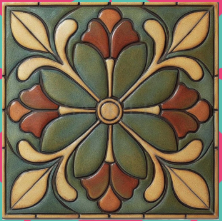
Art Nouveau
A design style from the late 19th to early 20th century characterized by flowing lines and stylized nature-inspired motifs.
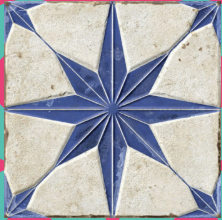
Art Deco
A design style from the late 19th to early 20th century featuring geometric patterns and bold colors inspired by futuristic design.
Industrial Revolution
Machinery allowed for mass production techniques. Tiles became more accessible to the public
Delft
A Dutch city famous for potters who produced huge quantities of hand-made blue and white pottery tiles between 1700 and 1900.
800 million tiles
Delft hand-made ____ over 200 years
18th Century
Tile flooring gained popularity in Europe
Machine pressing dry clay
Ceramic tiles
Malleable Clay
Fired
Fired in a kiln
Tiles are glazed or applied with a sealant
Digital Printing Techniques
enable the replication of intricate patterns, textures, and photographic images.
Abrasion Resistance
The measure of how a tile or surface stands up to wear and tear caused by friction, graded using the Porcelain Enamel Institute (PEI) rating.
Porcelain Enamel Institute Rating
A scale from 0 (wall applications only) to 5 (heavy-duty floor traffic) used to measure the hardness of a tile's glaze.
Pivot-points
Specific areas, such as in front of a sink or refrigerator, where there is noticeably more wear on glazed tile products.
Absorption
The ratio of the weight of water absorbed by a tile compared to the weight of a dry tile.
Adhesive
Comprise of aggregates and bonding agents derived from either natural or synthetic sources
Biscuit
The main base structure or core of a glazed tile, typically made of clay or porcelain.
Bowing/warping
Caused during the tile manufacturing and cooling process
Acceptable amount is related to the size of the tile and the degree of warp across the length of the tile
Butt Join
When two tiles are installed next to each other without a grout joint
Cove
Trim tile unit that has one edge with a concave radius
Used to form a junction between the floor and the bottom wall courses or to form an inside corner
Crazing
Cracks in fired glazes or ceramic coatings caused by critical tensile stress from temperature changes and vibration.
Cure time
A period that a tile installation setting material must be undisturbed and allowed to set for it to reach full strength
Varies widely and is dependent on the type of compounding used and the thickness of the tile
Expansion Joint
extends through tile, mortar, and reinforcing wire to the substrate, typically found in larger tiled floors and walls.
Grout
A mixture of silica sand, cement, and chemical fix used to fill tile joints and prevent moisture from reaching the back of the tiles.
Spacers
Plastic pieces used in installation to evenly separate tiles
Tanking
A waterproofing membrane system applied to a shower enclosure before tiling to protect the underlying substrate from water penetration.
Tile density
will depend on the materials, how it is compressed, and the temperature it is fired at.
The Tile Body
The core or biscuit
Provides structural integrity and durability
Three materials are used:
Ceramic
Porcelain
Natural Stone
The Glaze
Outermost layer of a tile and serves multiple functions, both practical and aesthetic
Applied to the tile’s surface
A backer board or underlayment
may be used between the subfloor and the tiles
Provides additional stability and help prevent issues like cracking or shifting
Ceramic Tiles
Most commonly used flooring tiles
Durable and non-porous
Made up of silica and clay
Fired at high temperatures
Can be glazed and unglazed
Stain and water-resistant
Versatile; Can be used for kitchens and bathrooms
Moderate foot traffic areas (living room and bedroom)
Porcelain Tiles
Tiles made from finer, denser clay and fired at higher temperatures than ceramic, resulting in a harder and less porous material.
Vitrified Tiles
Durable tiles with low water absorption and high density, available in variants like Glazed ______ Tiles (GVT), Polished GVT and Full Body Tiles.
Natural Stone Tiles
Made of marble, granite, and travertine
Very durable and give a raw, rustic look to walls
Highly scratch-resistant
Travertine
porous, outdoor walls (garden), porous
Marble
decorative floorings
Glass Tiles
Thin flat tiles made of glass, available in different shades, shapes, and transparencies and does not fade in the sunlight
Carpet Tiles
Alternative to the rolled carpet
Often used in commercial and public buildings
Ceiling Tiles
Lightweight and are used to cover ceilings
Placed in a supporting grid and can provide thermal insulation
Vinyl Tiles
Can be used as an alternative to sheet flooring in spaces such as kitchens, bathrooms, or in industrial spaces
Mosaic Tiles
A variety of decorative composite tiles, such as pebbles embedded in resin, glass, or metal tiles bonded onto mesh, and so on
Encaustic Cement Tiles
Developed in medieval times, these are created by dying cement tiles with mineral pigments to create intricate and bold patterns
Hardwood Tiles
Crafted from real wood like oak, maple, and walnut, to replicate the classic hardwood floor appearance
Faux Wood Tiles
Also known as wood-look tiles
Crafted from ceramic or porcelain, capturing the look of real wood at a more budget-friendly price
Thin-Set Over Concrete
An installation method using a layer of Portland cement, sand, and water-retaining agents approximately 3/16" to 1/4" thick.
Double Plywood Floor Method
A method using two layers of 5/8" exterior-grade plywood to provide stiffness for interior light-duty floors.
Thick-Bed (Mud Bed) Method
An installation method involving a mortar mixture of 1 part cement to 4-5 parts sand, applied in a layer 3/4" to 2" thick.
Cement Backer Board (CBU) Installation
an alternative to the mortar bed. It uses pre-fabricated cement or fiber-mesh boards.
Epoxy Method
A chemical-cure installation system using a resin and hardener mixed in an exact 2:1 ratio, offering high bond strength and water resistance.
Mastic/Organic Adhesive
A pre-mixed, glue-like paste consisting of acrylic/latex resins that dries via evaporation, used primarily for dry-wall areas.
Tanking Method
A waterproofing system applied to shower enclosures before tiling to prevent water damage to the substrate.
High Traffic Areas
Areas requiring durable tiles that withstand heavy use such as kitchens and cabinets
The Double Bond Method
A tile installation technique that involves applying an adhesive on both the substrate and the back of the tile, creating a stronger bond that minimizes movement and enhances durability.
Uncoupling Method
The use of a membrane between the subfloor and tile to allow them to move independently, preventing cracks in the grout of large open areas.
Self-Leveling Underlayment (SLU)
A high-flow, polymer-modified cementitious mixture designed to be poured over uneven concrete or wood subfloors. Because it is self-leveling, the material naturally spreads to create a perfectly flat, level base, while its fast-setting properties allow for quick installation of subsequent flooring.
Ready-Mixed Adhesives (Mastics)
Pre-mixed adhesives that are glue-like pastes made primarily from acrylic or latex resins. They cure by evaporation and are commonly used for tile installations in dry-wall areas where quick application and ease of use are essential.
Powdered Adhesive (Thin-set Mortar)
A standard, cement-based adhesive for floors and heavy-duty walls that cures via chemical hydration to become waterproof and highly durable. It comes in unmodified forms (pure cement and sand) or as Large Format Mortar (LHT) to support heavy tiles without sagging.
Grout
The final layer in a tile installation that fills the joints between tiles. It provides structural support to tile edges, locks the tiles together, and creates a protective barrier that prevents water, debris, and contaminants from penetrating the joints and reaching the subfloor.
Cordless mixers
High mobility and flexible for sites without access to power
Spiral paddles
Pulls and “flips” mixture/material from the bottom up to prevent dry pockets
Lippage
A condition where the edge of one tile is higher than its neighbor, often corrected using mechanical leveling systems like T-Lock or Spin Doctor.
Trowel
An application tool with notched edges (Square, V-notch, or U-notch) used to control the mortar depth and coverage.
Suction Cups
Tools designed to safely lift, maneuver, and position large-format tiles. They utilize rubber vacuum pads with integrated pumps to create a secure grip on the tile surface.
Manufacture Errors Allowance
A standard practice of adding 10% to the total number of tiles calculated to ensure sufficient supply despite breakage or bad cuts.
Furan Grout
A specialized grout made from furfuryl alcohol resins used in industrial settings requiring extreme acid resistance.
20% Extra Cost
Extra cost in estimating the cost of the tile.