AP Micro Market Failure & The Role of Government
 Call Kai
 Learn
Learn Practice Test
 Spaced Repetition
 Match
Match Flashcards
 Knowt Play
1/95

There's no tags or description
Looks like no tags are added yet.
Name | Mastery | Learn | Test | Matching | Spaced | Call with Kai |
|---|
No analytics yet
Send a link to your students to track their progress
96 Terms
market failure
a situation where free markets fail to allocate resources efficiently
reduce waste
in imperfect markets, well-designed government policy can _______
socially optimal
when the production or consumption of a good by the free market takes place at a level that is NOT ______________, the free market fails
too much / too little
free markets fail when either ______________ of the good will be produced by the free market
market clearing price
price at which the market is in equilibrium (no shortages & no surpluses)
MC = MB
the market clearing price is where _______, and it is allocatively efficient
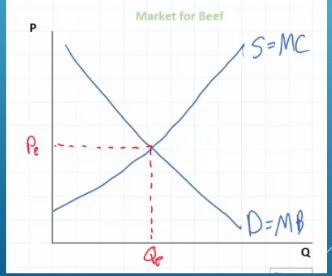
allocative efficiency for society
happens when marginal social benefit of consuming the last benefit = marginal social cost producing that last unit
maximizes total economic surplus
MSB = MSC does what
market failure
when allocative efficiency is not achieved, __________ occurs
deadweight loss
when allocative efficiency is not achieved, it creates
not allocatively efficient
price of beef is above equilibrium price, creates surplus, MC < MB
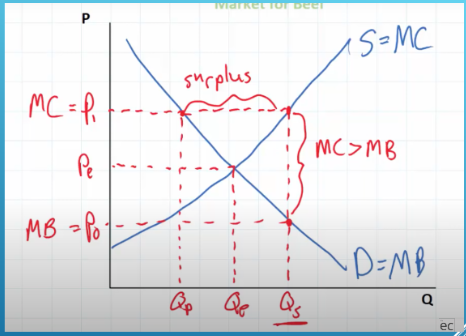
not allocatively efficient
price of beef is below equilibrium price, creates shortage MB > MC
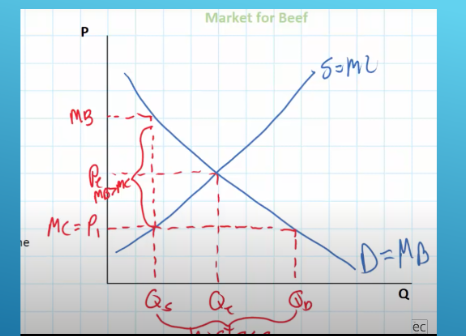
internalized
the market equilibrium quantity is equal to the socially optimal quantity only when all social benefits and costs are _____________ by individuals in the market
market power
refers to a company’s relative ability to manipulate the price of an item in the marketplace by manipulating the level of supply, demand, or both (monopoly, monopsony)
missing markets
market fails to form, resulting in failure to meet a need or want such as a need for public good (defense, street lighting, highways)
incomplete markets
markets may fail to produce enough merit goods (education, health care)
de-merit goods
markets can fail to control the manufacture and sale of goods which have less merit than consumers perceive (cigarettes & alcohol)
negative externalities
consumers and producers may fail to take into account the effects of their actions on a third-party (pollution, noise)
monopoly
market power that allows for a monopolistic producer to have excessive power (pricing, quality, access)
unstable markets
markets may become highly unstable where stable equilibrium may not be established and become volatile (agriculture, foreign exchange, credit)
property rights
markets work most effectively when consumers and producers are granted the right to own property but that right may not be clearly defined or well protected (industrial pollution poisoning wells of private homes)
inequality
markets may fail to limit the size of the gap between income earners (income gaps), markets reward with income and profits but the rewards may be concentrated in the hands of few
information failure (asymmetric information)
markets may not provide enough information because, during a transaction, it may not be in the interest of one party to provide full information to the other party (landlords know more about their properties than tenants; used car sellers know more about the cars than the buyers)
government intervention
policymakers use cost-benefit analysis to evaluate different actions to reduce or eliminate market inefficiencies, goal is to design policies that equate MSB to MSC, producing any non-efficient quantity results in DWL
excludable good
a good or service where the provider can prevent non-paying individuals from consuming it (movie tickets, cable TV subscriptions, a meal at a restaurant, or clothing)
non-excludable good
public goods that cannot exclude a certain individual or group of individuals from using them, nearly impossible to restrict access to the consumption of non-excludable goods (roads, parks, clean air, fish), people have incentive to free ride when a good is non-excludable
rival good
a good that can only be possessed or consumed by a single user
equal
with an ordinary rival good like a car, the marginal benefit of one more unit is ______ to the extra benefit received by the individual who receives that unit (that particular car)
nonrival good
a good that can be consumed or possessed by multiple users (internet, radio stations, street lights, clean water, fireworks display)
sum
for nonrival goods, the marginal benefit or providing an extra unit is the ____ of the marginal benefits received by each of the individual users
public goods
goods that are non-rivalrous and non-excludable, not provided by the free market (public education, roads, bridges, street lights)
Qso
for public goods ____ is the socially optimal quantity (where MSC=MSB), the free market will not provide these street lights (because of the free rider problem)
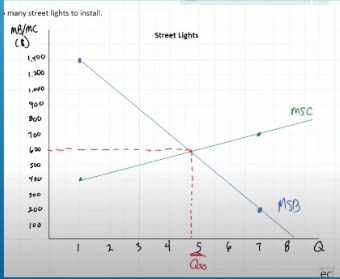
zero
marginal cost of providing a pure public good to one more consumer is
common access resources
natural resources that nobody owns but that anybody can exploit (ocean fish, fresh water), non-excludable but rivalrous
tragedy of the commons
occurs when an economic good is rivalrous in consumption, non-excludable, scarce, and a common-pool resource, private individuals inefficiently overconsume such resources at the expense of society (common pasture land)
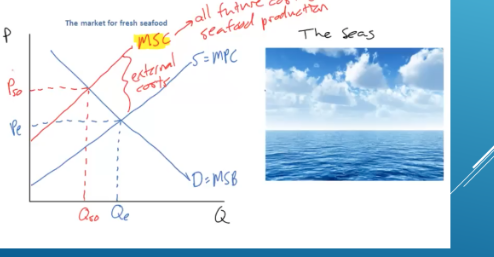
MSC>MSB
tragedy of the commons, cost to society is greater
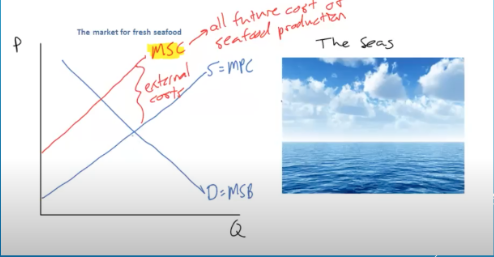
Qso
for tragedy of the commons, the equilibrium price & quantity Qe is lower in price and higher in quantity that ___ - too many fish being caught, rights to use these resources must be managed by the government
cap and trade
solution to the tragedy of the commons, allows companies to voluntarily trade the “right to fish” or the “right to pollute” from one company to another - the companies willing to pay will buy the “right to fish” or “right to pollute” - permits make it costly for companies to pollute
externality
the uncompensated impact of one person’s or firm’s actions on the well-being of another
negative externality
the impact is adverse, markets produce a larger quantity than socially desirable (exhaust from cars creates smog - the government sets emission standards and taxes gasoline)
positive externality
the impact is beneficial, markets produce a smaller quantity than is socially desirable (new technologies: the government maintains a patent system, subsidizes scientific research) (education leads to more informed voters, lower crime, and technological advances - the government funds education)
production externalities
when the production of a good creates spillover benefits or costs on a third party (deforestation: when when a logging company clears a forest, this leads to habitat loss, less biodiversity, and increased flood risk, Honey-making: bee-keeping results in better pollination)
consumption externalities
when the consumption of a good creates external or spillover benefits for a third party (using public transportation: reduces congestion on the roads and air pollution)
internalizing the externality
offering incentives so that people take account of the external effects of their actions, government can tax/subsidize goods
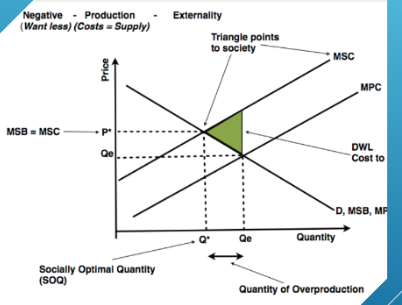
negative production externalities
production of a cost creates negative spillover costs passed on to society (environmental costs, health costs)
marginal private cost
actual monetary costs to firms of producing a good (raw materials, wages, etc), at every quantity there is a greater cost to society than MPC
marginal social cost
total cost of production born by society as a whole (includes the MPC and all external costs such as pollution and health costs)
marginal private cost
supply = MC =
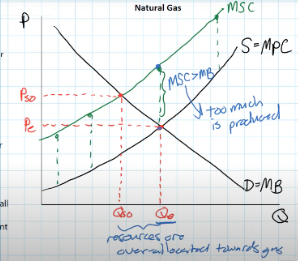
external costs of production
MSC curve takes into account the
socially optimal quantity
when all costs are taken into account (both external & private)
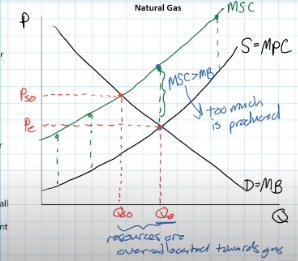
socially optimal price
price if all costs were taken into account
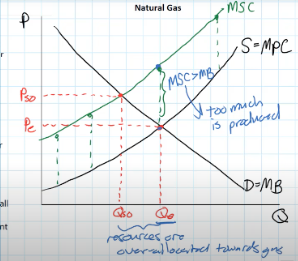
deadweight loss (MSC > MB)
at market equilibrium price, there is _________________ and an overallocation of resources to create the good
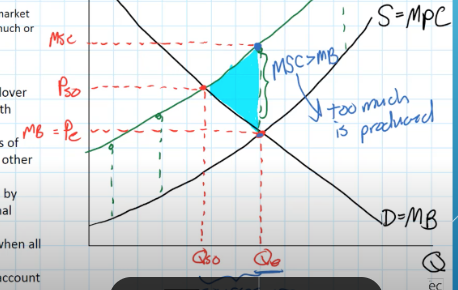
negative production externality
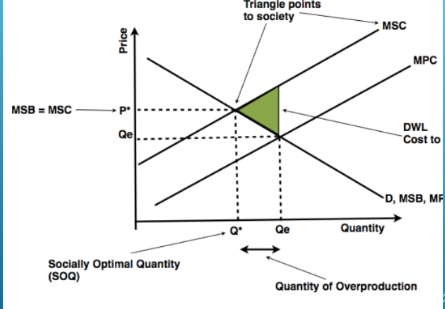
MSC > MPC
negative externalities, unless business are forced to internalize the external costs
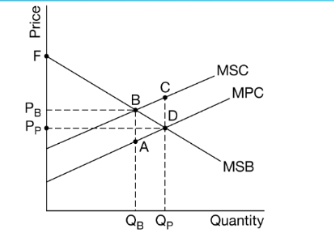
higher, lower
if producers had to bear all the external costs, then their private costs would be _______ and the equilibrium quantity would be _________
exceed
when there are negative Externalities associated with the production of a good, marginal social costs will _______ marginal private costs unless business are forced to internalize the external costs
marginal external cost
equal to the vertical distance between MSC and MPC at any quantity of output
command-and-control
government responds to negative production externalities by regulate behavior directly, (EPA regulations)
market-based policies
provide incentives so that private decision makers will choose to solve the problem on their own (corrective tax - gives incentive to reduce negative externalities, move the allocation of resources closer to the social optimum)
positive production externality
least common, when the production of a good or service creates spillover benefits that help a third party not involved in the market transaction - firms do not try to externalize any of the benefits of their production, firms want to maximize profits (malaria, HIV, COVID, tree farms, sports stadiums)
below
positive production externality will have a marginal social cost curve that lies ____ the marginal private cost curve (MPC higher)
MPC = MSB, MSB > MSC
positive production externality is at equilibrium where ________. resources are under-allocated
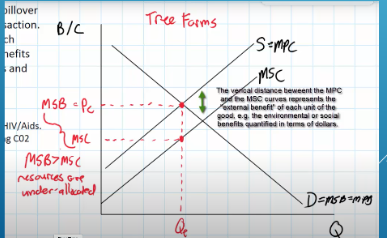
positive production externality graph
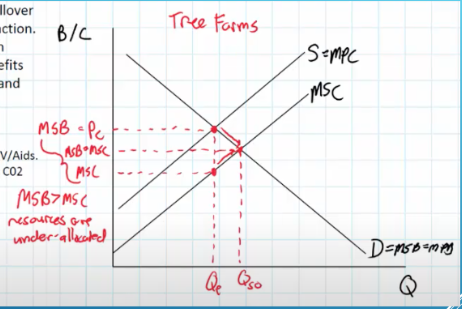
subsidies, tax breaks
government responds to positive production externalities by introducing:
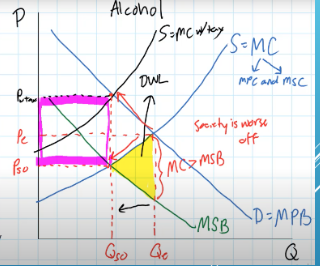
negative consumption externalities
when the consumption of a good creates negative external or spillover costs from a third party not involved in the market
MSB < MPB
negative consumption Externalities occur when
MC
in a negative consumption externality graph, supply =
demerit goods
activities or goods that create spillover costs as a result of their consumption (alcohol, tobacco, cars)
negative consumption externality graph
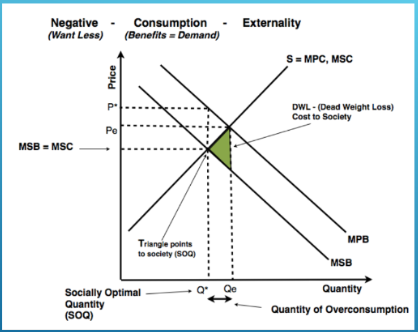
corrective taxes, subsidizing substitutes, regulations
solutions to negative consumption Externalities include ________, which shifts the supply curve to the left, leads to smaller quantity demanded
positive consumption externality
happens when consumption of a good or service creates spillover benefits enjoyed by a third party not involved in the market transaction
market failure
positive consumption externalities result in ________ because the quantity produced by the free market will be less than the socially optimal quantity (education, public transport, vaccines)
MSB > MPB
positive consumption externalities occurs when
MPC = MPB
equilibrium quantity for positive consumption externality is
MPC = MSC
supply curve for positive consumption externality is
greater
for a positive consumption externality, at Qe, the benefit to society is _______ than the personal benefit
MSB = MSC
a positive consumption externality is only efficient where
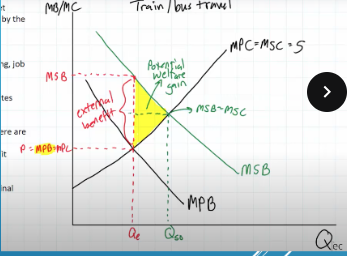
positive consumption externality graph
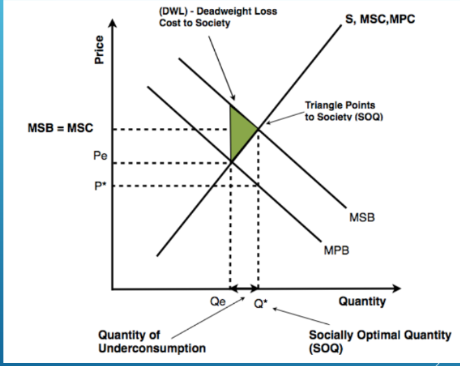
positive advertising, subsidies increasing supply
government solutions to positive consumption externalities include
regressive tax system
proportional (flat), lump-sum, tax rate decreases as taxable income increases
less able to pay
in a regressive tax system, people tend to decrease taxes on those with a higher ability to pay and shift greater burden to those ______________
Regressive tax system: proportional
fixed tax rate, equal tax incidence, constant marginal rate
regressive tax system: lump-sum
quantitatively equal tax charge ($4000 for all households), efficient and has minimum administrative burden), creates larger burden for those with low income, will NOT change market quantity of output (fixed)
tax policies to reduce poverty
gives tax break to workers on the middle and lower-end of the income scale
low-income
raising taxes on savings and providing subsidies to _________ households will lead to more equal after-tax and transfer incomes
downward
a lump-sum subsidy will shift the ATC
positive
for a lump-sum subsidy, in the short-run the firm will enter ______ economic profits due to the subsidy, in the long-run firms are attracted to this industry’s profits and will enter the market
increases, increases, normal
for a lump-sum subsidy, as more producing firms enter the market, supply ________, pushing down the market price and _________ the quantity produced, in the long-run the price will decrease to the point that the firm is only making ______ profit/zero economic profit
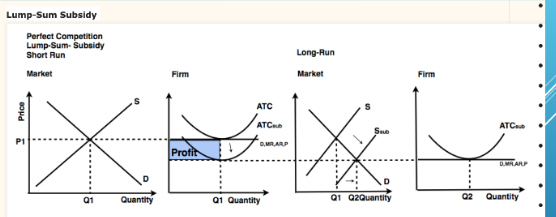
lump-sum
what action would a government take when regulating a natural monopoly to produce the socially optimal quantity?
a subsidy that increases as output increases
what will cause an unregulated monopolist to produce a more allocatively efficient level of output?
the income gap
markets may fail to limit the size of the gap between income earners, markets reward with income and profits but the rewards may be concentrated in the hands of a few
lorenz curve
shows the distribution of income (or wealth) in an economy
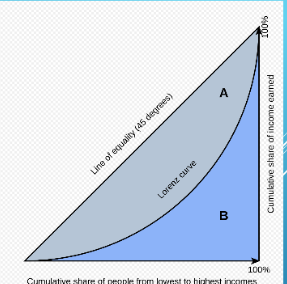
the degree of inequality in dist. of income within a country
what does the Lorenz curve show?
gini coefficient
measures income inequality for a nation - 0 is perfect equality, 1 is perfect inequality
production function
income inequality is measured by what economic concept?
progressive tax system
tax rate increases with greater taxable income and ability to pay