Chem Atomic Theory
 Call Kai
 Learn
Learn Practice Test
 Spaced Repetition
 Match
Match Flashcards
 Knowt Play
1/14

There's no tags or description
Looks like no tags are added yet.
Name | Mastery | Learn | Test | Matching | Spaced | Call with Kai |
|---|
No analytics yet
Send a link to your students to track their progress
15 Terms
Paschen Series
n—>3, lower energy than visible, in infrared region of EM spectrum
Balmer’s series
n—>2, visible region of EM spectrum
Lyman series
n—>1, too large to be visible, in UV region of EM spectrum
orbital
region in space where the chance of finding an electron is high (90%)
s-orbital
max electrons = 2
p-orbital
3 types (x,y,z) with 2 each (6 total)
d-orbital
5 types, 2 electrons each, 10 total
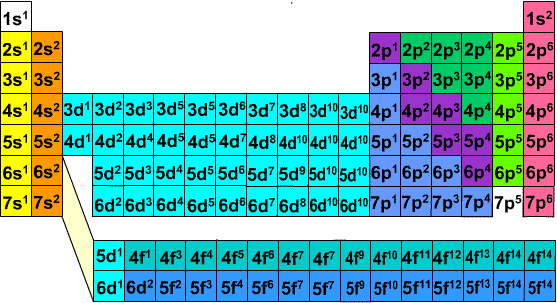
energy level configuration order
principal quantum number (n)
indicates general energy of orbital (n² = total orbital #)
angular/orbital quantum # (l)
determines type of orbital (s, p, d, f)
magnetic quantum # (ml)
determines type of sub-orbital (Px, Py, Pz, etc)
electron “spin” (intrinsic angular momentum) (ms)
charge allows electrons to develop a magnetic field as it moves
depending on direction of spin, they generate the field in a certain orientation
can spin up (+1/2) or down (-1/2)
Pauli exclusion principle
no 2 electrons in the same atom can have the same 4 quantum numbers (n, l, ml, ms)
must be filled lowest energy orbitals to highest
draw an orbital diagram for any element
yay!