LING - S+P Speech Acts
 Call Kai
 Learn
Learn Practice Test
 Spaced Repetition
 Match
Match Flashcards
 Knowt Play
1/5

There's no tags or description
Looks like no tags are added yet.
Name | Mastery | Learn | Test | Matching | Spaced | Call with Kai |
|---|
No analytics yet
Send a link to your students to track their progress
6 Terms
What is Information Transmission?
Classic answer for how we encode messages
Language is used to make statements about the world
Express propositions that are either true or false
Have to decode the message to identify what proposition is expressed;
Phonology, morphosyntax, morphemes, semantic components
J.L Austin Performativity
Utterances are Performative; consider felicity conditions
By saying certain things under right conditions, you perform the action described
Social act as opposed to true/false statement
“I do” = utterance indulges in the marriage
“I name this ship…” = action of naming the ship
Test for performativity → “I hereby…”
Social Actions
Can be achieved by utterances that don’t have any proposition associated with them
Hello = Doesn’t have truth conditions
Specialised to perform speech acts → action of greeting (mostly)
Goodbye = “I hereby take my leave”
Doesn’t really work; specialisation
Speech Act Theory
Locutionary
What was said / Semantic meaning
Illocutionary
What Social Action was performed
Hello = greeting/surprise/disbelief/attention check
I do = radically different in different contexts
Perlocutionary
What goal was achieved
Persuasion = perlocutionary effect of an illocutionary act
Hello = Politeness, Getting someone’s attention
How choice to perform speech act plays into goals
Sentence Types / Syntactic Categories
Declarative
Declaration of a statement
“The window is open”
Questions → “I’d like to know when the train leaves”
Implicitly asks for info politely
Correlated to indirectness, espec when imposing on someone
Requests → “I wonder if you could tell me the time”
grammatical statement, inferentially a polite request
Interrogatives
Questions
“Is the Window open?”
Statements → “Didn’t you hear Mary’s away?”
Requests → “Could you close the window?”
Grammatically a question to maintain politeness
Imperatives
Commands
Statements → “Let me assure you…”
Not actually a request for permission
Offers → “Help yourself…”
Maintains politeness
Indirectness
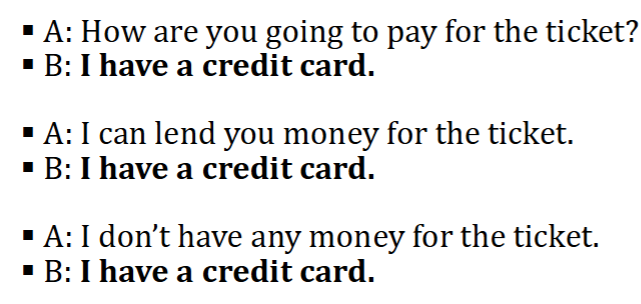
Speech Act identification relies on context ; potential goals decipherable
Assertion + Implication it will be used ; Indirect answer
Politely + Indirectly declines offer
Indirect Offer
Based on assumptions that speakers are Cooperative → Both people making relevant and helpful responses to each other ; a lot of background info is needed to fill in gaps + answer a follow up question they think would be reasonable to ask