(Reactions) Aldehyde and Ketone
 Call Kai
 Learn
Learn Practice Test
 Spaced Repetition
 Match
Match Flashcards
 Knowt Play
1/36

There's no tags or description
Looks like no tags are added yet.
Name | Mastery | Learn | Test | Matching | Spaced | Call with Kai |
|---|
No analytics yet
Send a link to your students to track their progress
37 Terms
Oxidation is a reaction that increases:
bonds to oxygen.
C-C single bonds cannot be broken during oxidation, therefore __________ alcohols cannot be oxidized.
tertiary
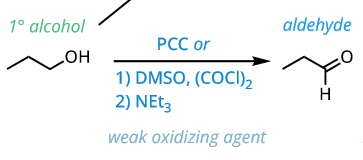
A primary alcohol reacting with a weak oxidizing agent produces:
aldehyde
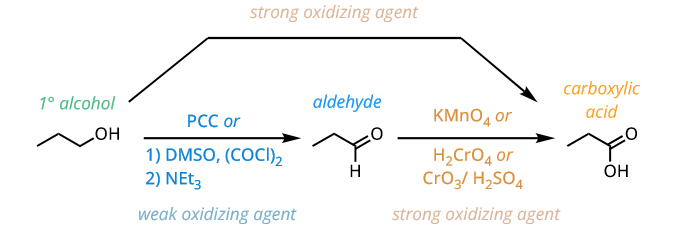
A primary alcohol or aldehyde reacting with a strong oxidizing agent produces:
carboxylic acid
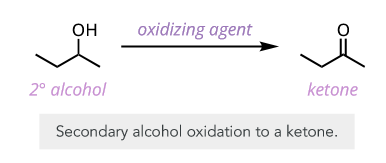
A secondary alcohol reacting with a strong OR weak oxidizing agent produces:
ketone
Weak oxidizing agents
PCC or
Swern oxidation (1. DMSO, (COCl)2 2. NEt3)
Strong oxidizing agents
KMnO4 or
H2CrO4 (Chromic acid) or
CrO3/H2SO4 (Jone’s reagent)
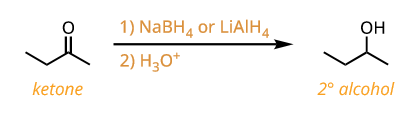
A ketone reacting with a weak or strong reducing agent, followed by an acid workup, produces:
secondary alcohol
An aldehyde reacting with a strong OR weak reducing agent, followed by an acid workup, produces:
primary alcohol
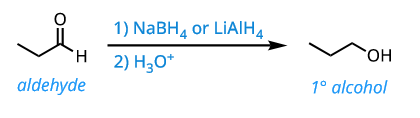
Weak reducing agent
NaBH4 (Sodium borohydride)
Strong reducing agent
LiAlH4 / LAH (lithium aluminum hydride)
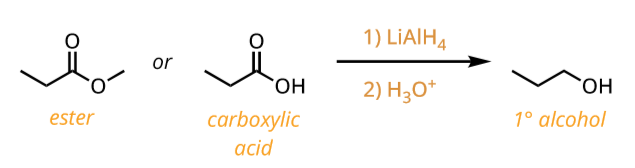
An ester reacting with a strong reducing agent (LiAlH4), followed by an acid workup, produces:
primary alcohol
A carboxylic acid reacting with a strong reducing agent, followed by an acid workup, produces:
primary alcohol
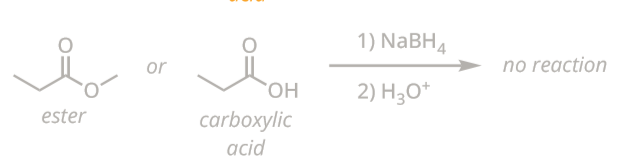
An ester or carboxylic acid reacting with a weak reducing agent (NaBH4), followed by an acid workup, produces:
no reaction
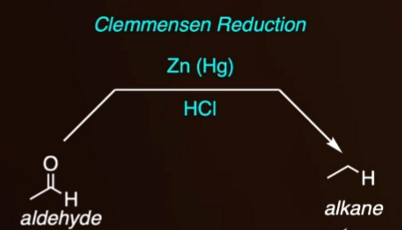
An aldehyde reacting through Clemmensen reduction produces:
alkane
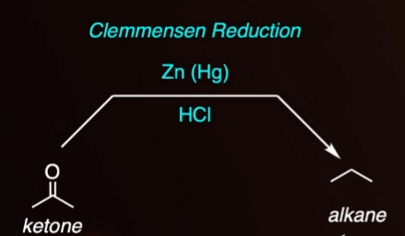
A ketone reacting through Clemmensen reduction produces:
alkane
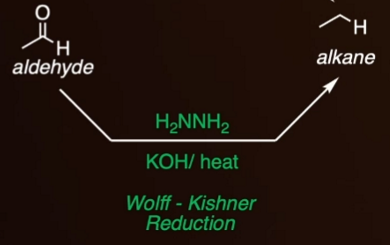
An aldehyde reacting through Wolff-Kishner reduction produces:
alkane
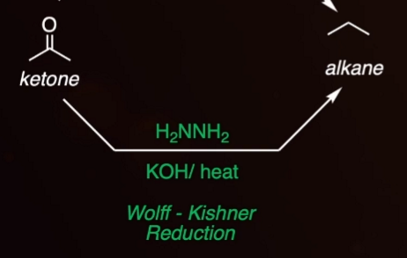
A ketone reacting through Wolff-Kishner reaction produces:
alkane
Reagents for Clemmensen reduction: (2)
Zn(Hg) (amalgamated zinc)
HCl
Reagents for Wolff-KIshner reduction: (2)
(H2NNH2) (hydrazine)
KOH/heat
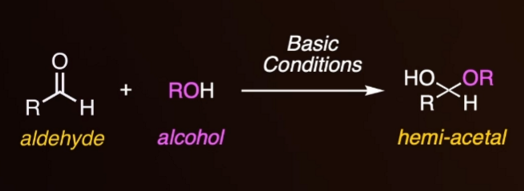
An aldehyde reacting with an alcohol in basic conditions produces:
hemi-acetal
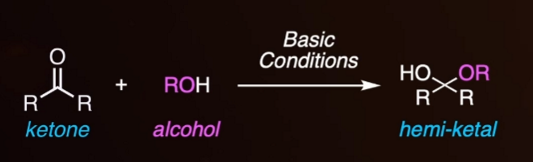
A ketone reacting with an alcohol in basic conditions produces:
hemi-ketal
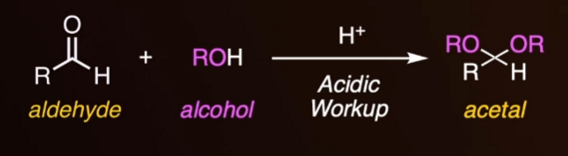
An aldehyde reacting with an alcohol in acidic conditions, followed by an acid workup, produces:
acetal
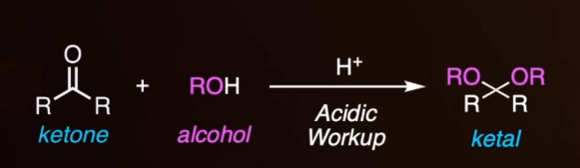
A ketone reacting with an alcohol in acidic conditions, followed by an acid workup, produces:
ketal
An acetal/ketal can be converted back into an aldehyde/ketone with:
H3O+ (aqueous acid)
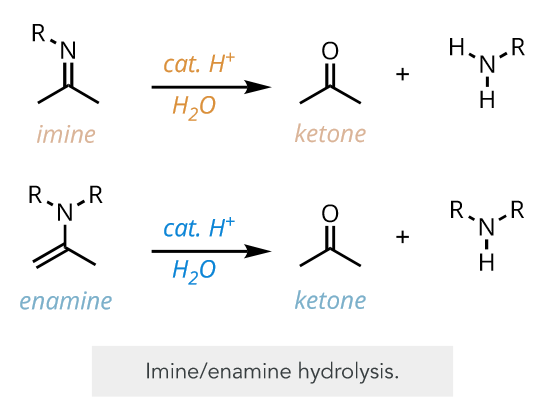
Imines and enamines can be converted back into ketones when reacted with:
catalytic acid in water
(cat. H+
H2O)
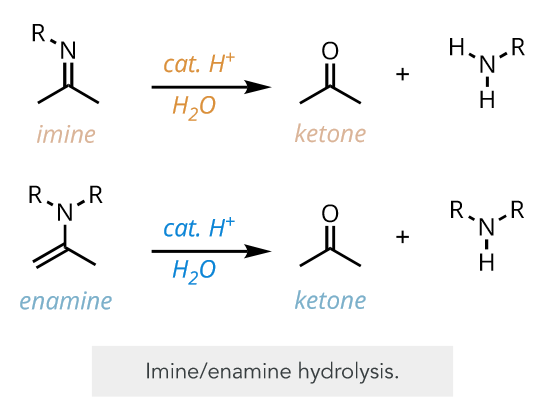
Hydrolysis of an imine or enamine in the presence of water leads to the formation of:
a ketone
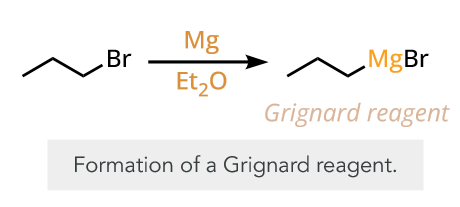
Grignard reagents contain a __________ atom inserted between a carbon and halogen (Cl, Br, I).
magnesium (Mg)
Grignard reagent can be formed by reacting a _______ _______ with Mg in an _______ solvent.
alkyl halide; aprotic solvent
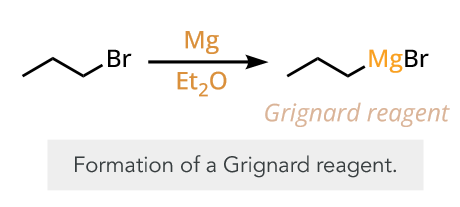
Aprotic solvent (for Grignard reagent)
THF or Et2O
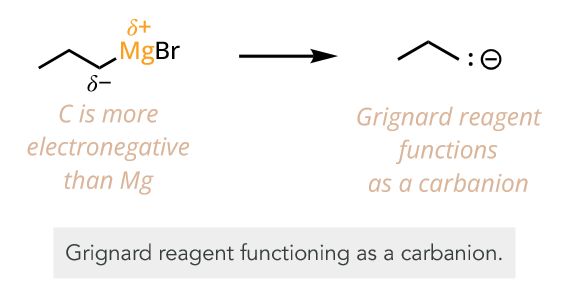
The partial negative charge on carbon allows the Grignard reagent to function as a:
carboanion (very strong nucleophile)
An aldehyde reacting with a Grignard reagent, followed by an acid workup, produces:
secondary alcohol
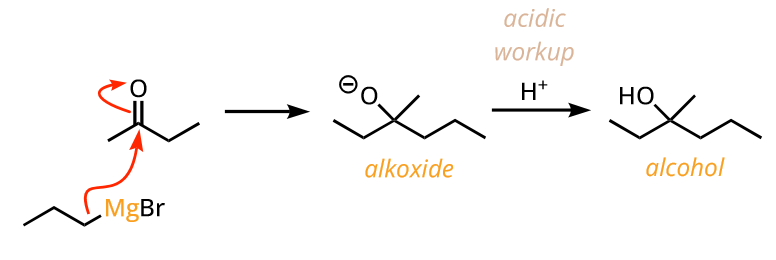
A ketone reacting with a Grignard reagent, followed by an acid workup, produces:
tertiary alcohol
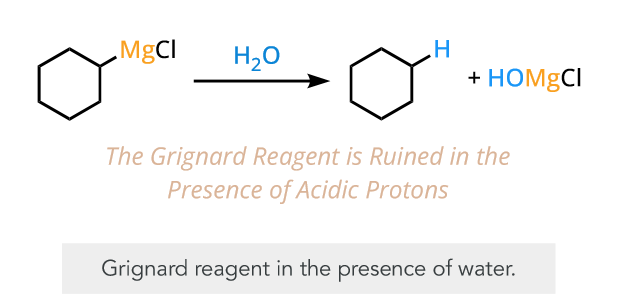
In the presence of water, a Grignard reagent will perform an acid-base reaction, producing:
alkane
Water is what kind of solvent?
protic
Protic sovents contain:
hydrogen directly bonded to O or N
3 components of a Wittig reagent:
PPh3
Alkyl halide
n-BuLi (strong base)