Physics 4.1 - Capacitance
 Call Kai
 Learn
Learn Practice Test
 Spaced Repetition
 Match
Match Flashcards
 Knowt Play
1/25

There's no tags or description
Looks like no tags are added yet.
Name | Mastery | Learn | Test | Matching | Spaced | Call with Kai |
|---|
No analytics yet
Send a link to your students to track their progress
26 Terms
Capacitor
A pair of conducting plates separated by an insulator. If a p.d. is placed across the plates, they acquire equal and opposite charges
Capacitance
Charge on either plate / p.d. between plates
Symbol used to denote capacitance
C
Unit of capacitance
F or CV^-1
Dielectric
Insulator between the plates of a capacitor, also serving to make the capacitance larger than if there were just empty space
Effect of using a dielectric on a capacitor
Increase C without changing the dimensions
Explain how a capacitor stores energy
Transferring charge from one player to the other, so that the plates carry equal but opposite charges so net charge is zero
Equation for capacitance if the insulator separating the plates is a vacuum or air
C = ε0 A/d
Electric field within a parallel plate capacitor
Uniform inbetween plates
Equation used to calculate electric field within a parallel plate capacitor
E=V/d
Unit for electric field
Vm-1
Equation used for energy stored in a capacitor
U=1/2QV
How can energy stored in a capacitor charged from 0V to V from a Q-V graph
Area under the graph
Capacitance in series
p.d. is shared
Q is equal
1/C =1/C1 + 1/C2 + 1/C3
Capacitance in parallel
p.d. is equal
Q is shared
C = C1 + C2 + C3 + …
Time constant
Time for Q to decrease to 1/e=0.37=37% of its original value
Unit for time constant
s
Symbol used to denote the time constant
τ = RC
explain what happens when a capacitor is charged
Current flows so electrons flow from one plate to another
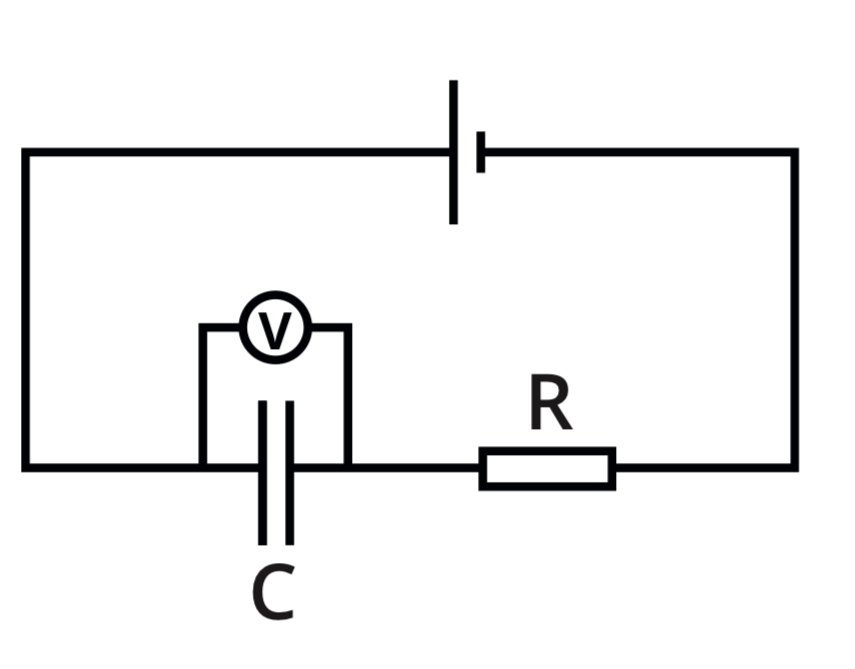
Circuit when charging a capacitor
Explain what happens when a capacitor is discharged
Current flows in opposite direction so electrons move back
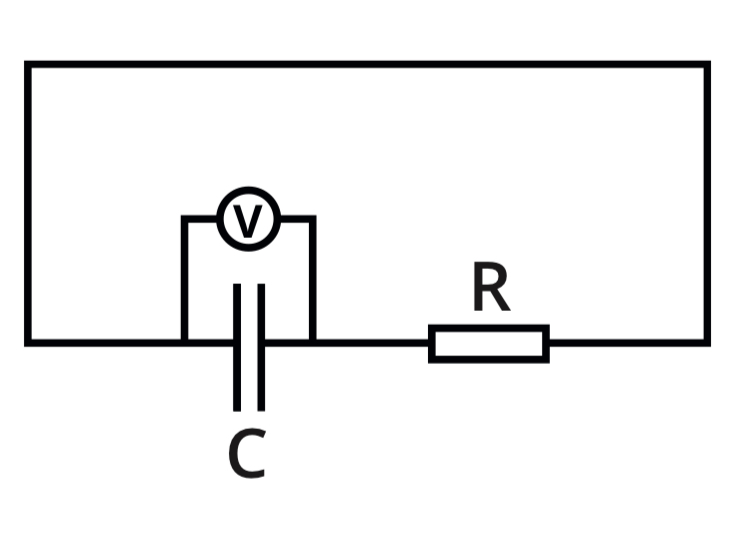
Circuit when discharging a capacitor
Graph for charging a capacitor
Graph for discharging a capacitor
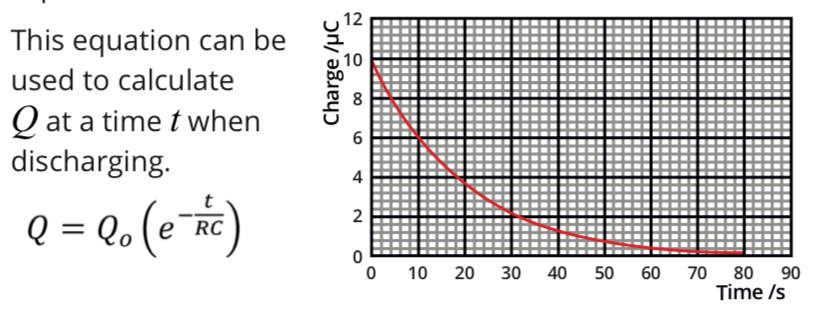
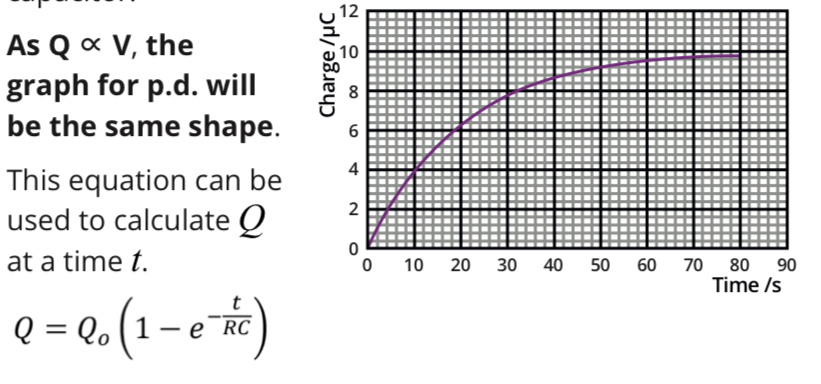
Equation used when charging a capacitor
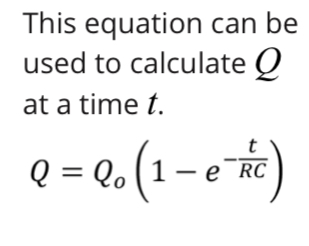
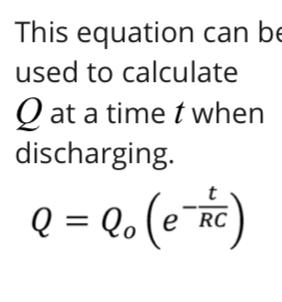
Equation used when discharging a capacitor