EPS SCI 15 Lab Final (extensive)
 Call Kai
 Learn
Learn Practice Test
 Spaced Repetition
 Match
Match Flashcards
 Knowt Play
1/135

There's no tags or description
Looks like no tags are added yet.
Name | Mastery | Learn | Test | Matching | Spaced | Call with Kai |
|---|
No analytics yet
Send a link to your students to track their progress
136 Terms
On a bathymetry map, the countours are lines of constant
depth
Lines of _____ are measured from 0-90 degrees north and south of the equator
latitude
On a bathymetry map, Vs that point UPHILL are
troughs (canyons)
On a bathymetry map, Vs that point DOWNHILL are
ridges
Vertical exaggeration calculation:
vertical scale over horizontal scale (distance on map / distance on earth)
Mass
density*volume
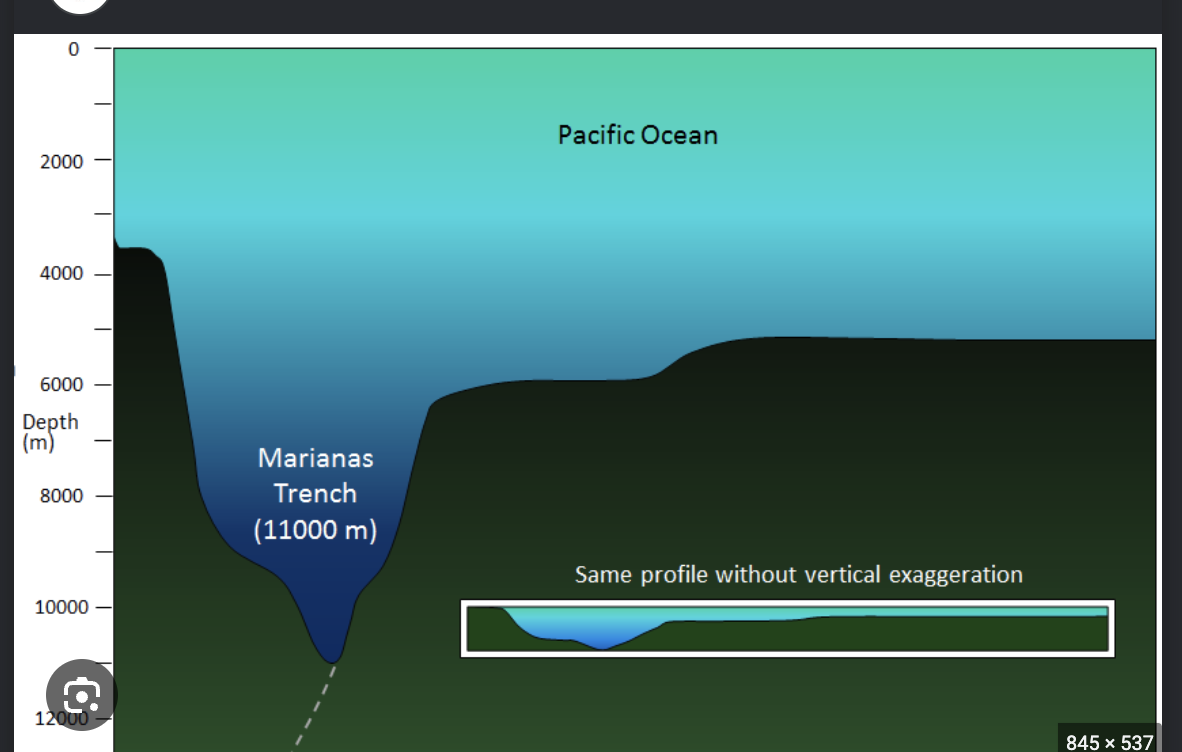
Atlantic style margins differ from Pacific style margins in that
pacific margins contain an oceanic trench instead of continental rise
What is the density of the continental crust (granite)?
2.7 g/cm^3
What is the density of the oceanic crust (basalt)?
3.0 g/cm^3
What is the density of the mantle?
3.3 g/cm^3
Mid-ocean ridges are frequently offset by perpendicular
fracture zones
Amongst ice, basalt, and granite, which is the least dense?
ice
The Archimedes' principle states that a rigid object displaces its full _______ when floating in a fluid.
weight
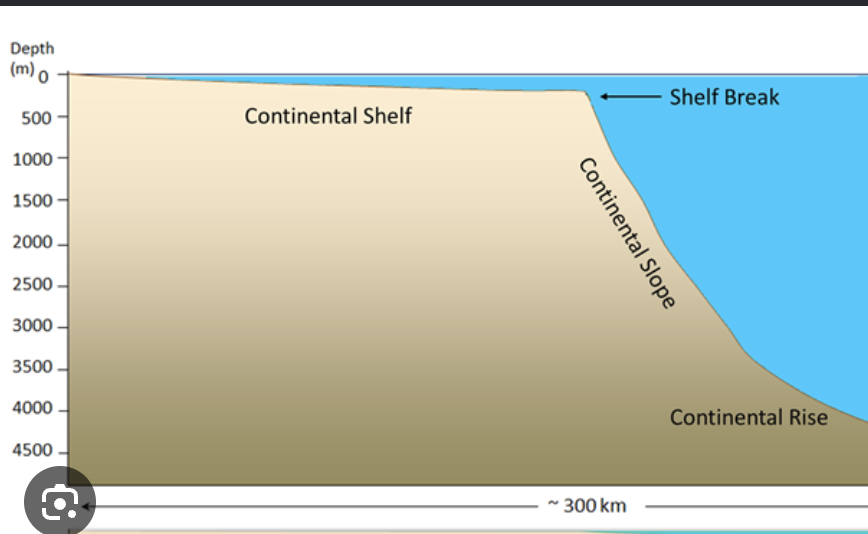
From the shoreline to the deep-ocean floor, what is the order of continental margins (shelf, slope and rise)?
shelf, slope, rise
What is the shelf break?
separation of the shelf and slope
Where does seafloor formation (new lithospheric material) occur?
mid-ocean ridges (moving outward)
Where is lithospheric material destroyed?
subduction zones
(dense oceanic tectonic plate bends and sinks beneath another plate into the Earth's mantle causing destroying and recycling of old lithosphere)
Spreading rate calculation:
distance / time (cm/yrs)
I.e. 400km = 400,000m = 40,000,000cm
→ 40,000,000cm / 15,000,000yr = 2.67 cm/yr
Where would you expect to find highest heat flow?
mid-ocean ridge
What is an example of a divergent plate boundary?
mid-ocean ridge
Where would you expect to find the most tectonic activity?
convergent boundary
What is an example of a convergent plate boundary?
subduction zone
Where would you expect to find the lowest heat flow?
subduction zone
Where would you find the least tectonic activity?
intraplate region
Which of the following sediments dissolve BELOW the carbonate compensation depth (CCD)?
calcareous oozes (CaCO3)
The CCD is ______ in cooler, more acidic waters at high latitudes
shallower
The CCD is _______ in warmer, less acidic waters at lower latitudes
deepest
Meteoroid dust is an example of ____ sediment
cosmogenous
Silt is an example of ____ sediment
terrigenous
Manganese Nodule is an example of _____ sediment
chemogenic
Foraminiferan Ooze is an example of ____ sediment
biogenic
Sedimentation rate calculation
mm / years
Where does most sediment accumulation occur?
around continents (much less accumulation happens in the deep sea)
What is the typical pH of seawater?
8
Residence time calculation:
amount of given element dissolved in ocean / the flux of the element in or out of the ocean
(i.e. 400g / 10g/yr = 40 yrs)
At which temperature does pure water reach its highest density?
4 degrees C
One consequence of hydrogen bonding in water:
high latent heat, high heat capacity, high melting point, high boiling point, less dense as a solid, etc.
Density of seawater increases when temperature
decreases
Which processes increase salinity of seawater?
freezing and evaporation
Which processes decrease salinity of seawater?
ice melting and precipitation
What is the average salinity of seawater?
34.7 PSU (~35)
What is one source of deep water?
North Atlantic Deep Water (and Antarctic Deep Water)
Surface currents are driven by
wind
The deflection of the intended path of a moving body by the Earth's rotation is the
Coriolis Effect
The surface and deep ocean are separated by which layer? What causes this separation?
Thermocline (change in temperature creates a change in density; more dense water sinks below less dense water)
Which plankton contributes to siliceous ooze production?
Diatom (phytoplankton)
Which plankton lives in chambered CaCO3 shells?
Foraminifera (zooplankton)
Which plankton is a minute crustacean with a chitin exoskeleton?
Copepod (zooplankton)
Which plankton makes up 50% of photosynthetic biomass?
Cyanobacterium (phytoplankton)
Types of macroplankton
krill, pteropods, gelatinous plankton (jellyfish)
Ratio of C:N:P
106:16:1
Cross sections provide a ____ view of earth
Side
Contour lines will never do what?
cross each other
Rapid change in elevation on bathymetric map.. contours would be spaced
closer together
What do concentric circles of counter lines represent?
mountains or valleys
What does the theory of isostasy suggest?
blocks of rigid lithosphere are floating = isostatic equilibrium on the plastic asthenosphere (region of earth's mantle)
What is the chemical composition of the Earth? (from inside to outside)
core, mantle, crust
What is the lithosphere?
cool rigid outer layer (crust and upper mantle)
What is the asthenosphere?
plastic part of mantle below lithosphere
What is the mesosphere?
middle and lower mantle, stronger plastic than asthenosphere
Passive (Atlantic) Margins
no plate boundary, low tectonic activity
Active (Pacific) Margins
high tectonic activity, abrupt transition to trench, absent continental rise
What are abyssal plains?
flat areas of deep ocean floor (flattest/smoothest regions, cover approximately 40% of ocean floor)
What are divergent plate boundaries?
two plates moving apart (new crust being created)
Three types of divergent plate boundaries?
1. Ocean ridge and rise system (high heat flow/volcanic activity, shallow earthquakes)
2. Young ocean basins (very young rift/ridge systems)
3. On land rifting (continents spreading apart, high heat flow/volcanic activity)
What are convergent plate boundaries?
two plates moving together, where subduction occurs
Three types of convergent plate boundaries?
1. Ocean-ocean (deep trenches, volcanic island arcs parallel to trench)
2. Ocean-continent (deep ocean trenches near continental volcanic arcs ~ Andes, Cascades)
3. Continent-continent (mountain building ~ Himalayas, Alps)
What are transform boundaries?
two plates sliding past each other (low heat flow, shallow earthquakes ~ San Andreas Fault)
What are two examples of calcareous oozes?
coccolithophores and foraminifera (chalk)
What are two examples of silicious oozes?
diatoms and radiolarians (diatomite)
What is the CCD? carbonate compensation depth
depth where the rate of supply of calcium carbonate from the surface is equal to the rate of dissolution
Where are calcareous oozes found?
warm shallow regions above CCD
Where are siliceous oozes found?
colder regions below CCD
Water has high ____ and ____?
latent heats (phase changes ~ melting and boiling require a lot of energy) and heat capacity
When salinity increases, density of water ________
increases
When salinity increases, boiling point of water ________
increases
When salinity increases, freezing point of water __________
decreases
Sources of salinity?
rivers, volcanic gasses, hydrothermal vents at ocean ridges
Sinks of salinity?
sedimentation, subduction, and circulation of water (through ocean ridge system)
The more H+ in a solution, the more ________ it is
acidic
On the pH scale, each step is
10x
42.5‰ (per mille) in percent would be
4.25%
These ions act as a buffer in the ocean, keeping seawater from becoming too acidic or too basic:
Bicarbonate ions (HCO3-)
When less dense water is on top of more dense water, this is considered _________
stable (inhibited mixing)
When more dense water is on top of less dense water, this is considered ___________
unstable (spontaneous mixing)
When water density is equal on both top and bottom, this is considered __________
neutral (easy mixing)
What is the thermocline?
rapid temperature change, separates top mixed water (turbulent) from bottom deep water
What is the pycnocline?
rapid density change
Net transport of Ekman Transport
90 degrees
Surface layer deflection of Ekman Transport
45 degrees
Direction of subtropical gyres in northern hemisphere
clockwise (vice versa in southern hemisphere)
What drives deep currents?
buoyancy forces (gravity is driving force)
Pelagic Zone
area not near the bottom (of body of water)
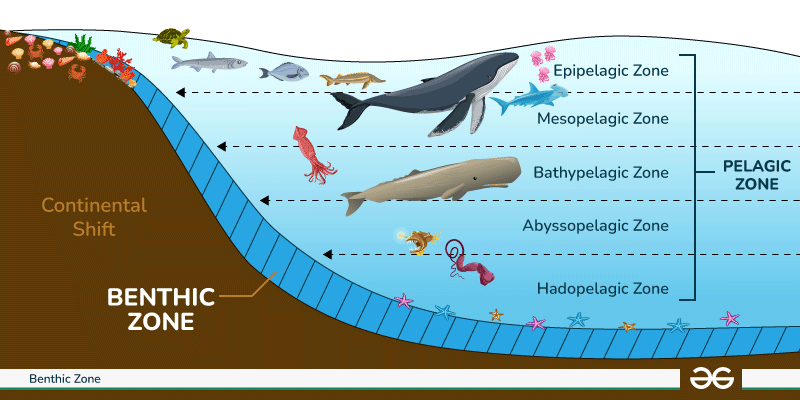
Benthic Zone
area at bottom of seafloor
Photic Zone
where light exists (includes euphotic and dysphotic zone)
Euphotic Zone
photosynthesis is larger than respiration
Dysphotic Zone
photosynthesis is smaller than respiration
Aphotic Zone
NO photosynthesis
Three trophic groups
1. Producers (autotrophs ~ phytoplankton)
2. Consumers (heterotrophs ~ zooplankton)
3. Decomposers (bacteria, worms)
Biological Pump
exports photosynthetic products from the euphotic zone to the deep ocean