bsc1005L- lab 12
 Call Kai
 Learn
Learn Practice Test
 Spaced Repetition
 Match
Match Flashcards
 Knowt Play
1/18

There's no tags or description
Looks like no tags are added yet.
Name | Mastery | Learn | Test | Matching | Spaced | Call with Kai |
|---|
No analytics yet
Send a link to your students to track their progress
19 Terms
Diversifying/Divergent Selection (Ex. Finch example and mice example)
Stabilizing Selection- (Ex. Human birth weight example and plant height example)
Directional Selection- Antibiotic Resistance example
12.3 What are the three general outcomes of natural selection? Provide multiple examples of each.
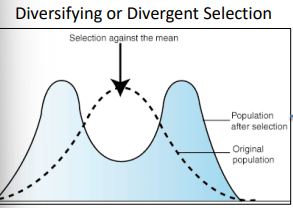
Diversifying/Irreverent Selection
A type of natural selection where extreme trait values are favored over intermediate ones, increasing phenotypic variance and splitting a population into two distinct groups. Promotes diversity by selecting against the average, often leading to divergent evolution and potentially new species.
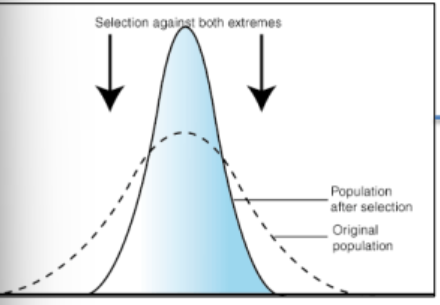
Stabilizing Selection
A type of natural selection that favors average, intermediate phenotypes rather than extreme variations, reducing genetic diversity and stabilizing a population's traits. It occurs when environmental conditions remain stable, acting against extreme, less-fit variations to maintain the status quo, making it very common in nature.
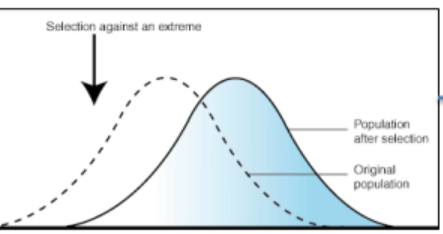
Directional selection
a mode of natural selection where individuals with an extreme phenotype at one end of the spectrum are favored, causing the population's trait distribution to shift toward that extreme over time. This process reduces genetic diversity by favoring advantageous alleles, often driven by environmental changes like climate shifts or new predators, resulting in evolutionary adaptation.
Finch example: In an environment where only large, hard seeds and small, soft seeds are available. Birds with large or small beak sizes are selected for, while medium beak birds that are not as successful are selected against.
Mice example: Light-colored mice (on sand) and dark-colored mice (in vegetation) are favored on a beach with patches of grass and sand, whereas intermediate-colored mice are eaten.
Examples of Diversifying/Irreverent Selection
Human birth weight example: Babies with very low birth rates and very large human babies having birthing complications. Mid-range babies are favored.
Plant height example: Plants too short are blocked from sunlight from taller plants, but plants too tall have damage from high winds. Medium plants have better survival chances.
Examples of Stabilizing Selection
****Antibiotic Resistance example: Antibiotic-containing environments favor RESISTANT strains of bacteria. When exposed to an antibiotics, susceptible bacteria die, while rare resistant bacteria survive and reproduce. Over generations, the entire population shifts toward becoming resistant, favoring the extreme phenotype (resistance) over the average (susceptibility)*******CER
Peppered Moths- Light-colored moths originally were better camouflaged with a light birch tree envoir. Then, industrial pollution makes trees dark with soot. Shifts so darker moths now have survival advantage
Examples of Directional selection
A heritable trait that confers an advantage for survival and reproduction in a particular environment will become more common in the population. Ability to survive and reproduce in a particular environment.
Genotype Variation —→ Phenotype variation —→ Fitness variation
12.2 How does genetic variation among organisms affect survival and reproduction?*
Species: a group of populations whose members have the potential to interbreed with one another in nature to produce fertile offspring.
Prezygotic reproductive barriers examples: temporal isolation, habitat isolation, behavior isolation, mechanical isolation, gametic isolation
Postzygotic reproductive barriers: reduced hybrid viability, reduced hyrid fertility, hybrid breakdown
12.4 How does the biological species concept define a species? Give examples of prezygotic and postzygotic reproductive barriers between species.
Species
a group of populations whose members have the potential to interbreed with one another in nature to produce fertile offspring
Prezygotic reproductive barriers
Mechanisms that prevent different species from mating or fertilizing, acting before zygote formation to maintain species boundaries
Temporal isolation
different breeding times between species
Habitat isolation
different locations
Behavior isolation
unique mating rituals
Mechanical isolation
Differences in the size, shape, or structure of reproductive organs prevent mating
Gametic isolation
incompatibility between sperm and egg cells of different species prevents fertilization
Reduced hybrid viability
hybrid offspring between two species fail to develop properly or survive to adulthood, reducing their evolutionary fitness
Reduced hybrid viability
hybrid offspring between two species fail to develop properly or survive to adulthood, reducing their evolutionary fitness
Hybrid breakdown
First-generation hybrid offspring are viable and fertile, but subsequent generations are weak, sterile, or inviable.