Block 9 Lesson 4
 Call Kai
 Learn
Learn Practice Test
 Spaced Repetition
 Match
Match Flashcards
 Knowt Play
1/28

Earn XP
Description and Tags
History and Future of the Universe
Name | Mastery | Learn | Test | Matching | Spaced | Call with Kai |
|---|
No analytics yet
Send a link to your students to track their progress
29 Terms
What did Edwin Hubble prove?
Edwin Hubble proved that galaxies are moving away from each other because of their redshift.
What did this lead scientists to believe?
This continued redshift also shows us that this movement is speeding up. This led scientists to believe that the universe was expanding and that galaxies closer to each other move slower than galaxies farther away from each other.
What are the two main theories for the start of the universe?
Steady State Theory
Big Bang Theory
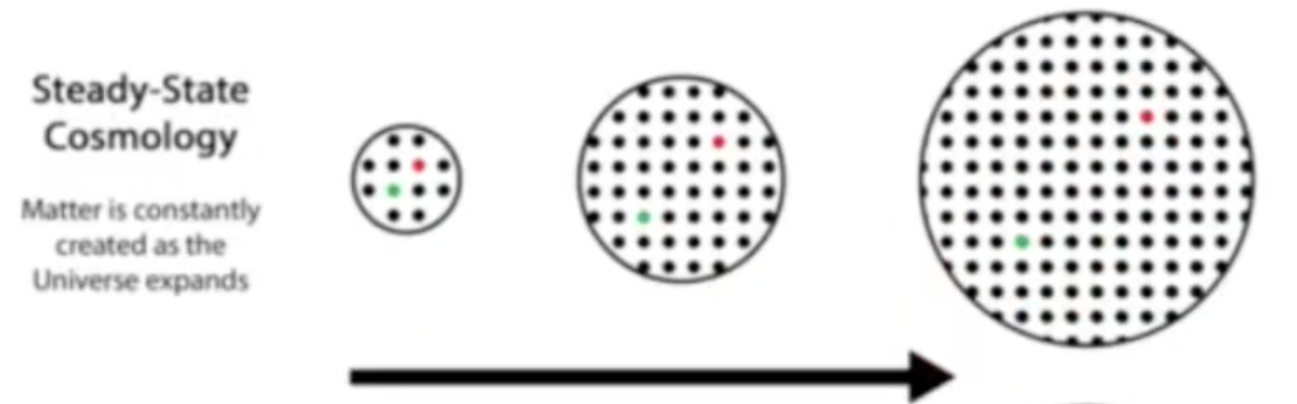
What is the Steady State Theory?
A steady state model of the universe proposes that the Universe always expands but the density of the stuff in the Universe stays the same.
This still accounts for redshift as the distance between two galaxies would still increase.
What is the Big Bang Theory?
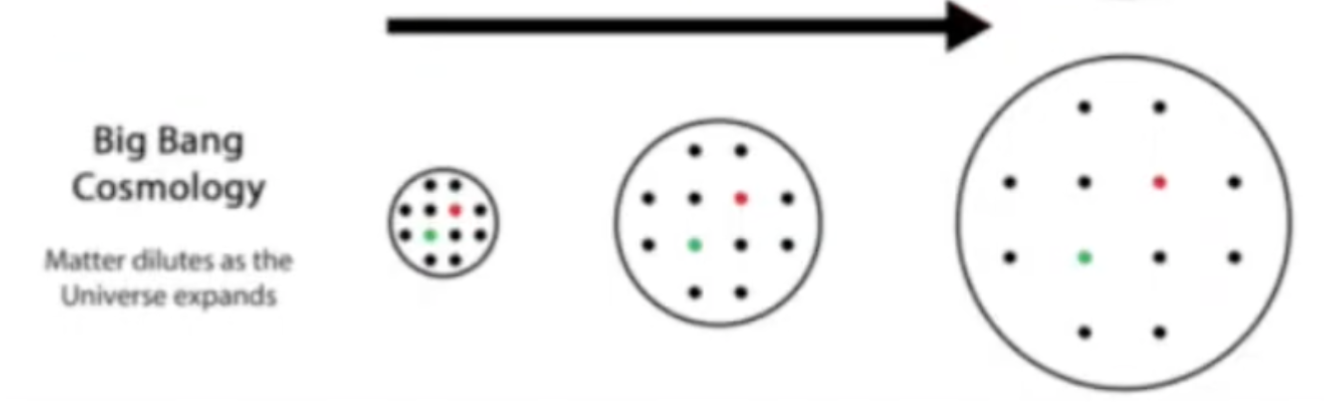
The Big Bang Theory is the theory that all matter originated from one point, singularity, some 13.7 billion years ago.
In the first second, matter, anti-matter, hydrogen and helium were created.
In the first minutes, the temperature was higher than 10,000 million.
This theory also had some very compelling things proving it.
What things proved the Big Bang Theory?
Quasars
Cosmic Microwave Background Radiation
Hubble Deep Field Image
What are Quasars?
The most powerful type of AGN
Extremely bright (can outshine the galaxy)
Have a similar appearance to a star because they mostly emit radio and x-ray waves. They have a gaseous region around the AGN that emits the radiation
Strong emission across all wavelengths
Millions to tens of billions solar masses heavy
Furthest, oldest (some are 11 billion years old) and are moving away from us very quickly
Only observed at high redshift (far away from us)
Often have jets
Also called quasi-stellar object
Things that we observe as far away from us are also farther back in time since light needs time to travel. This means that they only existed in the early universe.
Why do Quasars fit with the Big Bang Theory but not with the Steady State Theory? (edit this)
They fit within our models of the early universe as it would be if it originated with a Big Bang and don’t fit with a Steady State Theory.
This is because SST would need all parts of the universe to look the same since new matter is being created, but that doesn’t happen.
What is Cosmic Microwave Background Radiation?
CMB is the furthest and oldest signal detected by a telescope
It corresponds to an energy of 2.7K
It is a remnant of the extremely high energy radiation that was emitted in the early universe
That radiation has now been red shifted into microwaves.
Why does CMB fit with the Big Bang Theory but not with the Steady State Theory?
SST can’t predict this type of radiation and it fits with the prediction that the Universe was at first hot and then it expanded.
What two things studied CMB?
The Wilkinson Microwave Anisotropy Probe (WMAP)
The Planck Mission
What did the Wilkinson Microwave Anisotropy Probe (WMAP) do?
Mapped the CMB radiation and produced the first fine resolution map of the CMB sky
Determined the age of the universe to be 13.73 billion yrs old (±0.12 billion years)
Measured radiation across 5 microwave frequency bands which helped remove foreground radiation
Showed that dark matter & energy exists
Theoretical models that produce the same CMB require dark energy and matter to exist
What did the Planck Mission do?
Improved resolution of CMB images
Fluctuations in CMB can be used to determine the ratio of matter to dark matter
Showed that on the largest scale, the universe is ‘flat’ (Euclidian)
What are the Hubble Deep Field Images?
Long exposure photographs of parts of the sky where nothing is usually seen
Showed many extremely distant galaxies
There was a higher frequency of irregular galaxies, showing there were more collisions back then
The galaxies are very highly red shifted, meaning they are really far away
They are also much denser
This evidence points to a universe that was smaller and it doesn’t support SST
What is dark matter?
When measuring galaxies, scientists have found that they rotate faster than they should, considering their mass. This caused them to believe in the existence of some invisible matter that makes up over 90% of galaxies. This is dark matter. Without it, stars on the edges of galaxies would become disassociated and ‘fly off’.
What are 3 things that prove dark matter?
Galaxy clusters
Gravitational lensing
CMB
How do galaxy clusters prove dark matter?
Galaxies don’t have enough observed mass to cluster together
Therefore dark matter must exist to help clumping
How does gravitational lensing prove dark matter?
Galaxies don’t have enough mass to produce the lensing of light that we see
Therefore dark matter must exist to increase the mass of galaxies
How does CMB prove dark matter?
Dark matter doesn’t interact with radiation, but it can cause radiation to be deflected gravitationally
Causes the differences in temperature of CMB
What are the properties of dark matter?
Affects gravitational fields, therefore has mass.
Doesn’t interact with electromagnetic radiation, therefore no charge.
As it contains no charge, can’t contain quarks, electrons or positrons.
Has too much mass to only be composed of neutrinos (neutrinos are far too small)
Existence of dark matter makes general relativity match observations
What are difficulties in observing dark matter?
Doesn’t absorb, reflect or emit light, only interacts gravitationally
Gravity is a weak force, it is hard to detect its effect on small scales
What is dark energy?
Dark energy isn’t related to dark matter at all. It appears to be a force that moves galaxies away from each other.
The expansion of the Universe should’ve slowed down since the Big Bang. Instead, we are seeing that it speeds up; this is what scientists believe dark energy is doing.
It is also part of the ΛCDM model. The ΛCDM model has two parts: CDM or Cold Dark Matter which pulls parts of the universe together, and Λ which pushes the universe apart.
What are the difficulties in observing dark energy?
Dark energy is very sparse, but is distributed uniformly throughout the Universe so it is significant
Exact nature of dark energy is unknown, so we can’t devise an experiment to detect it
What is our best current estimate of the makeup of the universe?
Our best current estimate of the makeup of the universe is that dark matter makes up 72%, dark energy makes up 23%, and 5% is made up by normal matter.
What does the future of our universe depend on?
The future of the universe depends on the density of dark matter (slows down the expansion on a local scale) and dark energy (uniformly speeds up the expansion).
What are the three theories for how the universe will end?
The Big Rip
The Big Crunch
The Big Freeze
What is the Big Rip theory?
If there is too much dark energy and not enough dark matter, eventually, the expansion of the universe will get so strong that it will rip apart atoms themselves.
What is the Big Crunch theory?
If there is too much dark matter and not enough dark energy, eventually, the universe will stop expanding and start contracting until it reaches a singularity.
What is the Big Freeze theory?
If the amount of dark matter and dark energy is stable, then the universe will continue to exist but there will be less and less material for new stars to form. The last star will die, then the last supermassive black hole will evaporate and the Universe becomes a lifeless void.